Glued sounds: why ang and ink are taught as units
Published 2026-10-27 · Updated 2026-10-27

A glued sound is a short string of letters that is hard to separate, so you teach the string as one unit. Reading Universe names the patterns that trip children up after closed syllables: words with -am, -an, and -all, and words that end with a vowel followed by -ng or -nk. The letters stay together because the vowel shifts. Some teachers call the same chunks welded. The reading job is the same: learn the chunk, then read the word.
Short vowels in closed words come first. The practice guide says to present short vowel sounds spelled by single letters before later patterns. Glued chunks are that next closed-syllable snag, not a first-week sound.
Why ang and ink stay together
Say man slowly. You can tap /m/ /a/ /n/, but the short a is not the same a as in map. Reading Universe says /m/ and /n/ are nasal sounds, and they alter the short a. The same shift happens in jam. For -all, the shift is different: after ll, the a sounds like short o, so ball is /ol/, not /al/.
ng and nk do the same kind of work. The vowel and the nasal consonant glue. Children who tap /a/ /n/ /g/ as three clean sounds often never land on bang. Teach the chunk, then the word.
Keywords from that page:
| Chunk | Keyword | Sound of the chunk |
|---|---|---|
| am | ham | /am/ |
| an | van | /an/ |
| all | ball | /ol/, like short o plus l |
| ang | fang | /ang/ |
| ing | ring | /ing/ |
| ong | song | /ong/ |
| ung | lung | /ung/ |
| ank | tank | /ank/ |
| ink | pink | /ink/ |
| onk | honk | /onk/ |
| unk | trunk | /unk/ |
Word lists
Use these after the keyword is solid. Each word ends in the chunk. No extra pattern hiding inside.
ang: fang, bang, sang, hang, rang. ing: ring, sing, king, wing. ong: song, long, gong. ung: lung, hung, sung, rung. ank: tank, bank, sank, rank. ink: pink, sink, link, wink. onk: honk. unk: trunk, bunk, junk, sunk.
am and an words children already meet as CVC: ham, jam, van, man, pan, can. Read them again as chunks once you teach the shift, so map and man are not stored as the same vowel.
all: ball, call, fall, hall, tall, wall. Say the vowel as in short o, which is what the overview describes, not as the a in cat.
Is ill a welded sound?
No, not in this set. Reading Universe lists -all, not -ill. fill, hill, will, and bill are short i plus a doubled l. That doubling is the FLOSS pattern, on the FLOSS rule. all is the glued chunk that looks similar and sounds different.
If a program calls ill welded, it is stretching the label. Keep ill with the doubled letters, and keep all with ball.
How to teach the unit
- Show the chunk, not the separate letters first. Write ing. Say /ing/. Show ring.
- Children say the chunk, then the word. ring, sing, king.
- Contrast a plain short vowel: sit versus sing, pin versus pink, cat versus call.
- Read a line that uses only the chunk and sounds already taught. If bang is in the line, b and the short-vowel work must already be known. The chunk is the new part.
- Spelling: the child hears /ing/ and writes ing, not i-n-g as three decisions. That is the point of gluing them.
Do not open ng and nk on the same day. ing and ink are one letter apart, and they stick together in the child's ear for the wrong reason.
What children do instead
Three misses show up as soon as the chunk is new.
- They tap every letter. bang becomes /b/ /a/ /n/ /g/, and the word never snaps shut. Cover the chunk with a finger, say /ang/, then uncover the first letter.
- They use the plain short a from map inside man, ball, and bank. Go back to the keyword: ham, ball, tank. The overview's point is that the vowel has shifted. Hear the keyword, then the new word.
- They spell sing as sig or sin. The chunk has to be written as a unit. Say /ing/ and have them write ing before you dictate the whole word.
am and an are the quiet case. man and can were already CVC words. After the glued lesson, read map and man in a pair so the vowel change is the lesson, not a correction you spring on a child who thought man was finished.
One limit: a glued chunk is a reading convenience, not a claim that the sounds cannot be pulled apart by a specialist. The overview's reason is practical. The letters are hard to separate, so the unit is what you teach. A child who already taps sing cleanly does not need a week on the chunk.
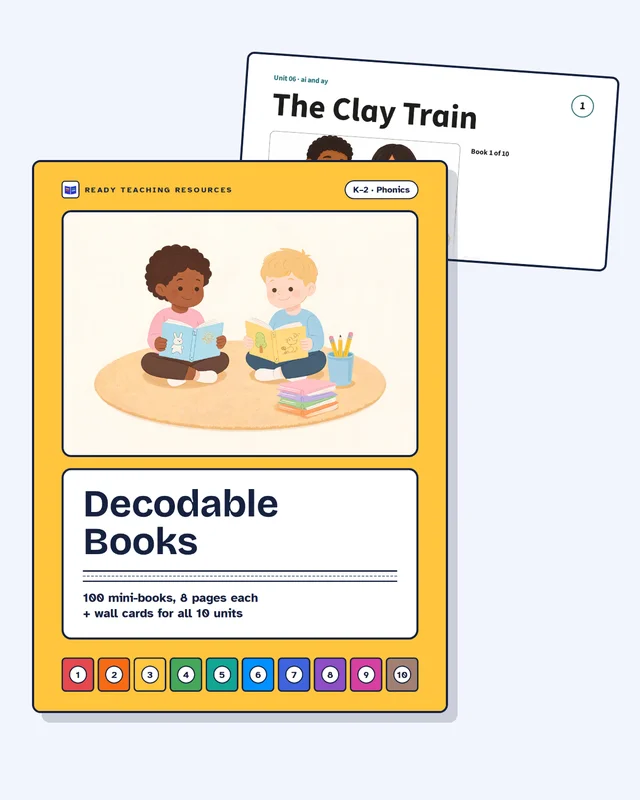
The K-2 Decodable Books files arrive as an instant digital download, and each book has a word list. A stapler is needed, with scissors, to cut and staple the half pages.
What is a glued sound in phonics?
A chunk of letters that is hard to pull apart, so you teach it as a unit. Reading Universe names vowel plus ng or nk, and the chunks am, an, and all.
Is ill a welded sound?
Not in that glued set. ill, as in fill and hill, is the doubled-l spelling after a short vowel. all, as in ball, is the glued chunk. Welded is another teacher name for the same glued chunks.
Sources
-
Decodable Books
100 mini-books, 8 pages each, plus wall cards for all 10 units