What Is a Grapheme?
Published 2026-10-27 · Updated 2026-10-27

A grapheme is the written mark for one sound. Vocabulary.com says one unit of a writing system is a grapheme: the letter t is a grapheme, and so is the letter combination ch. Cambridge Dictionary defines a grapheme as the smallest unit in a writing system that can express a difference in sound or meaning. The sound it spells is a phoneme. The difference between those two words is in what is a phoneme.
Say grapheme as GRAF-eem. Cambridge Dictionary prints the US pronunciation /ˈɡræf.iːm/, with the stress on the first syllable.
Types K-2 students meet
Phonic Books says a grapheme in the English code can be one, two, three, or four letters. The names follow the letter count.
| Type | Letters in the grapheme | Example from Phonic Books |
|---|---|---|
| Single letter | One | m in mat |
| Digraph | Two | sh in ship, and ch in chip |
| Trigraph | Three | igh in high, and igh in night |
| Four-letter grapheme | Four | eigh in eight |
Phonic Books defines a digraph as a two-letter grapheme and a trigraph as a three-letter grapheme. A consonant digraph such as sh is two consonant letters that spell one sound. That is not the same as a consonant blend. In clip, c and l are adjacent consonants, and each is its own sound, so cl is two graphemes, not one. A vowel team such as oo or ai is a vowel digraph: more than one letter for a vowel sound.
Children meet single letters first, then digraphs such as sh, ch, and th, then longer vowel spellings. You do not need the four-letter row in kindergarten. You do need the habit that a box or a blank can hold more than one letter when those letters spell one sound.
A mapping example
Phoneme-grapheme mapping lines the sounds up with their spellings. Phonic Books sets ship out as the grapheme sh for the first sound, then i, then p. Three phonemes, three graphemes, four letters.
Say ship. The child taps /sh/ /i/ /p/. Then they write sh in the first space, i in the second, p in the third. The spaces are grapheme spaces, not letter spaces. If the child writes s and h in two spaces, they have mapped letters, not sounds. Cover the word, say it again, and rebuild sh as one tile.
Hat is the easy case on the same page: h, a, and t, one letter per phoneme. Teach hat, then ship, so the child sees when the grapheme grows.
Mapping is phonics. It uses print. The oral tap before the writing is phonemic awareness. How those two jobs share one word is in phonics vs phonemic awareness. Sound boxes are a grid for the same match: one box per sound, then the grapheme in the box. The steps are in Elkonin boxes.
Another correspondence, from Vocabulary.com: oo, th, igh, and ough are graphemes too, because each spelling stands for a sound. Ough is a long chain. You will not start there. The idea is the same as sh. The writing can be longer than one letter and still be one grapheme.
How to count graphemes in a word
When each grapheme spells one phoneme, count this way:
- Say the word and count the phonemes.
- Underline or box the letters that spell each phoneme.
- Those boxes are the graphemes.
Ship: four letters, three boxes, three graphemes. Night: n, igh, t. Three graphemes, and igh is the middle one. Eight: eigh and t. Two graphemes. A child who counts letters will be wrong on those words.
That one-to-one count is not every word. The Literacy Nest says the grapheme x represents the phonemes /k/ and /s/. In fox, x is one grapheme for two sounds, so the grapheme count and the phoneme count are not the same.
This Reading Mama starts the phoneme side from the root phone, meaning sound. Use that as the memory hook: phoneme is the sound, grapheme is the writing. If you cannot hear a separate sound, do not split the spelling into two boxes. That check keeps a digraph together. It does not turn x into two graphemes.
This practice turn is illustrative. Put the count on a sticky note beside the word, then take the note away. The child says ship, writes sh-i-p in three spaces, and reads it back. If the spaces become four, the grapheme sh split. Rebuild that one space and read the word again. Stop while sh is still one team. The label "digraph" can wait until the child is already spelling sh as one team.
The limit of grapheme labels
Naming "digraph" does not help a child read ship. The label is for the teacher. The child needs to see sh, say /sh/, and blend it with the rest of the word. Teach the mapping on a few words, then read those words in a sentence. A stack of grapheme cards without connected text leaves the skill on the card.
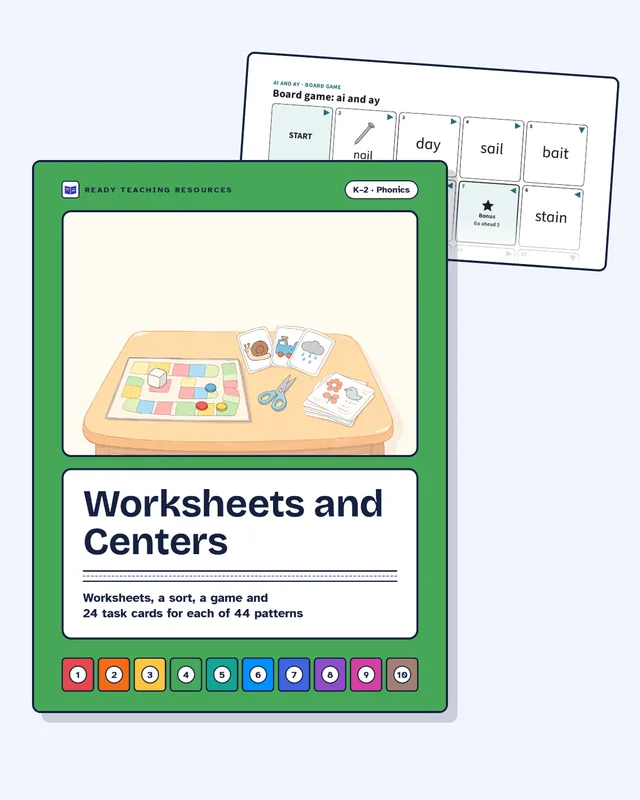
The K-2 Phonics Worksheets and Centers Mega Pack includes, for each of 44 phonics patterns, a worksheet set, a word-sort center, a board game, 24 task cards, and an exit ticket. Centers and task cards are cut out by the teacher.
What is a grapheme in phonics?
It is the letter or letters that spell one phoneme. In ship, sh is one grapheme, i is one grapheme, and p is one grapheme.
Are graphemes written letters?
A grapheme is written. It may be one letter, or a team of letters such as ch, igh, or eigh. The writing stands for a sound.
How do you say grapheme?
The Cambridge Dictionary gives the US pronunciation as GRAF-eem, with the stress on the first syllable.
How do you tell how many graphemes are in a word?
When each spelling stands for one sound, count those spellings, not the letters. Ship has four letters and three graphemes. The Literacy Nest says the grapheme x represents the phonemes /k/ and /s/.
What is phoneme-grapheme mapping?
It is matching each phoneme to the grapheme that spells it, in order. Say the sounds, then write one grapheme per sound.
Is phoneme-grapheme mapping phonics?
Yes. Mapping is the phonics job of connecting a sound to its spelling. The listening count alone is phonemic awareness.
Sources
-
Worksheets and Centers
Worksheets, a word sort, a board game and 24 task cards for each of 44 patterns