The Doubling Rule for One-Syllable Words
Published 2026-10-27 · Updated 2026-10-27

Double the final consonant when a one-syllable word has one vowel and one final consonant, and you are adding a vowel suffix, unless the word ends in w, x, or y. Hop becomes hopping. Stop becomes stopped. Sip becomes sipped. Mix becomes mixed and mixing, not mixxed. That is the doubling rule, also called the one-one-one rule.
| Word | One syllable | One vowel | One final consonant | Vowel suffix | Result |
|---|---|---|---|---|---|
| hop | yes | o | p | -ing | hopping |
| stop | yes | o | p | -ed | stopped |
| sip | yes | i | p | -ed | sipped |
| jump | yes | u | no, mp | -ing | jumping |
| rest | yes | e | no, st | -ed | rested |
| rain | yes | no, ai is a team | -ing | raining | |
| hope | yes | silent e | -ing | hoping, e dropped | |
| sell | yes | e | already ll | -ing | selling |
| mix | yes | i | x, not doubled | -ing | mixing |
The three checks
This Reading Mama's one-one-one pack states the rule: if a base word is a one-one-one word, double the last letter before adding a vowel suffix. A one-one-one word has:
- one syllable, as in pop, wed, and dig
- one vowel, as in pop, wed, and dig
- one final consonant, as in pop, wed, and dig
Y and w can be part of a vowel team, as in day and snow. Those words fail the one-vowel check. A final w, x, or y is not doubled. Mix ends in x, so the spelling is mixed and mixing, not mixxed.
The suffix has to start with a vowel. -ing and -ed are the endings in that pack. -s does not start with a vowel, so hop plus -s is hops. The p stays single.
A Pearson chapter on inflected endings uses the same cut for a VC base such as hop: double the final consonant before -ing or -ed. Hopped, stopped, and dropped are in its double column.
Why the p doubles in stopped
Stop passes all three checks. One syllable. One vowel, o. One final consonant, p. -ed is a vowel suffix. Double the p: stopped.
The double keeps the o short. Stoped would look like a silent-e word, the way hope looks. Stopped does not. The Pearson chapter also flags the reading error of splitting stopped into stop-ped. The -ed in stopped is the past-tense spelling, and the word is still one syllable. The sounds of -ed are on the inflectional endings guide.
The same check explains the other doubles in the table. Hop plus -ing is hopping. Sip plus -ed is sipped. Rub plus -ed is rubbed. Jog plus -ing is jogging. Wrap plus -ed is wrapped. Wrap has one vowel, a, and one final consonant, p. The w is part of the onset, not a second vowel.
Words the rule does not cover
Run the three checks. If one fails, do not double. A final w, x, or y does not double even when the other checks look like a yes.
Two consonants already. Jump, rest, stand, and thank end in two consonants. The pack says to do nothing to a VCC base before adding the ending. Jumping, rested, standing, thanked. Lick ends in ck, two consonant letters, so the ending is licking, not lickking.
A vowel team. Rain has the team ai. Snow has the team ow. Add the ending: raining, snowing. Day is the pack's other team example. It is not a one-vowel word.
A silent e. Hope is not a one-final-consonant word in the doubling sense. Drop the e: hoping, hoped. The Pearson chapter puts hoped in the e-drop column, beside hopped in the double column. Those two spellings are the pair to teach together. The drop-e steps are on the inflectional endings guide.
A consonant suffix. Hops, jumpy, and sadly do not take a double from this rule, because the ending does not start with a vowel. This page stays with -ing and -ed, the vowel suffixes the pack practices.
A final w, x, or y. Do not double those letters. Snow ends in w, so the spelling is snowing, not snowwing. Mix ends in x, so the spelling is mixed and mixing. The Pearson chapter lists mixed as an oddball beside the double column. Fixing keeps a single x, because xx is not an English spelling. Box follows mix: boxed, boxing. A final y is not doubled either. Play adds the ending (playing). Cry keeps y before -ing (crying). The y-to-i change, as in cry to cried, is on the inflectional endings guide.
A floss word. Off, fall, and buzz already have a double consonant. That is a different rule. The Reading Universe glossary uses "doubling consonant rule" for a one-syllable word with a short vowel that ends in /f/, /l/, /s/, or /z/, spelled ff, ll, ss, or zz. That is the floss rule, not the one-one-one suffix rule. Sell already ends in ll. Selling does not add a third l.
A two-syllable base. The one-one-one check is for one syllable. Begin is two syllables. This page does not extend the rule to begin or to other longer bases.
Teach the check, then the pair
Put hop and hope on the board. Students tap the vowels and the consonants after the vowel.
- Hop: one vowel, one consonant. Adding -ing doubles the p. Hopping.
- Hope: silent e. Adding -ing drops the e. Hoping.
- Jump: two consonants. Adding -ing changes nothing in the base. Jumping.
- Mix: ends in x. Adding -ing does not double the x. Mixing.
Then do the same with -ed: hopped, hoped, jumped. Mixed is mix plus -ed, with no extra x. Stopped belongs in the hopped column. Students should be able to say which check failed when the consonant stays single.
One honest limit: the check is a spelling test for these endings. It does not decide the sound of -ed, and it does not apply to irregular past forms such as sleep and slept. Spell the ending, then read the word.
A sort after the check
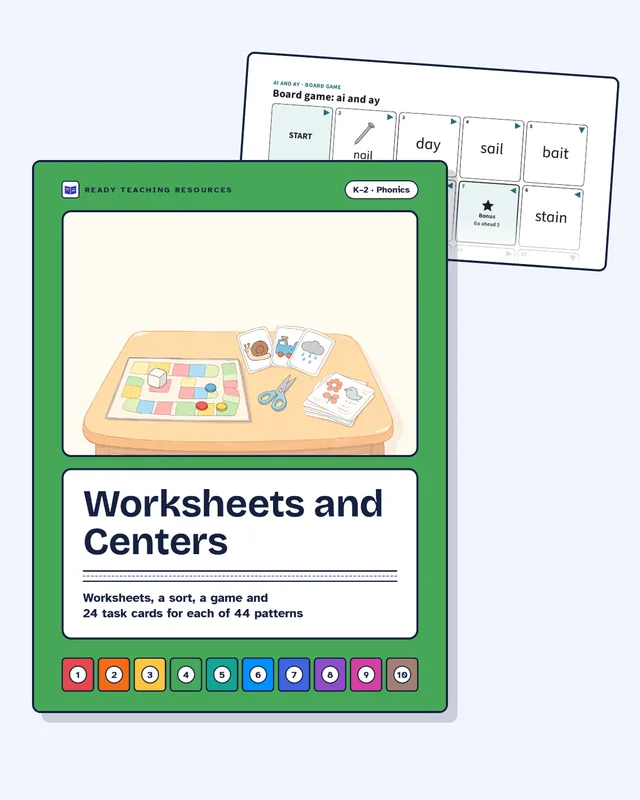
The K-2 Phonics Worksheets and Centers Mega Pack gives practice, centers and quick checks for every pattern in the 10-unit phonics sequence, including a word-sort center and task cards. Its task cards and centers are cut out by the teacher.
Sort hopping with stopped, and jumping with raining, after students can say which check passed.
Why do we double the p in stopped?
Stop has one syllable, one vowel, and one final consonant. -ed is a vowel suffix, so the p doubles. Stopped keeps the short o. Stoped would look like a silent-e word.
What is the doubling rule?
Double the last consonant of a one-syllable word with one vowel and one final consonant before you add a vowel suffix such as -ing or -ed, unless the word ends in w, x, or y. Hop becomes hopping. Mix becomes mixed and mixing. Jump does not double, because it already ends in two consonants.
What is the floss spelling rule?
The floss rule doubles f, l, s, or z at the end of a one-syllable short-vowel word, as in off, fall, and buzz. That is a different double from the one-one-one suffix rule.
Sources
-
Worksheets and Centers
Worksheets, a word sort, a board game and 24 task cards for each of 44 patterns