Inflectional Endings: -s, -es, -ed, and -ing
Published 2026-10-27 · Updated 2026-10-27

Inflectional endings are suffixes that mark tense and number. The Pearson sample chapter on inflected endings gives the set as -ing, -ed, -s, and -es, with examples such as walked, walking, walks, cats, and foxes. Teach four jobs: add -s or -es, drop the e before -ing and -ed, and sort the three sounds of -ed.
| Ending | Letters and sound | Examples |
|---|---|---|
| -s, starter bases only | add the letter s when the base does not end in ch, sh, x, s, or a consonant plus y, and its last sound is not /s/, /z/, /sh/, /ch/, or /j/; sound /s/ or /z/; no extra syllable | cats, dogs |
| -s on a base that already ends in e after an /s/, /z/, or /j/ sound | add the letter s only; the ending is still an extra syllable | horses, voices, changes |
| -es | add the letters es after ch, sh, x, or s; extra syllable | boxes, dishes, watches, buses |
| consonant + y | change y to i before -es or -ed, not before -ing; not a plain -s | fry to fries; frying; cry to cried |
| -ing | action in progress, after a drop-e on hope | hoping, jumping |
| -ed | past; sounds /t/, /d/, or /id/ | helped, named, wanted |
What an inflectional ending is
An inflectional ending changes the grammatical job of a word the student already knows. It does not build a new meaning the way -ful does in helpful. That contrast is why these four endings come before the meaning suffixes on the prefixes and suffixes guide.
The Pearson chapter calls them a subcategory of suffixes that indicate tense and number. Walked, walking, and walks are the verb set. Cats and foxes are the number set. A verb inflection is the set of those forms: walk, walks, walked, walking.
The practice guide tells teachers to teach -s, -ed, and -ing, and to have students add -ing to words such as park, call, and sing. An SRA reteach page says words ending in -ed show an action that happened before, and words ending in -ing show an action happening now: I jumped yesterday. I am jumping now.
When to add -es
The starter rule is narrow. Add the letter s, and do not add a syllable, only when the base does not end in ch, sh, x, s, or a consonant plus y, and its last sound is not /s/, /z/, /sh/, /ch/, or /j/. The syllable count follows the last sound of the base, not its last letter. Cats and dogs are that case. Cats ends in /s/. Dogs ends in /z/. The ending is a sound on the base, not a new syllable.
Letters added and syllable count are different facts. The Pearson chapter sorts horses, voices, and changes under add -s. The letter added is s, because horse, voice, and change already end in e. Each of those plurals still has an extra syllable, the vowel-plus-z you also hear in boxes.
Add the letters es after ch, sh, x, or s. The Pearson chapter reviews that set and shows that adding -es adds a syllable, the syllable /ez/, as in boxes and fences. Fence already ends in e, so only the letter s is added; the extra syllable comes from its last sound, /s/, as in horses. Dishes, watches, and buses follow the same consonants the chapter names.
- box + es = boxes
- dish + es = dishes
- watch + es = watches
- bus + es = buses
- fox + es = foxes
A base that ends in a consonant plus y does not take a plain -s. The Pearson chapter says to change the y to i before adding -es or -ed. Fry becomes fries. Cry becomes cries and cried. The y stays before -ing, because a double i would look odd: frying, not friing. If the y follows a vowel, do not change it: play becomes plays. Fries and plays are still one syllable. The extra syllable belongs to the sibilant cases, not to every word that gains the letters es.
Say the base, then the extra syllable when there is one: box, box-es. If a student writes boxs, the missing vowel is the signal to use -es. If a student writes frys, the signal is the consonant before y.
Drop the e before -ing and -ed
We drop the e because the base is a silent-e word and the ending starts with a vowel. The Pearson chapter says the vowel pattern of the base decides the spelling: drop the final e on a VCe word such as hope before adding -ing or -ed. Hope becomes hoping and hoped. Save becomes saving and saved. Name becomes naming and named.
Keeping the e would leave hopeing. That is not the spelling the rule produces. The silent e has already done its job in hope. The ending brings its own vowel, so the e is dropped and the long vowel stays.
Do not drop the e when the base is not a silent-e word.
- jump ends in two consonants. Add the ending: jumping, jumped.
- rain ends in a vowel team. Add the ending: raining, rained.
- hop is a short vowel closed by one consonant. That pattern doubles the consonant: hopping, hopped. The steps for that double are on the doubling rule guide.
The chapter sums the three spelling choices as double, e-drop, or nothing. This page is the e-drop. Use it on hope, save, name, bake, and smile before -ing and -ed.
Three sounds of -ed
The Pearson chapter says -ed can be pronounced three different ways, and it sorts the words as /t/, /d/, and /id/. The spelling stays -ed in every column.
| Sound | What you hear | Words from the chapter's sort |
|---|---|---|
| /t/ | no extra syllable | hoped, passed, helped |
| /d/ | no extra syllable | named, saved, planned |
| /id/ | an extra syllable | wanted, started, acted |
Wanted is want plus a syllable. Helped is help plus a /t/ sound, still one syllable. Students who write WALKT for walked, or who read stopped as stop-ped, are hearing the sound and missing the spelling. The chapter's point is that past tense is spelled -ed even when it sounds like /t/ or /d/.
Sort by sound after students can spell the ending. Tap the base, then say the ending. If the base ends in t or d, expect the extra syllable: wanted, started, acted. The chapter notes that d and t come before the /id/ sound, and that this column has added a syllable.
A short teaching order
- Week one: -s on cats, dogs, cups. Students hear /s/ or /z/ and no extra syllable. This week is only the starter bases.
- Week two: the letters es on boxes, dishes, watches, and buses, and the extra syllable. Then horses, voices, and changes: the letter added is s, and the syllable is still extra. Fry to fries is the consonant-y change, still one syllable, not a plain -s.
- Week three: -ing on jump and rain (just add), then hope and bake (drop the e).
- Week four: -ed with the same spelling choices, then the sound sort: helped, named, wanted.
Say a sentence with the base and the ending: I help. I helped yesterday. I am helping now. The SRA page uses that contrast with jumped and jumping. Irregular verbs such as sleep and slept, and unusual plurals such as foot and feet, sit outside these rules. The Pearson chapter sets them aside as a later list. Do not force them into -ed or -es.
One honest limit: these rules are for the spelling and the sound of the ending. They do not tell you the meaning of an unfamiliar base. Read the base first, then add the ending.
Print practice for the ending
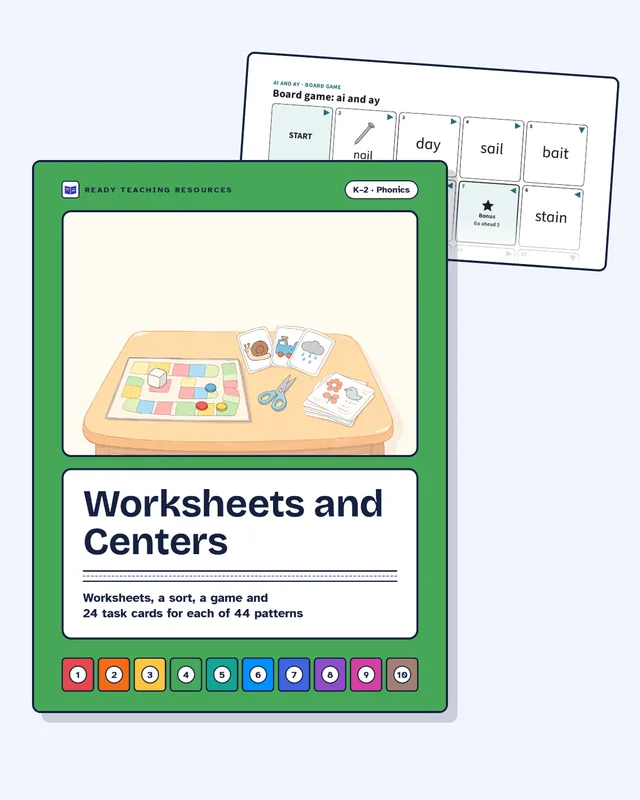
The K-2 Phonics Worksheets and Centers Mega Pack has a teacher page, print list and contents for each unit, and answer keys for every page with an answer. It needs a printer, paper, scissors, one die and game counters.
Sort -s against -es, then hoped against hoping, before you send students to a game.
What is the inflection of verbs?
A verb inflection is the set of endings that mark tense or number on a verb. Walk, walks, walked, and walking are the set for walk.
Can you give me an example of an inflection word?
Cats is an inflection for number. Walked is an inflection for past tense. Hoping is hope with the e dropped before -ing.
Why do we drop the e when adding ing?
Hope is a silent-e word, and -ing starts with a vowel. The e is dropped, so the spelling is hoping, not hopeing. The same drop gives hoped.
How many sounds can the suffix ed make?
Three. The spelling stays -ed. The sounds are /t/ as in helped, /d/ as in named, and /id/ as in wanted.
Sources
-
Worksheets and Centers
Worksheets, a word sort, a board game and 24 task cards for each of 44 patterns