Heart Words: What They Are and How to Teach Them
Published 2026-10-27 · Updated 2026-10-27

A heart word is a high-frequency word with at least one part that does not follow the spelling pattern a child can use yet. Literacy Learn uses the term for an irregular word: part of the spelling needs to be learned, and the rest is still read by sound. The mark goes on that irregular part only. The other letters stay a phonics job.
That is the whole idea. You do not memorize the word as a shape. You map the parts that match, and you learn the part that does not.
Heart word, sight word, high-frequency word
These labels get swapped on classroom lists. They are not the same job.
A high-frequency word is a word that shows up often in print. The Institute of Education Sciences practice guide tells teachers to teach both regular and irregular high-frequency words so students recognize them quickly. Regular examples in that guide include in, and, had, and did. Irregular examples include the, was, said, have, and of.
A sight word is any word a reader already identifies instantly. Keys to Literacy defines it as a word identified at once, and says storing it is not the same as memorizing how the word looks. The sounds have to be attached to the letters. See sight words for that definition, and high-frequency words for which common words are regular.
A heart word is the teaching name for the irregular case. Literacy Learn puts a heart over the irregular part and keeps the decodable letters available for sounding out. Other classroom names for the same words include puzzle words, trick words, and red words. The name is not the method. The method is which part you mark.
Mark only the part that is irregular for now
"Irregular" depends on what the class has been taught. The National Center on Improving Literacy says to teach consonants and short vowels in words where the letters have their most common sound, such as a in bat, before words where a letter does something else. A letter that uses a pattern from a later unit is a heart for now. After that pattern is taught, it is a phonics letter, and the heart comes off.
Literacy Learn makes the same split in list form: many high-frequency words are fully decodable and should be taught that way, including red, three, and me, while some, such as do, have an irregular part, and of is irregular in every letter. Do not put a heart on "me" once open syllables are in the lessons. Do not put a heart on "and" at all.
The routine, on three real words
Literacy Learn starts at the sound level, then moves to print. Use that order. Keep the new set to a few words, the ones this week's books actually need. The Institute of Education Sciences practice guide uses a ring of three to five high-frequency words for that kind of practice.
- Say the word. Students repeat it and tap the sounds they hear.
- Push one chip into a sound box for each sound.
- Decide which box is the heart. Put the mark on that box only.
- Spell the word, matching each sound to its letters, and stop on the heart part so the child can see it.
- Write the word together, saying the letter names. Read it, then read it in a sentence the child can decode.
- Practice the word again on later days until it is quick. On a card, ask for it within 3 seconds, which is the timing the Institute of Education Sciences practice guide uses in small-group flashcard practice. If the child misses it, say the word. Do not ask for a guess from the first letter.
and: no heart
"And" is in the practice guide's regular column. Every letter matches a short-vowel pattern. Tap /a/ /n/ /d/, match each sound to a letter, and leave the card unmarked. If a child is memorizing "and" as a shape, the list is being used wrong. See orthographic mapping for why the sounds have to stay attached to the letters.
has: one heart, and only if s as /z/ is new
L is for Literacy breaks "has" into /h/ /ă/ /z/. The h and the a match patterns beginners know. The final sound is /z/, spelled with s. That s is the heart if the class has not yet learned that s can say /z/. Put the mark on s only. Read h and a by sound, then learn the s. If a later lesson teaches s as /z/, take the heart off and read the whole word by pattern.
was: mark the unexpected vowel
L is for Literacy uses "was" as the example where w behaves as expected, a says /ŭ/, and s says /z/. The National Center on Improving Literacy uses the same word as the contrast with a in bat. Leave w unmarked. Put a heart on a, because that letter is not the short-a sound from bat. Treat s the same way you treated it in "has": a heart only while s as /z/ is untaught.
Say "was," tap the sounds, spell it, and read it in a sentence the same day. The Institute of Education Sciences practice guide also says to teach irregular high-frequency words as whole words, not only as a string of sounds. Keep that ending step. The heart mark is how you show the odd part. The last move is still the whole word, read and written, until it is instant.
of: the whole word can be the heart
Some words have no letter the child can use yet. Literacy Learn gives "of" as that case. Say the word, show the spelling, and tell the child the letters do something this week's patterns cannot explain. Practice the whole word. Do not invent a regular reading of "of" to avoid the mark.
Order through the K-2 year
Teach letter sounds before heart words. A heart mark on a letter the child has never been taught is just a sticker.
In kindergarten, the early irregular words are the ones in the first books: the, was, said, of, and a few others from the practice guide's irregular column. Teach them when the book needs them, a few at a time, not as a stack of a hundred cards.
In first grade, many words that felt irregular become pattern words: silent e, vowel teams, and the /z/ spelling of s. Remove hearts when the pattern arrives. Add new hearts only for the spellings that are still ahead, such as the odd vowel in "said" if that pattern is not in the current unit.
In second grade, the same routine covers less common irregular parts. The habit stays: sound first, mark only the leftover, read the word in a sentence.
Mistakes that put hearts on the wrong letters
- Marking every word on a sight-word list. Regular words such as in, and, and it get no heart.
- Marking a whole word when one letter is the problem. On "has," the heart belongs on s, not on h or a, once those sounds are known.
- Leaving a heart on a letter after the pattern has been taught. The mark is temporary when the irregularity was only "not yet."
- Practicing the card and never the sentence. The word has to show up in text the same day.
- Asking the child to guess. If the heart part is missed, say it.
One limit of this advice: a heart mark shows the child which part to learn. It does not change the spelling, and it does not teach the phonics patterns the other letters depend on. Keep the pattern lesson even when the heart-word cards are quick.
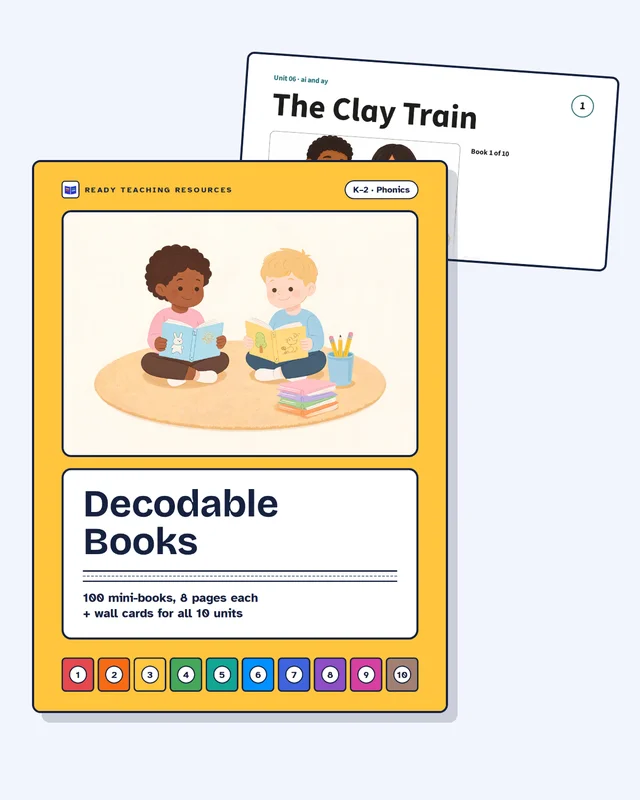
A teacher page for each unit, plus phonics wall cards that include heart-word cards, comes in the K-2 Decodable Books download. The print files are US Letter only.
What is a heart word for kids?
A heart word is a word with at least one part the child cannot yet read from the patterns already taught. The child reads the other letters by sound and learns the unexpected part.
How is a heart word different from a sight word?
A sight word is any word the child already reads instantly. A heart word is a word still being taught because part of the spelling is irregular for now. After practice, a heart word can become a sight word.
Which letters get the heart?
Only the letters that do not match a pattern the class has learned. Leave the regular letters unmarked and read them by sound. If a later lesson teaches that pattern, take the heart off.
How do you teach sight words with this routine?
Sort the week's list. Sound out the regular words. Use the heart-word steps only for the words with an unexpected part. A few words at a time is enough.
Sources
- Literacy Learn: Free Heart Word Resources for Teaching Irregular Words
- L is for Literacy: What Are Heart Words? A Teacher's Guide to This Game-Changing Approach
- Institute of Education Sciences: Foundational Skills to Support Reading for Understanding in Kindergarten Through 3rd Grade
- Keys to Literacy: The Role of Orthographic Mapping in Learning to Read
- National Center on Improving Literacy: The Alphabetic Principle: Linking Sounds to Letters
-
Decodable Books
100 mini-books, 8 pages each, plus wall cards for all 10 units