Sight Words: What They Are and How to Teach Them in K-2
Published 2026-10-27 · Updated 2026-10-27

A sight word is any word a reader identifies instantly. Keys to Literacy defines it that way, and notes that adult competent readers have between 30,000 and 60,000 such words. A high-frequency word is a different label: a word that shows up often in print, such as the, and, was, or in. The Institute of Education Sciences practice guide tells teachers to teach both regular and irregular high-frequency words so students can recognize them quickly.
Many high-frequency words can be sounded out. Some cannot, at least not with the patterns a kindergartner has learned so far. A child who reads "and" instantly has a sight word, even though "and" follows a regular pattern. A child who still sounds out "said" does not yet have "said" as a sight word, even if it is on this week's card.
How the classroom label differs from the reading term
School lists often use "sight words" for a short set of common words children are asked to recognize on cards. Understood says these are common words that schools expect kids to recognize instantly, and that some schools call the same words high-frequency words. Other names on that page are star words, core words, and popcorn words, because the words pop up so often in reading and writing.
The list is a planning tool. It is not a theory of how a word gets stored. Use it to choose words the class will meet in books. Do not use it to decide that every word on it must be memorized as a shape.
Understood gives in, hat, and bed as words that follow spelling rules and can be sounded out. The same page gives of, to, and was as words a beginner may pronounce "off," "toe," and "wass" if they sound every letter with its most common sound. Those two groups need different first moves. The frequency of the word does not decide which move.
For a sorted list of common words, and which ones are decodable with the patterns you have taught, see high-frequency words.
Phonics and sight words work as one job
Phonics is the teaching of how letters map to sounds. A sight word is the stored result of that learning, not a second method. The National Center on Improving Literacy explains that when the alphabetic principle is well developed, readers can decode about 70% of the single-syllable words they meet in text. The rest still need attention, including words whose letters do not use the sound just taught.
Keys to Literacy describes orthographic mapping as the mental process that attaches a word's sounds to its letters and stores them with the word's meaning. Mapping is not the same as memorizing how the word looks, and it is not an activity you assign on a worksheet. What you can teach is phonemic awareness and phonics, which make mapping possible. See orthographic mapping for that process in more detail.
Teachers of kindergarten and first grade typically give explicit instruction on some high-frequency words while they teach students to decode most other words, Keys to Literacy notes. Once students can map, they start storing those words as sight words on their own. That is why a kindergarten list is a start, not the definition of "sight word."
A mapping routine you can run tomorrow
Keep the new set small. The Institute of Education Sciences practice guide shows a practice ring of three to five high-frequency words. Use the same steps for each new word.
- Say the word the way it is spoken, so the child hears the real pronunciation before seeing a debate about the spelling.
- Have the child break that pronunciation into sounds. Keys to Literacy says the spoken word has to be pulled into its phonemes before the letters can stick to them.
- Match each sound to letters that follow a pattern the class has already learned. For a regular word, that is the whole word. The Institute of Education Sciences practice guide says to have students apply letter-sound skills, for example with sound boxes, and then practice until recognition is quick.
- If a letter does not use the sound the class has learned for it, tell the child that part and have them learn it while still reading the rest by sound. The National Center on Improving Literacy contrasts the letter a in bat, where it has its common short sound, with a in was.
- Read the word on a card, then in a sentence the child can decode. Ask for the word within 3 seconds on the card, which is the timing the Institute of Education Sciences practice guide uses in small-group flashcard practice, then shorten the wait until the word is immediate. If the child misses it, say the word and practice it again.
The named version of step 4, where only the unexpected part is marked, is a heart word. Use that guide when you want the mark on the card. The routine here is the same idea in classroom steps.
A regular word: and
The child says the sounds in "and," matches each sound to a letter, reads the word, and then reads it in a short sentence such as "Sam and I sat." No letter needs a special mark. The Institute of Education Sciences practice guide lists and with the regular high-frequency words, beside in, had, that, him, did, then, with, and down. Sound those out first. Practice makes them instant. Memorizing the shape does not.
An irregular word: was
The Institute of Education Sciences practice guide lists was with the irregular high-frequency words, beside the, there, want, from, said, have, friend, and of. The National Center on Improving Literacy uses was as the case where the letter a has a different sound from the a in bat.
Say "was." Tap the sounds. Match w to the sound the class already knows for w. Tell the child that the a in this word is not the short-a sound from bat. Read "was" in a sentence the same day. The goal is instant recognition of the whole word.
The practice guide also recommends teaching irregular high-frequency words as whole words, rather than only as a string of sound units. Use the sound match for the letters that fit, and still practice the whole word until it is quick. Do not drop the sounds the child can already use, and do not pretend every letter in "was" is a pattern the class has had.
Which words to teach, and when
Follow the phonics sequence. A random card stack fights that sequence.
Start with letter sounds. The National Center on Improving Literacy says to teach consonants and short vowels in words where the letters represent their most common sound, such as a in bat, before asking children to read words where a letter does something else. That is explicit, systematic phonics: one pattern, then the words that use it.
Next, teach regular high-frequency words built from those sounds. In, and, it, and had belong here once short vowels and those consonants are in place. Sound them out, then practice them until they are quick.
When a book the class is about to read needs an irregular high-frequency word, teach that word before the reading. Introduce only the ones the week's text uses. The, was, said, and of are common early ones from the practice guide's irregular column. A word that feels irregular in kindergarten, because the class has not learned its pattern yet, can be read by sound later. Teach it by sound once the pattern is in the lessons.
Kindergarten examples, not a quota: Understood gives be, but, do, have, he, she, they, was, what, and with as examples of sight words children meet in kindergarten. The same page says schools set their own rules about which words children need by which grade. There is no national count, and no official kindergarten total to hit. Sight Words for Kindergarten says some literacy experts, including Tim Shanahan, believe kindergarteners should master 20 sight words by the end of kindergarten, notes that the Dolch word list has 40 words listed for Pre-K, and says some school districts require kindergarteners to learn 100 sight words by the end of the year. Savvy Learning lists a common classroom target of 25 to 100 words by the end of kindergarten and says those figures are not universal standards. A kindergartner should recognize the small set that appears in the books the class is reading. A borrowed stack of a hundred cards, memorized as shapes, is not that job.
First grade and second grade keep the same routine. The words change as the patterns change. Keep adding only what the current books and the current phonics lesson require.
Practice that still makes the child read the word
A game helps only if the child has to read the word. The Institute of Education Sciences practice guide describes three practices that fit a K-2 room:
- Flashcards in a small group. Students try to read each card. Missed cards go on a teacher pile and are taught again. Cards read correctly go on a student pile.
- A word wall of high-frequency words that partners read together. When a child meets the word in a book, they point to it on the wall.
- A ring of three to five cards. Through the week, another adult asks the child to read the ring. The guide puts a star on the card for each correct reading and adds new words when each card has three stars.
Writing belongs in the same lesson. Building a regular word with letter tiles, then changing one sound, is the word-building step the National Center on Improving Literacy recommends for connecting sounds to print.
Skip games that reward a guess from a picture or from the first letter only. Those habits fight the mapping you just taught. Short, frequent practice beats a long drill. The ring of a few words is enough for one week.
Mistakes that slow the instant word down
Stop these four habits.
- Asking children to memorize "in," "and," or "it" as shapes. Those words are regular. Sound them out first.
- Handing out a long list before letter sounds are secure. A child who cannot yet hear the sounds in "and" is not ready to store it.
- Practicing only on cards. Read the word in a sentence the same day.
- Treating phonics and sight words as a choice. The instant word is the result of the phonics work, plus practice.
One limit of this advice: marking the unexpected letter in "was" does not teach the short-vowel patterns the next book will need, so keep the phonics lesson even when the cards are quick. Instant words help the child attend to the sentence. They do not carry the patterns that have not been taught.
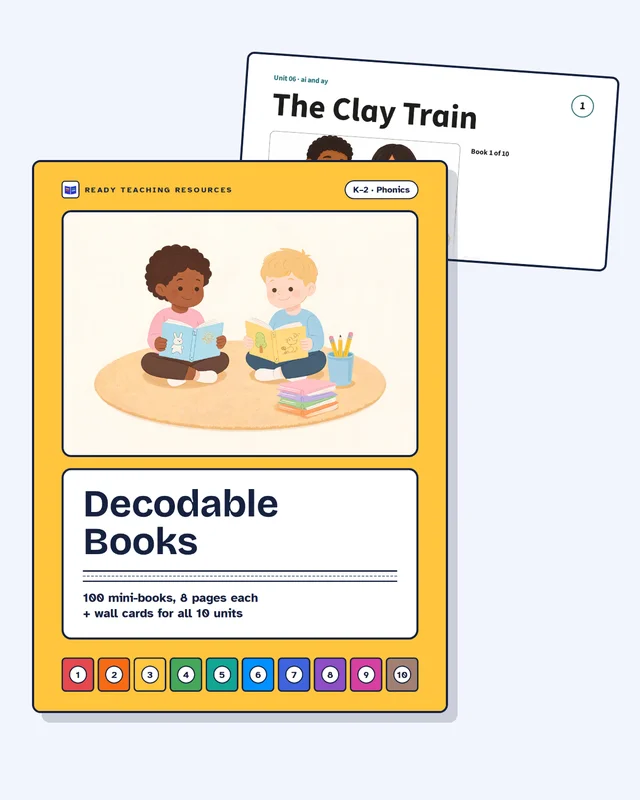
Phonics wall cards for all units, sound cards and heart-word cards, and a word list in every book are in the K-2 Decodable Books download, under a single-classroom license for one teacher and one classroom.
What are sight words?
A sight word is any word a reader identifies instantly. A classroom list of common words is a planning tool, not that definition. Many words on those lists can be sounded out.
What are sight words in kindergarten?
In kindergarten, sight words are the small set of common words the class meets in books, recognized quickly. Letter sounds come first. Schools choose their own lists.
What's another word for sight words?
Understood lists high-frequency words, star words, core words, and popcorn words as classroom names. In research, a sight word is any instantly recognized word, which is a wider set than a weekly list.
What's the difference between sight words and phonics?
Phonics is the teaching of letter-sound patterns. A sight word is a word the reader already stores for instant recognition. Phonics builds that store. The two are not rival methods.
How do you teach sight words?
Say the word, break it into sounds, match the letters that follow patterns already taught, tell the child about any letter that does not, then read it in a sentence. Practice a few words at a time.
What order should you teach sight words in?
Letter sounds first, then regular high-frequency words built from those sounds, then the irregular words the week's books actually use. Do not start with a random stack of cards.
What are some basic sight words for kindergarteners?
Understood gives these kindergarten examples: be, but, do, have, he, she, they, was, what, and with. Sound out the ones that follow patterns the class knows. Map the ones that do not.
How many sight words should a kindergartner know?
There is no national count. Sight Words for Kindergarten says some literacy experts, including Tim Shanahan, believe kindergarteners should master 20 sight words by the end of kindergarten, notes that the Dolch word list has 40 words listed for Pre-K, and says some school districts require kindergarteners to learn 100 sight words by the end of the year. Savvy Learning lists a common classroom target of 25 to 100 words by the end of kindergarten and says those figures are not universal standards. Teach the words in the books the class is reading.
What grade do you learn sight words?
Explicit practice usually starts in kindergarten and first grade, beside decoding lessons. Instant recognition keeps growing long after second grade. A kindergarten list is a start, not the whole store of instant words.
Should kindergarteners know sight words?
Yes. They should recognize a small set of high-frequency words from the books they are reading, taught beside letter sounds. They do not need a long list memorized before phonics starts.
What is a fun way to teach sight words?
Use a short game that still requires reading the word: partner reading of a word wall, a small-group flashcard pile, or a ring of a few cards. Skip games that reward a guess from a picture.
Sources
- Institute of Education Sciences: Foundational Skills to Support Reading for Understanding in Kindergarten Through 3rd Grade
- Keys to Literacy: The Role of Orthographic Mapping in Learning to Read
- Understood: What are sight words?
- Learning Without Tears: Sight Words for Kindergarten
- Savvy Learning: 100 Sight Words for Kindergarten
- National Center on Improving Literacy: The Alphabetic Principle: Linking Sounds to Letters
-
Decodable Books
100 mini-books, 8 pages each, plus wall cards for all 10 units