How to teach letter sounds so the first words appear this week
Published 2026-10-27 · Updated 2026-10-27

Teach letter sounds a few at a time, and put a short vowel in the first set, so children can read words in the first week. The Institute of Education Sciences practice guide says to teach each letter and its sound, working with a few phonemes at a time, and to present consonants and short vowel sounds represented by single letters first. One first group it names is /s/, /m/, /d/, /p/, and /a/. With those sounds, children can read sad, mad, pad, sap, map, pam, Sam, dad, and am.
That is the direct answer to how to teach letter sounds. The rest of this page is the order, the words each new letter unlocks, the routine for a new sound, and the letters to keep apart.
A letter order for the first words
Alphabetical order is a poor teaching order. A, B, and C do not make a word, and b and d look alike. A useful order mixes consonants children can say cleanly with one short vowel, then stops so those letters can be read before the next set arrives.
Use the practice guide's first group, one new sound a day. Move short a up if you want words before the fifth day. Either way, the vowel is what turns letter practice into reading.
| New sound | Keyword picture | Words to read once this sound is taught |
|---|---|---|
| s /s/ | sun | None yet. There is no vowel. |
| m /m/ | map | Still none. Stretch /s/ and /m/ so children hear a sound that can be held. |
| d /d/ | dog | Still none. Say /d/ as a quick tap. Do not add "uh." |
| p /p/ | pig | Still none. Lips pop, voice off. |
| a /a/ | apple | am, Sam, sad, mad, dad, pad, sap, map, pam |
Check each word before you put it on a card. sad, mad, pad, sap, map, and dad are consonant-vowel-consonant words with only these sounds. am is vowel-consonant. Sam and pam are the same pattern as names. Skip as: the s says /z/, not /s/. Skip ma and pa: the vowel is not short a.
If you teach /a/ on day three, after s and m, the first words are am and Sam. dad, sad, and mad arrive with d. The rest arrive with p. Children who already know some of these letters should not restart at s. The same guide says many children enter kindergarten knowing the letters in their name, and it recommends building on familiar letters while you introduce new ones.
What to add next, still one sound at a time:
| Next sound | Why this one | New words |
|---|---|---|
| t /t/ | A stop that does not look like d | at, sat, mat, pat, tap, tad |
| i /i/ | A new short vowel, easy to see against a | it, sit, sip, pit, tip, dip, dim, did, mid |
| f /f/ | A continuous sound, teeth on the lip | if, fat, fit |
| n /n/ | Another continuous sound, after m is secure | an, in, nap, pan, man, pin, tin |
Leave out words like and and sand for now: both end in nd, two consonant sounds side by side, and blends come later. See consonant blends when this set is easy.
Hold these back:
- b, until d is instant. The practice guide notes that mixing up b and d is common, and it says to teach one letter until the child knows it, then the other, then both.
- q, except with u. qu says /kw/, two sounds, not a simple letter sound.
- x at the start of a word. In box it says /ks/, which is two sounds.
- The soft sound of c and g. Before a, o, or u, c says /k/, as in cat. Soft c, as in city, is a later lesson.
What a letter sound is
A letter sound is the phoneme a letter stands for in a word. Reading Universe counts 44 sounds in English, spelled by the 26 letters alone or in combination. Teaching that link is phonics. Reading Universe calls it sound-letter correspondence. The practice guide calls it letter-sound relations. It is not phonemic awareness. Phonemic awareness is hearing and moving sounds with no print. If you want that split in one place, read phonics versus phonemic awareness and what a phoneme is.
Examples of the first letter sounds, said cleanly:
- s says /s/, as in sun, not "suh."
- m says /m/, as in map. Lips stay together and the voice hums.
- a says short /a/, as in apple. The mouth is open. This is not the letter name "A."
- d says /d/, as in dog. The tongue taps. Voice on, no extra vowel after it.
- p says /p/, as in pig. Lips pop. Voice off.
Two letter sounds can mean two different things, and both come up in class.
A grapheme can be more than one letter. Reading Universe uses chop as the example: four letters, three sounds, because ch is one grapheme. sh, ch, th, wh, and ck are the digraphs to teach after single letters. A blend is not a digraph. In stop, s and t each keep their sound. The practice guide says a digraph makes a single sound and must be taught as a unit, and it says not to memorize blends as units. Teach digraphs after children can read the first short-vowel words, and teach blends by sounding each letter.
The other meaning is one letter with two sounds. c can say /k/ or /s/. g can say /g/ or /j/. The practice guide says to start with the most common sound each letter represents, and to introduce each letter sound one at a time. For c, that first sound is /k/.
How to introduce one new sound
Use the same short routine every time. The practice guide's steps for each phoneme are: name the letter or letters, show both uppercase and lowercase, show a memorable picture of a familiar word that contains the sound, say the sound, and have children repeat it. Then review the new sound with a small group of sounds they already know, and have them write the letter in a word such as mad or sad.
Reading Universe adds the formation of the letter to that same moment. In its overview, the teacher and children name the letter, say the sound, and sky-write the letter. Name, sound, and formation together give the child more than a flash card.
A lesson for /p/ can look like this.
- Show P and p. Say the name, then the sound: "P, /p/."
- Show a picture of a pig. Tell a one-line story that repeats the sound: pig wants pizza and says /p/ /p/ please. The practice guide's sample is that kind of memorable picture, not a lecture.
- Children sky-write p and say /p/ as the pencil moves.
- Stretch known continuous sounds and tap the stop: /sss/ /a/ /p/, sap. Then /m/ /a/ /p/, map.
- Change one sound: map to mad, mad to sad, sad to pad. One change at a time.
Stop sounds are the usual stumble. The practice guide says to listen for a strong schwa, the "uh," after stop sounds, as when /b/ becomes "buh." That extra vowel makes sap sound like "suh-a-puh," and the word never snaps together. Clip /p/, /d/, and /t/. Stretch /s/, /m/, /f/, and /n/. The same guide says continuous sounds are easier for students to elongate as they identify the unique sounds in a word, which is why s and m belong in the first set.
Activities that use only known letters
The useful games are the ones that force a sound-to-letter match. Song and alphabet order can wait.
- Keyword picture and a short sound story, as above. One picture per sound, not a poster of the whole alphabet.
- Sky-write, then write on a line. Say the sound while the hand moves.
- Sound boxes for a word of two or three sounds. Push a tile for each sound, left to right, then blend. The practice guide describes this with words the child can already map to letters they know. A full how-to is on Elkonin boxes.
- Word chain. sad, mad, map, sap, tap, tip, sip, sit. Each step changes one sound. If a child cannot say which sound changed, the chain is too fast.
- Name writing, only for the letters already taught. A name is a reason to care. It is a poor scope and sequence, because names hide odd spellings.
Skip worksheets that ask for a letter the child has not been taught. A page of mixed b, d, p, and q in week one teaches confusion.
Letters children mix up
Shape mix-ups and sound mix-ups are different problems.
b and d are the shape pair. Teach d in words (dad, sad, mad) until it is fast. Then teach b alone (not in this first set). Only then put both in a chain. The practice guide's advice is to focus on one letter at a time, review it, then teach the other, then mix them in different words.
m and n are the sound pair. Both are nasal. Teach m in the first set and n only after m is secure, with the mouth cue visible: lips together for m, lips open and tongue up for n.
Short vowels are the next mix-up, especially short e and short i. Do not add short e in the same week as short i. The vowel page has the mouth cues: short vowel sounds.
q, x, and y are not starter sounds. qu is two letters. x is two sounds. y as a vowel is a later pattern.
Read the words in a book, not only on cards
Cards prove the sound. A book proves the child can use it. Once sad, map, and Sam are easy, the child should read a few lines that contain only taught sounds, plus a tiny set of heart words you have taught on purpose, such as the and a. If the page has was, they, or said, the child is guessing, not sounding out. For the word pattern itself, use CVC words and blending sounds.
This order will not fit every child. A child who already reads map does not need five days on s, m, d, p, and a. A child who cannot yet hear that map has three sounds needs oral blending before more letters. Letter-sound teaching is also not the whole of reading. The practice guide's later recommendations are decoding in text and daily connected reading. Sounds on cards, with no words and no book, stall.
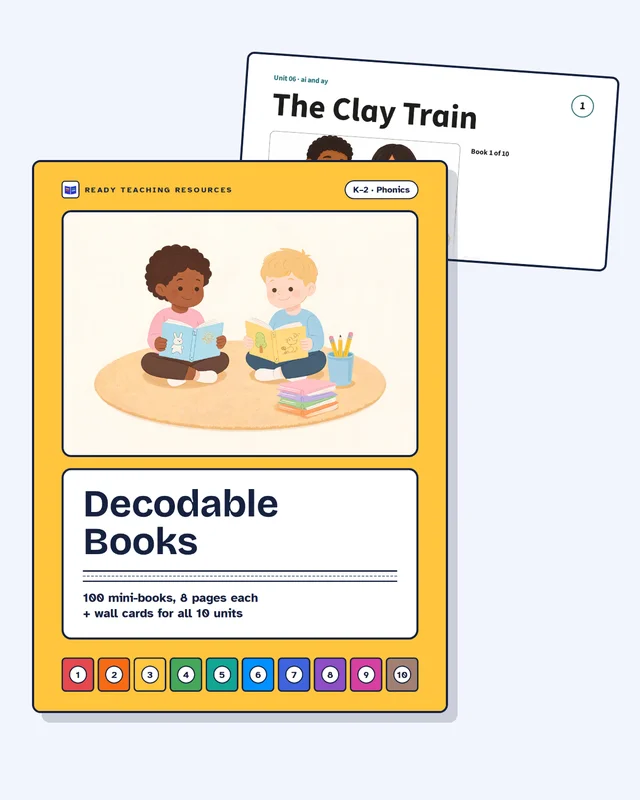
Ready to print, the K-2 Decodable Books set gives K-2 readers a decodable mini-book for every phonics pattern in teaching order. Inside each book are a word list and three comprehension questions, with answer keys, and the set also holds phonics wall cards for the units. They need a printer, paper, scissors and a stapler, and they print single-sided so you can cut and staple.
What are examples of letter sounds?
Start with /s/ as in sun, /m/ as in map, /d/ as in dog, /p/ as in pig, and short /a/ as in apple. Those five unlock sad, mad, map, sap, pad, and Sam.
How to introduce letter sounds?
Name the letter in uppercase and lowercase, say the sound and have children repeat it, show a keyword picture, write the letter, then blend it into a word made only of sounds already taught.
What is it called when you teach letter sounds?
Teaching how letters stand for sounds is phonics. The skill itself is letter-sound correspondence. Phonemic awareness is the sounds alone, with no letters.
What are two letter sounds?
Two letters that spell one sound, such as sh or ch, are a digraph. A blend, such as st, keeps two sounds. Some single letters also have two sounds, such as c saying /k/ or /s/; teach the frequent sound first.
What are some fun activities to teach letter sounds?
Use a keyword picture with a short sound story, sky-write the letter, stretch continuous sounds in sound boxes, and change one letter in a word chain such as sad, mad, map, sap, tap.
Sources
-
Decodable Books
100 mini-books, 8 pages each, plus wall cards for all 10 units