Long Vowel Sounds: K-2 Spellings and the Order to Teach Them
Published 2026-10-27 · Updated 2026-10-27

A long vowel sound is the vowel saying its letter name. In cake, the a says the name of the letter a. In bee, the e says the name of the letter e. Little Lions Literacy defines a long vowel as the sound pronounced like the letter name, and contrasts it with a short vowel, which has its own sound.
Apple is a short vowel. The a in apple matches the short a in cat, not the long a in cake. Little Lions Literacy uses cat and cake for that contrast. Bed, sit, dog, and cup are short. Bee, bike, boat, and cube are long.
| Vowel | Short word | Long word |
|---|---|---|
| a | cat | cake |
| e | bed | bee |
| i | sit | bike |
| o | dog | boat |
| u | cup | cube |
Those five long words are enough to answer "which word has a long vowel?" Cake, bee, bike, boat, and cube each have one. Cat does not.
Spellings for each long vowel
Little Lions Literacy notes that long vowels can be spelled in more than one way, including silent e, vowel teams, and open syllables. Teach one spelling at a time. The first spelling in each group below is the one to teach first in K-2. The later spellings wait until that one is readable.
Long a
Silent e, spelled a_e: cake, make, name, late, cape, snake, brave. A blend in front of the vowel still leaves a long a, as in snake and brave.
Vowel teams: ai in rain, train, wait, and mail. Ay in day, play, say, and stay. Ay usually ends the word. Ai usually sits in the middle. Said is a heart word: the ai does not follow that pattern.
Long e
Vowel team ee: see, tree, feet, green, sheep, sleep.
Vowel team ea, when it spells long e: eat, team, leaf, beach, clean, dream.
Silent e, spelled e_e, is rare. Reading Universe says the e_e pattern is not very common and is often taught last. These, Pete, and theme are enough.
Open syllable, a vowel with no consonant after it in the syllable: me, we, he, be, she.
Long i
Silent e, spelled i_e: bike, kite, time, five, ride, smile.
Vowel team igh: light, night, high, right.
Ie at the end of a one-syllable word: pie, tie. Piece and field are a different job of ie. They spell long e, so leave them out of the long-i list.
Y at the end of a one-syllable word: my, fly, cry, try. The open syllable hi belongs with this sound as well.
Long o
Silent e, spelled o_e: home, hope, note, bone, stone, rose.
Vowel team oa: boat, coat, road, soap, toast.
Ow when it spells long o: snow, grow, show, slow. Cow and now are a different sound. Keep them out of this list.
Open syllable: go, no, so.
Long u
Long u has two sounds. Reading Universe notes that u_e can be the y-glide in cube or the oo sound in tune.
Y-glide: cube, cute, mule, few, cue.
Oo sound: flute, rule, June, blue, glue, new, grew.
A K-2 order for those spellings
Start when short vowels are secure. Little Lions Literacy says to teach long vowels after a learner can read short vowel sounds in words such as bat, run, hit, set, and mop.
Then teach silent e, one vowel at a time: a_e, i_e, o_e, u_e, and e_e last. The silent e words guide has the pairs and the lists. Reading Universe shows a first-grade teacher introducing that pattern.
Vowel teams come after silent e, still one team at a time. Skip the slogan "when two vowels go walking, the first one does the talking." Reading Universe says that saying works less than half the time, and gives head, break, and heard as words outside that saying. Teach each team by the sound it spells. The vowel teams guide lists those teams.
Open syllables are a real long-vowel spelling. Little Lions Literacy describes a vowel at the end of a syllable as usually long, with be, go, and me as examples. In K-2, teach me, we, go, and no as wholes first. Teach the open-syllable type when students start reading two-syllable words.
One later pattern can wait. The same Little Lions page lists i or o as long before two consonants, as in kind and gold. That is a real pattern. It is a poor first long-vowel lesson, because the vowel is not marked by a silent e or a vowel team.
Practice that stays on one spelling
Hear the letter name, build three or four words with only the spelling of the day, read them, then write them from dictation. Kindergarten through 3rd grade teachers can follow the What Works Clearinghouse practice guide: students decode words, analyze word parts, and both write and recognize them. That practice guide also wants every student in connected text each day, in support of accuracy, fluency, and comprehension.
A decodable sentence that uses the spelling of the day is the right text. A page that mixes ai, ay, a_e, and open a on the first day is not. One honest limit of this advice: knowing that a vowel says its name does not tell the student which spelling to write. Spelling still has to be taught pattern by pattern.
Books in teaching order
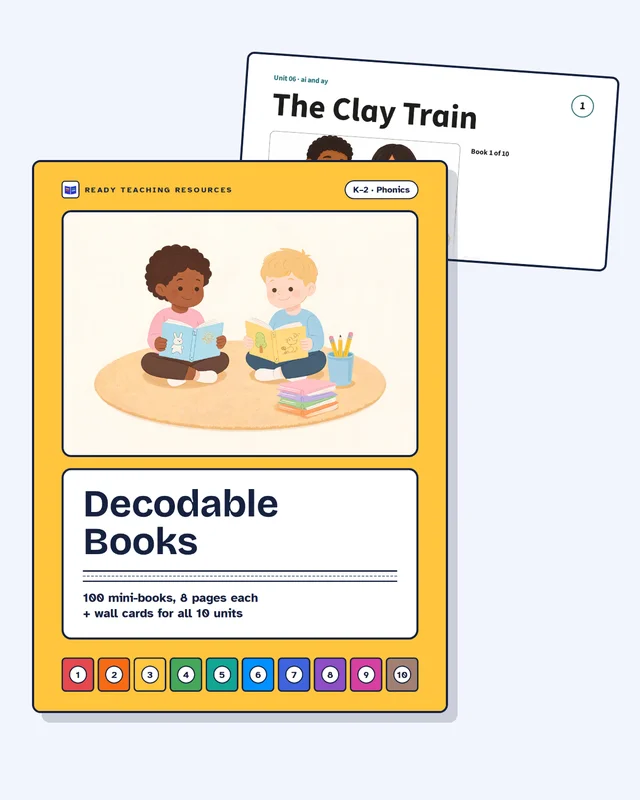
Once one spelling is readable, students need sentences that stick to it. The K-2 Decodable Books: 100 Phonics Mini-Books + Wall Cards give readers a decodable book for every phonics pattern, in teaching order, ready to print, with a Start Here guide that holds the scope and sequence. Those books print single-sided, two half pages per sheet, to cut and staple.
What is a long vowel sound?
A long vowel sound is the vowel saying its letter name. The a in cake says the name of the letter a. A short vowel, as in cat, has a different sound.
Which word contains a long vowel sound?
Cake, bee, bike, boat, and cube each contain a long vowel. Cat, bed, sit, dog, and cup use the short sound of the same letters.
Is apple a short or long vowel?
Apple is short. The a in apple matches the short a in cat, not the long a in cake.
Sources
-
Decodable Books
100 mini-books, 8 pages each, plus wall cards for all 10 units