Silent E Words: Lists by Vowel and How to Teach the Pattern
Published 2026-10-27 · Updated 2026-10-27

A silent e word ends in a vowel, a consonant, and an e that is not pronounced. In the long-vowel job, that e makes the vowel say its name: cap becomes cape. Reading Universe calls this the vowel-consonant-e pattern, or VCe, and lists the same spelling under the names silent e, sneaky e, bossy e, final e, and magic e.
Teachers also say CVCe when a consonant sits in front of the vowel, as in cake, and CCVCe when a blend does, as in snake. Reading Universe uses cake and snake for those two shapes. Both are silent e words. The silent e rule is the same in each: the e is quiet, and the vowel says its name.
Ten words to start with: cake, bike, home, cube, these, cape, kite, note, flute, and theme.
Pairs that show the job of e
Read the short word, then the silent e word. Only one letter is added. The new e is silent, and the vowel changes from short to long.
| Short word | Silent e word | Vowel that says its name |
|---|---|---|
| cap | cape | a |
| tap | tape | a |
| hat | hate | a |
| mad | made | a |
| pin | pine | i |
| kit | kite | i |
| bit | bite | i |
| hop | hope | o |
| not | note | o |
| cub | cube | u |
| tub | tube | u |
Cube keeps a y-glide, as in "cyoob." Tube may sound like "toob" or like "tyoob," depending on the speaker. Teach the pair, then sort the two u sounds in the lists below.
Count the consonants between the vowel and the e, not the consonants in front of the vowel. In brave, the blend br comes before a, and only v sits between a and e. Brave is a long-a word. Smile, stone, and plate work the same way.
Silent e words by vowel
Use these for reading, sorting, and dictation. Stay with one vowel until the pairs are easy, then add the next.
Long a, spelled a_e
cake, make, name, game, same, late, cape, tape, lake, bake, wave, shade, whale, chase, plate, snake, grape, flame, brave, shape
Taste, paste, and waste keep a long a even though two consonants sit between the vowel and the e. They can wait until the one-consonant pattern is easy. Dance is different: the a stays short, and the e is there so c spells /s/.
Long i, spelled i_e
bike, kite, like, time, five, nine, ride, side, line, mine, hide, pine, bite, smile, white, drive, slide, prize, rise, wise, ice, nice
Ice and nice are long-i words, and the e also makes c spell /s/. Leave fire and tire for later. The r changes the vowel, so they are a poor first example of this pattern.
Long o, spelled o_e
home, hope, note, bone, stone, those, rose, nose, joke, rope, globe, hole, woke, smoke
Long u, two sounds
Reading Universe notes that the u_e pattern makes two sounds: a y-glide, as in cube, and an oo sound, as in tune.
Y-glide: cube, cute, mule, huge, fuse
Oo sound: tune, flute, rule, June, rude, prune
Huge is a y-glide word, and the e also makes g spell /j/.
Long e, spelled e_e
Reading Universe says the e_e pattern is not very common, so it is often taught last.
these, Pete, theme, eve, Steve, scene
Scene is long e, and the e makes c spell /s/. These, Pete, and theme are enough for a first lesson.
The s sound in nose and these
Wiktionary records the General American pronunciation of nose as nōz, so the letter s spells /z/ in that word. Have students listen for the same sound in rose, those, these, rise, and wise. Then listen to case, base, and chase, where s stays /s/. A short sort is enough. Treat it as a listening note for this set, then go back to reading.
Teaching the pattern after short vowels
Wait until CVC words are secure. Students need to hear that long vowel sounds say their names before the silent e spelling will make sense.
A first lesson can follow this routine.
- Show a pair the student can already read on the short-vowel side, such as cap and cape.
- Tap only the sounds you hear. Cap is three taps. Cape is three taps. The e gets no tap.
- Mark the pattern, then take the mark away. Reading Universe describes a rainbow arch from the e back over the consonant, landing on a line that marks the vowel long, and says to fade that scaffold once students can decode on their own.
- Sort a handful of words by vowel, using one column from the lists above.
- Spell from dictation: say the word, and have the student write the vowel, the consonant, and then the e.
- Read a decodable sentence that uses the pattern and only the spellings already taught.
The What Works Clearinghouse practice guide for kindergarten through 3rd grade says to teach students to decode words, analyze word parts, and write and recognize words. The same guide says each student should read connected text every day to support accuracy, fluency, and comprehension. A silent e sentence or a short decodable book is the right text. A page of untaught words is not.
Reading Universe shows a first-grade teacher introducing the pattern, and she calls it silent e. Literacy Learn tags its silent e list and picture-match worksheets for 1st through 3rd grade, and that page offers a free download of the list. Classes meet the pattern at different points. The useful check is whether short-vowel words are secure, not a single grade label.
Magic e words and silent e words are the same set when the vowel says its name. If a student still says the e out loud, go back to the pair and tap only the sounds you hear.
Words the pattern does not explain
A final e does not always make the vowel say its name. Reading Universe lists have, give, house, and mouse as exceptions, where the vowel is not the long sound the final e usually signals. In have and give the vowel is short; in house and mouse, ou spells the /ow/ sound. Add come, some, and love to the heart-word set for this unit, and teach them as wholes.
Live splits by meaning. In "a live show" the i says its name. In "live here" the i stays short. Teach the short one as a heart word until the sentence makes the meaning clear.
Silent e is the first long-vowel spelling to teach, not the only one. Vowel teams such as ai, ay, ee, and oa spell many of the same sounds with two vowel letters. Dropping the e before a suffix such as -ing is a later spelling job. Leave it until the base pattern is easy.
Pattern books for this unit
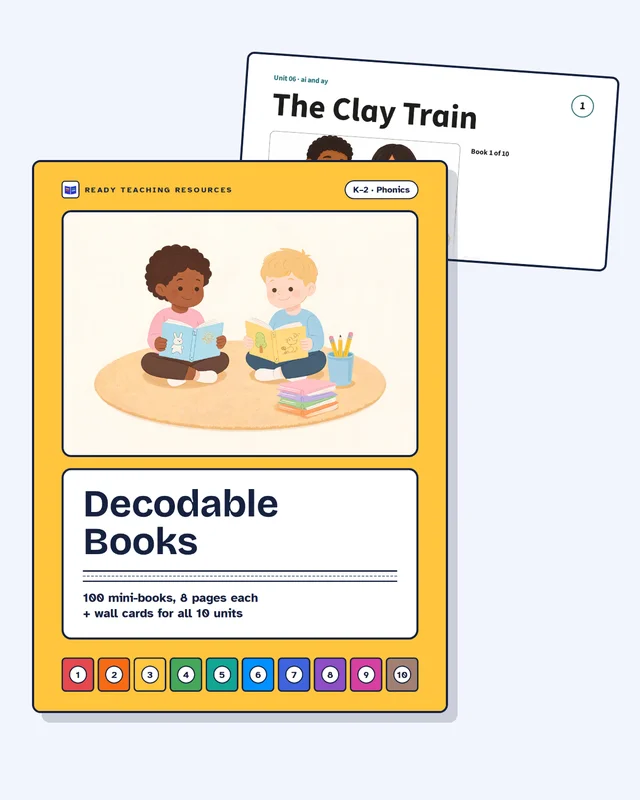
Once the pairs and one vowel list are readable, students need sentences, not another isolated list. The K-2 Decodable Books: 100 Phonics Mini-Books + Wall Cards include 100 decodable mini-books, a word list and 3 comprehension questions in every book, and phonics wall cards for all 10 units. In those books, children's reading text is drawn as vector outlines, so a screen reader cannot read it aloud.
What is magic e called now, and what is sneaky e?
Magic e, silent e, sneaky e, bossy e, final e, and VCe are names for the same vowel-consonant-e pattern. Sneaky e is not a different rule.
What is the silent e rule, and what is a CVCe word example?
In a vowel-consonant-e word, the final e is silent and the vowel says its name. Cake is a CVCe example: consonant, vowel, consonant, silent e.
What grade is magic e taught?
A Reading Universe classroom video shows a first-grade lesson. Literacy Learn tags its silent e list for 1st through 3rd grade. Teach the pattern once short-vowel words are secure.
Can you give me ten magic e words?
Cake, bike, home, cube, these, cape, kite, note, flute, and theme.
Is there a PDF list of magic e words?
Literacy Learn offers a free download of a silent e word list and picture-match worksheets. The lists on this page can be used without that download.
Is there a word with a silent e?
Yes. Cape, kite, hope, cube, and these all end with an e that is not pronounced.
Sources
-
Decodable Books
100 mini-books, 8 pages each, plus wall cards for all 10 units