How to Teach Phoneme Segmentation
Published 2026-10-27 · Updated 2026-10-27

Phoneme segmentation is pulling a spoken word into every sound, in order. The child hears sun and says /s/ /u/ /n/. Reading Universe names two classroom moves for that job: Touch and Say, and Stretch and Shrink. The lesson plan models Stretch and Shrink as stretching make to listen for each sound, then Touch and Say as a touch on a felt square for /m/, the vowel, and /k/. The ladder below is the word list those moves need, from two sounds up to a blend.
The Institute of Education Sciences practice guide starts segmentation with two- or three-phoneme words such as dig, sun, and at. It also says continuous sounds are easier to stretch while the child finds each sound. Begin on the left of the ladder. Move right only when the child can say every sound without an extra vowel.
A ladder from two sounds to blends
Say the word. The child repeats it, then segments it. You say nothing during the segment except a prompt from the last column.
| Word | Sounds to expect | If the child stalls |
|---|---|---|
| at | /a/ /t/ | "Stretch it. I hear the vowel, then the last sound." |
| up | /u/ /p/ | "Touch your arm for each sound. Two touches." |
| sun | /s/ /u/ /n/ | "Hold /s/. Now the middle. Now the end." |
| map | /m/ /a/ /p/ | "Three touches. Do not stop after /m/." |
| slip | /s/ /l/ /i/ /p/ | "I hear /s/ and /l/ as two sounds, not one lump." |
| stop | /s/ /t/ /o/ /p/ | "Say /s/, then /t/. The blend is two sounds." |
At and up are the two-sound start. Sun and map are the three-sound work the practice guide uses for first lessons. Slip and stop add a consonant blend. The blend is not a new kind of sound. It is two phonemes said close together. If the child says /sl/ as one unit, ask them to separate /s/ and /l/ and touch once for each.
Prompts that keep the sounds clean
Stretch and Shrink. The lesson plan has the teacher stretch the word to listen for each sound, then stretch and shrink a new word with the child. Use that stretch when the child can blend but freezes on the pull-apart. Blending is the reverse job, and the prompts for it are in blending sounds.
Touch and Say. The same lesson plan has the teacher touch a felt square for each sound and point out how many sounds are in the word. The practice guide has the child pull one disc into a box for each sound they say. Those boxes are Elkonin boxes. The step-by-step for those boxes, including the move to letters, is in Elkonin boxes.
Model one word, then hand the next word over. "Watch. Sun. /s/ /u/ /n/. Your turn. Map." If you model every word, you are the one segmenting.
Prefer words the child uses in talk. A familiar word lets you hear the segmentation instead of a vocabulary miss. The practice guide says to tell students the word and have them repeat it slowly before they mark the sounds.
Errors to expect
An extra "uh." The child says /muh/ /a/ /puh/ for map. They have added vowels that are not in the word. Say the consonant as a puff or a hum, then ask for the sounds again. Continuous sounds (/m/, /s/, /n/) are the practice guide's recommended start because the child can hold them without that extra vowel.
A dropped sound in a blend. Stop comes back as /s/ /o/ /p/. The /t/ vanished. Point to the place: "I still need the sound after /s/." Have them say /s/ /t/ before they add the vowel.
A letter count instead of a sound count. The child says four sounds for ship because they are thinking of four letters. Cover any print. Say ship again. The sounds are /sh/ /i/ /p/. Segmentation is a listening job until letters are added on purpose.
A guess from the first sound. The child hears /s/ and says "snake" or "sun" and stops. Ask for every sound, in order, with a touch for each. The first sound is not the segment.
A two-sound word is the right first success. At and up have nowhere for a blend to hide. When those are clean, sun and map add a middle sound. Only then does slip or stop make sense. A child who fails stop on Monday and is handed another blend on Tuesday is practicing the miss. This return step is illustrative. Go back one row on the ladder until the sounds are clean, and return.
The limit of segmentation practice
A child who can segment sun can hear the word. They still have to attach s, u, and n and read the printed word. The practice guide treats segmentation as part of linking sounds to letters, not as a finished reading skill. When the oral ladder is solid through three sounds, put letters in the boxes for sounds the child knows, and read those words in a line of text. The wider map of where segmentation sits is in what is phonemic awareness.
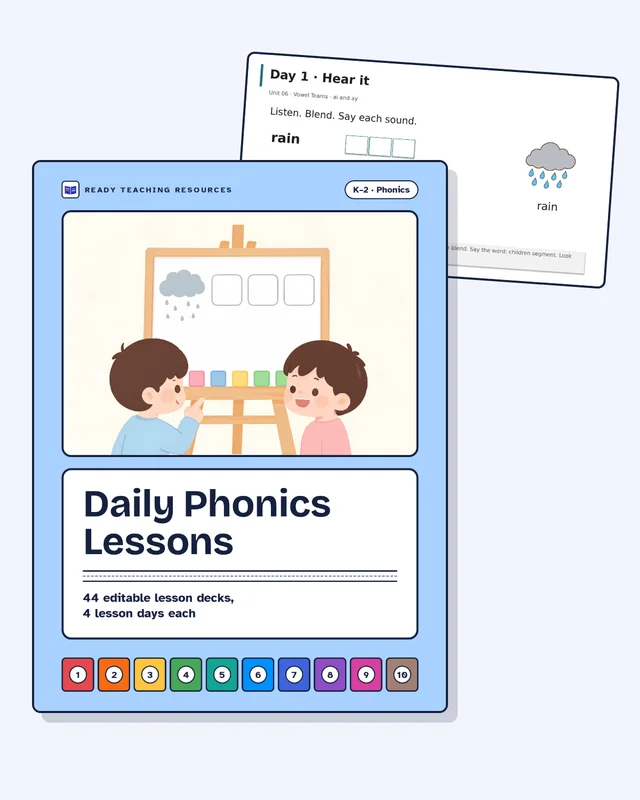
The K-2 Daily Phonics Lessons (Slides) are for Kindergarten, 1st grade, and 2nd grade. The daily routine on the decks is Hear it, Build it, Read it, Write it.
What is segmenting words?
Segmenting means pulling a spoken word apart into its sounds, in order, with nothing left out and nothing added.
What does it mean to segment words?
The child hears a whole word and says each phoneme by itself. Lip becomes /l/ /i/ /p/. The letters can stay out of sight.
Can you give an example of phoneme segmentation?
Say sun. The child says /s/ /u/ /n/. If they say /suh/ /u/ /n/, they added a vowel. Ask for the sound again, short and clean.
Sources
-
Daily Phonics Lessons
44 editable lesson decks, 4 lesson days each