What Is Phonemic Awareness?
Published 2026-10-27 · Updated 2026-10-27

Phonemic awareness is the ability to hear a spoken word and move the sounds inside it. Literacy How defines it as awareness of, and the ability to manipulate, the individual sounds, called phonemes, in spoken words. No letter has to be in sight.
The skills come in size order, large pieces of speech first. The Institute of Education Sciences practice guide tells teachers to move from words in sentences, to syllables, to the onset and rime inside a syllable, and then to individual phonemes. First phoneme lessons use two- or three-phoneme words such as dig, sun, and at.
Skills in teaching order
Say each consonant as a clean sound. Literacy How tells teachers to say /b/, not /buh/. The turns below follow that guide's sequence and the oral examples in the Northern Illinois University literacy clinic handout.
| Skill, in order | Ask this | Oral example |
|---|---|---|
| Words in a sentence | Tap once for each word you hear. | "Sam has a dog." The child taps four times. |
| Syllables | How many beats are in this word? | Put a hand under the chin and say "rabbit." The chin drops once for rab and once for bit. |
| Onset and rime | What word is this? | /c/ and /ool/ make cool. |
| Isolate a phoneme | What is the first sound? Then the last, then the middle. | Ball starts with /b/. Tap ends with /p/. Cup has /u/ in the middle. |
| Blend | What word do these sounds make? | /m/ /a/ /t/ makes mat. |
| Segment | Pull the word apart. | Lip is /l/ /i/ /p/. |
| Add, delete, or substitute | Change the word in your head. | Sit without /s/ is it. Pin with /p/ changed to /w/ is win. |
Onset means the opening consonant sound or sounds. Rime means the vowel and everything after it in that syllable. The practice guide uses cool as the model: /c/ is the onset and /ool/ is the rime.
Rhyming sits beside this list, not in front of it as a locked gate. Literacy How states that rhyming is not a prerequisite for learning to read, and that a child who struggles to rhyme should still be taught to segment and blend.
How to teach it in kindergarten and first grade
Literacy How says this instruction should begin in kindergarten and continue into first grade, and that most children in that stretch acquire basic phonemic awareness: segmenting and blending five sounds in words. Children past first grade who still struggle need the advanced tasks that page names: addition, deletion, and substitution.
A useful kindergarten goal is concrete. The child names the first sound in a spoken word, blends a short string of sounds into a word, and segments a short word, then starts to match those sounds to letters. Do not write a goal that says the child must rhyme perfectly before any of that.
A basic-level activity needs no materials. Say /s/ /u/ /n/ and ask for the word. When the child says sun, ask for the sounds back. If the child guesses from the first sound alone, say the three sounds again and have the child repeat each one before blending. Scripted games for a whole group are in phonemic awareness activities.
Mouth awareness belongs in those early turns. Literacy How suggests mirrors so children can see the mouth formation for each sound. Have the child watch the lips come together for /m/ and stay open for /s/. The point is to hear the difference, not to name the letters m and s yet.
Sound boxes come after the child can hear the sounds. The practice guide has students drop a counter into a box for each phoneme in a two- or three-phoneme word, then run a finger under the boxes from left to right as they blend. Letters replace the counters only after a few letter sounds are known.
What to tell a parent
Northern Illinois University's literacy clinic explains it for families as the ability to hear, identify, move, or change sounds, called phonemes, in spoken words, usually taught during kindergarten and the beginning of first grade so children are ready to develop into readers. A parent can ask, while putting on a hat, "What sounds do you hear in hat?" The answer the clinic gives is /h/ /a/ /t/. That conversation is the skill. A worksheet is not required for it.
Phonemic awareness, phonics, and phonetics
Phonemic awareness is one layer inside a wider sound skill. Literacy How calls it a subset of phonological awareness, which works with oral language at the level of word, rhyme, or syllable. The side-by-side levels are in phonemic awareness vs phonological awareness.
Phonics is the print step. It connects a phoneme to the letter or letters that spell it. How the same word is taught both ways is in phonics vs phonemic awareness.
Phonetics is a different job from either classroom skill. The Cambridge Dictionary defines phonetics as the study of the sounds made by the human voice in speech. A child can blend /m/ /a/ /t/ while phonetics stays a subject for linguists. Phoneme awareness depends on hearing spoken sounds. Letter names are a separate skill that arrives with print.
A more complex level is a change inside the word, not a longer list of words. Literacy How treats segmenting and blending as basic phonemic awareness, and addition, deletion, and substitution as the advanced work. A child who can only say that dog starts with /d/ is at a simpler level than a child who can drop the first sound of sit and say it. Judge the level by the task the child can do.
Mistakes that slow the work
Adding a vowel after a stop consonant hides the phoneme. Keep /b/ short. The mirror tip above is for the child's mouth, and the teacher's mouth has to match it.
Holding the class on rhyme until every child can produce a rhyme delays the skill that reading actually uses. Move to segmenting and blending, and keep rhyme as language play.
Teaching a consonant blend as a chunk to memorize fights the point of phoneme work. The practice guide says to teach each sound in a blend and then have students blend those sounds together. A digraph is the exception the same page names: sh, th, and ch each make a single sound and are taught as a unit.
What oral practice cannot do alone
Hearing sounds is necessary and not sufficient. The practice guide says that to decode print into speech and to encode speech into print, students must identify the phonemes they hear, name the letters, and identify each letter's sound. The same guide states that the ability to isolate sounds and then link those sounds to letters will help students read about 70 percent of regular monosyllabic words, such as fish, sun, and eat.
The practice guide rates the recommendation to develop awareness of the segments of sound in speech and link them to letters as strong evidence. Once a child can segment a short spoken word, teach the letter for each sound and build the word. The practice guide calls that link the alphabetic principle.
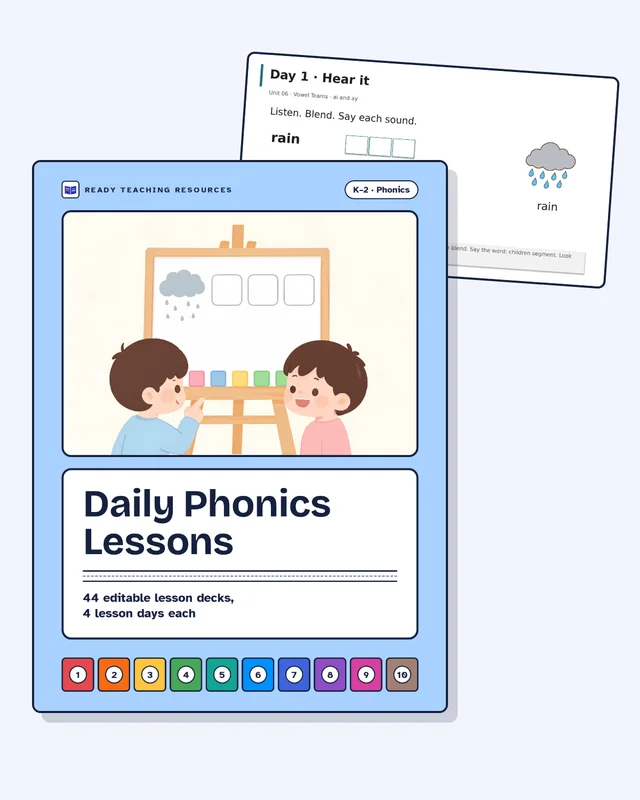
The K-2 Daily Phonics Lessons (Slides) include 44 lesson decks, one per phonics pattern, 4 lesson days each, and a Start Here guide with the routine, pacing and scope and sequence. They teach every pattern with the same daily routine: Hear it, Build it, Read it, Write it. They are lessons only: no assessments or tracker.
What is phonemic awareness?
It is the ability to hear and manipulate the individual sounds, called phonemes, in a spoken word. The child can do it with eyes closed. Letters are a later step.
How do I explain phonemic awareness to a parent?
Say that it is hearing, identifying, moving, or changing the sounds in spoken words, and that families can practice it in ordinary talk, such as asking for the first sound in dog.
Why use mouth awareness when teaching phoneme awareness?
A mirror lets the child see the mouth formation for each sound, which makes similar sounds easier to tell apart while the work is still oral.
Which activities work at the basic phoneme awareness level?
Isolation, blending, and segmenting of short spoken words. Ask for the first sound, say three sounds for the child to blend, or have the child pull a short word apart.
Is there a list of seven essential phonemic awareness skills?
The Northern Illinois University literacy clinic names six components rather than seven: rhyming, isolation, segmentation, deletion, substitution, and blending. Teach by the size of the sound, from words down to single phonemes.
What are useful phonemic awareness goals for kindergarteners?
Hear the first sound in a spoken word, blend short words, and segment short words, then link those sounds to letters. Keep rhyming as language play beside that work.
What does phoneme awareness depend on?
It depends on hearing the sounds in spoken words. Letter names are a separate skill that comes in when print is added.
How do phonetics differ from phonemic awareness?
Phonetics is the study of speech sounds. Phonemic awareness is a child's skill of noticing and moving the phonemes inside spoken words, not a course in that field.
Which work shows a more complex level of phoneme awareness?
Adding, deleting, or substituting a sound is more complex than naming the first sound. A child who can drop the first sound of sit and say it is further along than a child who can only say that dog starts with /d/.
Sources
-
Daily Phonics Lessons
44 editable lesson decks, 4 lesson days each