Phonemic Awareness Activities for K-2
Published 2026-10-27 · Updated 2026-10-27
A phonemic awareness activity is a short oral turn. The child hears a spoken word, or a string of sounds, and does something to those sounds. Northern Illinois University's literacy clinic shows the basic moves with everyday words: isolate a sound, blend sounds into a word, pull a word apart, delete a sound, or swap a sound. The scripts below use the voice only. A card or a marker can wait. Chips help later. The voice is enough.
Group the turns by the job, not by how cute the theme is. A kindergarten block can use the first three groups. First grade adds deletion and substitution. Second grade keeps those for children who still cannot do them. The skill order behind that choice is in what is phonemic awareness.
Isolation: name one sound
Say a word the child knows. Ask for one position only.
Teacher: Listen to map. What is the first sound? Child: /m/. Teacher: Listen to map again. What is the last sound? Child: /p/.
The clinic handout uses the same shape: the beginning sound in ball is /b/, the ending sound in tap is /p/, the middle sound in cup is /u/. First sound is the kindergarten entry. Last sound comes next. Middle sound is harder, so save it until first and last are steady.
A no-materials game: "Stand up if your name starts with /s/." Literacy How uses that kind of transition line, such as getting a coat if the name begins with /s/. Keep the sound clean. Say /s/, not /suh/.
Blending: push sounds into a word
You say the sounds. The child says the word.
Teacher: /b/ /i/ /g/. What is the word? Child: Big.
The clinic's model is /m/ /a/ /t/ makes mat, and /b/ /i/ /g/ makes big. If the child shouts a guess after the first sound, say the string again and have them repeat each sound before they blend. Continuous sounds such as /m/, /s/, and /f/ are easier to hold. The practice guide recommends those continuous sounds when children are first learning to hear each sound in a word.
Kindergarten game: stretch a snack. "I am thinking of a food: /j/ /a/ /m/." The child says jam. Then they stretch a food for you.
Segmenting: pull the word apart
You say the word. The child says every sound.
Teacher: Lip. What sounds do you hear? Child: /l/ /i/ /p/.
That is the clinic's segmentation example. Have the child tap a finger on the table for each sound, or drop a chip into a square. The squares are sound boxes. How to move from chips to letters is in Elkonin boxes.
Kindergarten game: robot talk. The child says their name the way a robot would, one sound at a time. You write nothing yet. You only listen for a missing sound or an extra "uh."
Deletion, addition, and substitution
These are the advanced jobs. Literacy How treats addition, deletion, and substitution as the work beyond basic segmenting and blending.
Deletion. The clinic's line is: say sit without the /s/. The word left is it. A kinder version uses a compound word first if the phoneme deletion is too hard, then returns to a single sound. Stay on the sound, not the spelling.
Addition. "Say at. Add /s/ at the beginning." Sat. "Add /m/ at the end of say." Same. Say the place (beginning or end) so the child is not guessing where the sound goes.
Substitution. The clinic's line is: the word is pin. Change /p/ to /w/. The new word is win. Kindergarten game: silly switch. "The word is cat. Change /k/ to /h/." Hat. Laugh at the silly ones. The laugh is fine. The sound change is the point.
A sample kindergarten block
This order is illustrative, not a required dose.
- Two isolation turns, first sound only.
- Two blending turns with two or three sounds.
- One segmenting turn on a word you just blended.
- Stop while the child is still successful.
That is the whole block. Literacy How says instruction should begin in kindergarten and continue into first grade, with segmenting and blending as the basic aim, including words with five sounds as children grow into that. Do not spend the block on a worksheet border or a craft. The activity is the talk.
If you want a mirror, Literacy How suggests one so children see the mouth formation for a sound. Pass it for /m/ and /s/. Then put it away and go back to the words.
When the oral game is no longer the lesson
Add letters when the child can blend and segment a short spoken word. The practice guide has students pull a disc or a letter tile into a box for each sound, then sweep a finger under the boxes and blend. Letter tiles belong only after those letter sounds are known. Until then, use blank chips.
The honest limit: these games do not replace reading words in print. A child who can blend /b/ /i/ /g/ in the air still has to learn that b, i, and g spell big, and then read big in a sentence. Keep the oral block short so there is time for that print work.
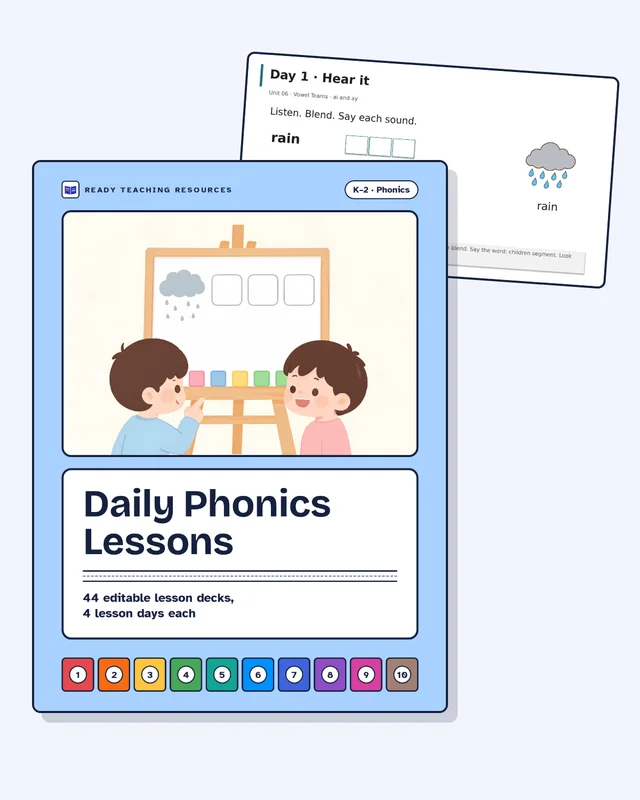
The K-2 Daily Phonics Lessons (Slides) include 44 lesson decks, one per phonics pattern, 4 lesson days each. Each deck is a PowerPoint deck made for Google Slides, and the set is lessons only, with no assessments or tracker.
What is an example of a phonemic awareness activity?
Say the sounds /b/ /i/ /g/ and ask the child to blend them into big. No letters, no picture, no worksheet.
What are some fun phonemic awareness games for kindergarteners?
Play I hear a sound at the door, stretch a classmate's name into sounds, and change the first sound of a snack word to make a silly word.
How do I teach phonemic awareness in kindergarten?
Use a few minutes a day. Start with the first sound and with blending short words. Add segmenting, then adding, deleting, and swapping sounds for children who are ready.
Sources
-
Daily Phonics Lessons
44 editable lesson decks, 4 lesson days each