Word chains for phonics lessons
Published 2026-10-27 · Updated 2026-10-27

A phonics word chain is a line of words. Each word changes one sound from the word before it. Children build the word, make the change, and read the new word before the next step.
The practice guide has students add, move, or replace one letter tile at a time, starting from fat and moving to fan, can, and cat. This chain tool describes chains as adding, deleting, or substituting one sound, as in cat, cats, coats, boats, oats.
Use a chain after the spellings in it have been taught. Blending those sounds is the skill in blending sounds. A sort that groups the same patterns is in word sorts.
How to run one
Sit where everyone can see the tiles or the board.
- Say the first word. Children repeat it and stretch the sounds.
- Build it with letter tiles, or write it. The practice guide says to choose words whose letter sounds children have already learned, so the tiles match sounds they can already map.
- Name one change: the first sound, the vowel, or the last sound.
- One child moves or writes that change.
- The group reads the new word.
- Repeat for the rest of the chain, then read the whole line.
Model the first change yourself. Then hand the move to the group. At a small table, you name the change and one child moves the tile while the others read.
The published tile example uses f, a, t, c, and n:
| You say | Tiles | Word |
|---|---|---|
| Make fat | f a t | fat |
| Change a letter to make fan | f a n | fan |
| Change a letter to make can | c a n | can |
| Make it say cat | c a t | cat |
Each step changes one sound and one letter. That match is the goal of a beginner chain.
Ready chains
These lines are examples for patterns already taught. Each step changes one sound. Read them aloud before you hand them to children, so a word you would not use is already out.
Short vowels, one letter and one sound. Start here with CVC words.
cat, can, man, mat, hat, hit, sit, sat
- cat to can: last sound /t/ to /n/
- can to man: first sound /k/ to /m/
- man to mat: last sound /n/ to /t/
- mat to hat: first sound /m/ to /h/
- hat to hit: vowel /a/ to /i/
- hit to sit: first sound /h/ to /s/
- sit to sat: vowel /i/ to /a/
Add or delete one sound.
at, cat, can, an, man, mat
- at to cat: add /k/
- cat to can: last sound /t/ to /n/
- can to an: delete /k/
- an to man: add /m/
- man to mat: last sound /n/ to /t/
Beginning blends, after the blends are taught. This blends activity is for practice reading words with beginning blends, like snap and twig. A chain you can run with tiles:
lip, slip, slap, slam, clam, clap
- lip to slip: add /s/ to make the blend
- slip to slap: vowel /i/ to /a/
- slap to slam: last sound /p/ to /m/
- slam to clam: first sound /s/ to /k/
- clam to clap: last sound /m/ to /p/
Silent e, after that pattern is taught. The practice guide extends word building to cane after can, cart after cat, and flat after fat. A silent-e line that keeps one sound change per step:
cape, tape, tale, sale, same, came
- cape to tape: first sound /k/ to /t/
- tape to tale: last sound /p/ to /l/
- tale to sale: first sound /t/ to /s/
- sale to same: last sound /l/ to /m/
- same to came: first sound /s/ to /k/
The silent e stays. The sound that changes is a consonant. That is cleaner than asking children to treat the silent-e marker as a sound.
One digraph as one sound. After sh and ch are taught, the two letters move together because they spell one sound:
ship, shop, chop, chip, chin, thin
- ship to shop: vowel
- shop to chop: /sh/ to /ch/
- chop to chip: vowel
- chip to chin: last sound /p/ to /n/
- chin to thin: /ch/ to /th/
Kindergarten, 1st grade, and 2nd grade
Kindergarten uses the short-vowel chain and the add-or-delete chain, after the letter sounds in those words are known. Three tiles are enough. You say the change. The child moves one tile and reads.
1st grade adds the blend chain and the silent-e chain once those spellings are in the lesson. Two headers in a sort compare the patterns. The chain makes children use them in order.
2nd grade can run the digraph chain and a vowel-team chain on the same rule: one sound changes, and the letters that spell that sound move together. A two-syllable word can wait. The chain stays short enough to read back in one breath.
Mistakes
A step that changes two sounds is a new word, not the next link. If you say "change cat to mop," stop and pick a one-sound change.
A word with an untaught spelling breaks the chain. If silent e is still new, stay on cat, can, man, mat.
Children sometimes move a tile you did not name. Have them read the word they built. If it is not the word you asked for, put the tile back and name the sound again.
Reading only the last word hides the middle. Read every word as soon as it is built, then read the line.
Printed practice beside the chain
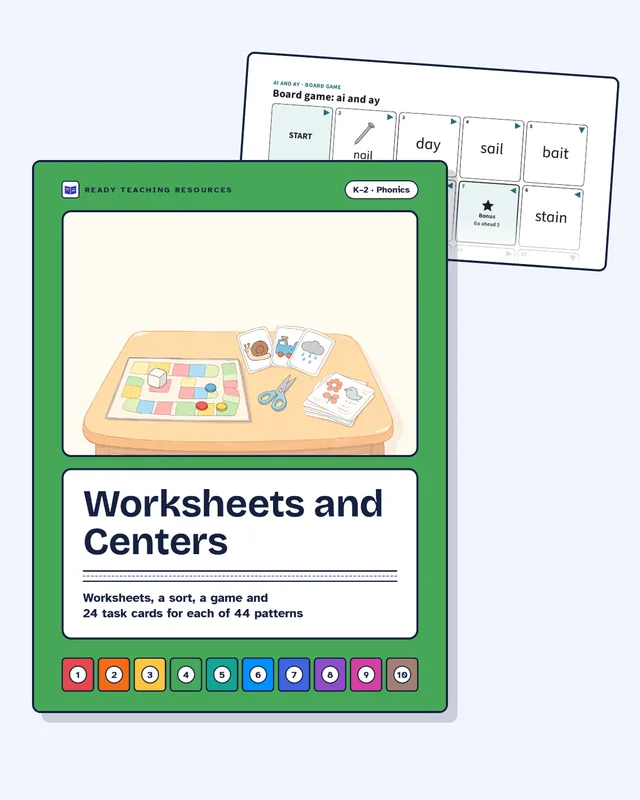
The K-2 Phonics Worksheets and Centers Mega Pack holds, for each of 44 phonics patterns, a worksheet set, a word-sort center, a board game, 24 task cards and an exit ticket. It has an answer key for every page with an answer. It includes a teacher page, a print list and contents for each unit. It uses a printer, paper, scissors, one die and game counters. It covers kindergarten, 1st grade, and 2nd grade. It has centers and task cards the teacher cuts out. It arrives as an instant download after checkout, and nothing ships.
The chains on this page need only tiles or a board. The pack is the printed practice for the same patterns.
The limit
A chain practices sounds and spellings children can already map. It will not teach a new letter sound by itself. Keep each step to one sound, and move every letter that spells that sound together once digraphs and silent e are in the words.
What is a word chain in a phonics lesson?
Children build a word, then change one sound to make the next word, and read each new word before the next change. The spellings in the chain are ones they have already been taught.
How is a word chain different from a word sort?
A sort groups a pile of words under spelling headers. A chain is a line: each word differs from the one before it by a single sound. Use a sort to compare categories. Use a chain to build and read.
Can kindergarten students use word chains?
Yes, once they know a few letter sounds. Start with three-sound words and one tile change. Add blends and silent e after those patterns are taught.
Sources
-
Worksheets and Centers
Worksheets, a word sort, a board game and 24 task cards for each of 44 patterns