How to use word sorts for phonics
Published 2026-10-27 · Updated 2026-10-27
A word sort groups words by a sound or a spelling children have already been taught. Put the category headers on the table and the sort is closed. Leave the headers off, ask children to find the groups, and the sort is open. Run the closed sort first.
In this guide, those two names are the two ways to run the same cards. A closed sort means you supply the spellings. An open sort means children build the groups, then name them.
This word-sort page calls the activity a categorization task that reinforces phoneme-grapheme correspondences already taught. The practice guide tells teachers to hand out word cards that show the target pattern and word cards that use other spellings, then ask children to sort the cards into groups.
Copy the sets below after the pattern has been taught. The teaching moves sit in a phonics lesson plan. The sort is the practice that follows.
Closed sort
A closed sort starts with the headers already written. For a first short-a sort, the headers are the families -at, -an, -ap, and -ack. This short-a lesson uses those four families, glues the header cards in columns, and has children compare the words.
Use this order at the table:
- Say the sound and show the spelling on the header.
- Read each header aloud and place it.
- Model two cards. Say the word, name the vowel spelling, and place the card under the header.
- Pass the rest of the cards. Each child reads one card and places it.
- Read down each column together.
- Each child writes two words from one column.
This short-a lesson plans five 20- to 30-minute sessions for that introduction: a teacher model, a partner sort, an individual sort, and a spelling check. Once a pattern is familiar, a closed sort inside a daily phonics block can be a few minutes. The published frame belongs to that lesson, not to every pattern you will ever sort.
At a small table, you still model two cards. Then each child places one card and reads it. That is the whole group turn. You stay long enough to hear the column read back.
Worked placement, sh against ch, after both spellings are taught:
| Card | What the child says | Where it goes |
|---|---|---|
| fish | "Fish. I hear /sh/ at the end. The letters are s-h." | sh |
| chip | "Chip. It starts with /ch/. The letters are c-h." | ch |
| shop | "Shop. /sh/ at the start, spelled s-h." | sh |
| much | "Much. /ch/ at the end, spelled c-h." | ch |
Thin uses th. Leave it out of a two-header sh/ch sort. Add a third header only after the pair is easy to tell apart.
Open sort
Use the same cards a day or two later. Take the headers off the table. Mix the cards. Ask children to put together words that share a spelling, then to name each pile.
If a pile is ship, shop, fish, and wish, and a child says "sh," put the sh header back on that pile. If the piles come out as animals and objects, the categories were meaning. Put the spelling headers back and run the closed sort again.
An open sort is a check. It shows whether children can find the spelling when you are not pointing at it. It is the wrong first meeting with a new pattern.
Ready word sets
These are example cards for the four short-a families named in the short-a lesson. They are a starter set you can write on index cards today. They are not that lesson's printed deck.
| Family | Header | Word cards |
|---|---|---|
| -at | at | hat, mat, sat, fat, bat, rat |
| -an | an | can, man, pan, ran, fan, van |
| -ap | ap | cap, map, tap, nap, lap, gap |
| -ack | ack | back, pack, sack, tack, rack, jack |
Closed-sort headers for a later pair, after sh and ch are taught. More on those spellings is in digraphs.
| Header | Word cards |
|---|---|
| sh | ship, shop, shut, fish, wish, shed |
| ch | chip, chop, chat, chin, much, such |
Open-sort mix for short a and short i, headers off. Accept a vowel group or a family group if the child can name the spelling. Words like these also sit in CVC words.
hat, can, sit, pin, map, fin, back, lip, sat, win
Keep oddballs out until the main contrast is easy. One oddball, such as said in a short-e sort, is enough. Said is a heart word, not a short-e pattern word, so it does not belong under an e header.
Kindergarten, 1st grade, and 2nd grade
Kindergarten starts with picture sorts by the first sound, then a closed sort of two short-a families, -at and -an, before all four families land on the table. The child says the picture or the word, then matches the spelling you have posted.
1st grade closed sorts contrast spellings children mix up: sh and ch, then blends that share a letter, then silent-e beside a short vowel. Two headers are enough. The open sort comes after the closed sort is quick.
2nd grade uses the same two moves on vowel teams and r-controlled pairs, such as ar beside or, or oi beside oy. The child still says the word, names the spelling, and reads the column. A longer word can wait until the one-syllable contrast is solid.
Mistakes that scramble the sort
Sorting on the day the spelling is new turns the cards into a guessing game. Teach the sound, show the letters, and blend two words before the envelope comes out.
Four headers before two are solid leaves children hunting. Stay with a pair.
A header written as a full rule sentence is a reading task, not a sort cue. Put the spelling on the header: sh, ch, a_e, igh.
An open sort on day one often becomes a meaning sort. Run the closed sort first.
Stopping when the last card is placed hides whether anyone can read the column. Read every column aloud before you put the cards away.
A printed sort for each pattern
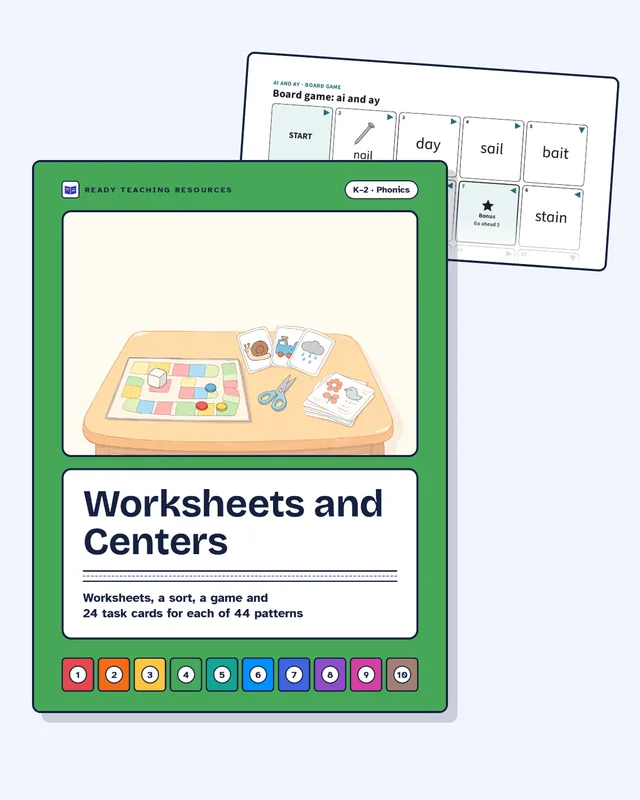
The K-2 Phonics Worksheets and Centers Mega Pack includes a word-sort center for each of 44 phonics patterns, plus a worksheet set, a board game, 24 task cards and an exit ticket. Answer keys are included for every page with an answer. It includes a teacher page, print list and contents for each unit. Plan on a printer, paper, scissors, one die and game counters. Its grade span is kindergarten through 2nd grade. The teacher cuts out the centers and task cards. It is an instant download after checkout, and nothing ships.
The sets on this page are enough to run tomorrow's sort. A chain that changes one sound at a time is the next move, in word chains.
What a sort will not do
A sort shows whether children can use a spelling they have been taught. It will not introduce a new sound. Pair it with a lesson that says the sound, shows the letters, and has children blend and spell before the cards come out. One contrast at a time is the honest limit of this practice: two headers, words they can already decode, and a column read aloud at the end.
What is a closed word sort?
The spelling headers are on the table before the cards are dealt. Each child reads a word and places it under the matching header, then the group reads down the column.
What is an open word sort?
The headers stay off. Children group words that share a spelling, name each group, and you add the header once the group is right. Use this after a closed sort, not on the first day.
When should a word sort come in the lesson?
After the sound and the spelling have been taught. The sort is practice and a check. It is a poor way to introduce a pattern children have not heard yet.
Sources
-
Worksheets and Centers
Worksheets, a word sort, a board game and 24 task cards for each of 44 patterns