Prefixes and Suffixes for K-2
Published 2026-10-27 · Updated 2026-10-27

A prefix is a meaningful part added to the front of a base word. A suffix is a meaningful part added to the end. A base word can stand alone. Help is a base word. Helpful adds -ful. Unhelpful adds un- as well. Those builds match the examples in the IES first-grade family guide.
For K-2, teach a short list first.
| Part | Where | Meaning | Example words |
|---|---|---|---|
| un- | front | not; opposite | unlock, uncover, undo |
| re- | front | again; back | rewrite, reread, reprint |
| -s, -es | end | more than one, or a verb | cats, boxes |
| -ed | end | past | jumped, played |
| -ing | end | the action going on | jumping, playing |
| -er | end | a person who | trainer |
| -ful | end | full of | helpful |
| -less | end | without | harmless, fearless |
A compiled list of common suffixes gives -ful as notable for, or full of, and gives -less the meaning used for endless and fruitless. Helpful is full of help. Harmless is without harm. Fearless is without fear.
The sounds of -ed, when to use -es, and the drop-e spelling are on the inflectional endings guide. Doubling the consonant in hopping is on the doubling rule guide.
What each part is
A prefix is a word part that carries meaning and is attached to a root or base word to change or add to that meaning. The practice guide says a prefix precedes a root or base word and modifies the meaning, as re- does in reprint.
A suffix is a morpheme attached to the end of a base, root, or stem. The practice guide says it changes the meaning or the grammatical function of the word. -ful in helpful changes the meaning. -s in cats changes the job of the word: one cat, or more than one.
A base word can stand alone and has meaning. The first-grade guide uses help. Uncle is a base word. The letters un at the front are not a prefix there, because cle is not a base that stands alone.
The knowledge of these parts is morphology. The practice guide defines morphology as the knowledge of meaningful word parts, typically prefixes, suffixes, and roots or base words. That is the name for this study.
The first prefixes
Start with two prefixes whose meaning is stable.
un- means not, or the opposite. A compiled list of common prefixes gives that meaning and the words uncover and unlock. The first-grade guide builds undo from un- plus do, and unhelpful from un- plus help plus -ful. Unlock, uncover, and undo are enough for the first week.
re- means again, or back. The same list gives rewrite, reread, and return. The practice guide's own example is reprint: print again. Rewrite, reread, and reprint are the first re- words. Ready is a base word. The re at the front is not the prefix re-.
After those two are easy, add the prefixes the practice guide names: dis-, mis-, and pre-. The compiled list gives dis- as not or away (disagree), mis- as wrongly (misplace), and pre- as before (preview). The first-grade guide also builds misuse and discolored. Teach one of these at a time, with a base the student can already read.
The first suffixes
The practice guide tells teachers to teach suffixes such as -s, -ed, -ing, and -est, and to have students add -ing to words such as park, call, and sing. Those are the first suffixes, because they attach to words students already read.
- cats is cat plus -s
- boxes is box plus -es
- jumped and played add -ed
- jumping and playing add -ing
Keep the lesson on the build. The sound sort for -ed belongs with inflectional endings.
Next, use the suffixes the first-grade guide actually builds:
- trainer is train plus -er, a person who trains
- helpful is help plus -ful, full of help
- harmless is harm plus -less, without harm
- fearless is fear plus -less, without fear
-er has two jobs, and -est is a third. Trainer uses person -er, a person who trains. Taller is tall plus -er, the comparative. Tallest is tall plus -est, the superlative. -est is not another comparative. The practice guide names -est as a suffix to teach. Teach person -er, comparative -er, and superlative -est in separate weeks so those three jobs stay apart.
How to teach a new word part
Use the four moves from the first-grade guide.
- Read the whole word.
- Break it into prefix, base, and suffix. Write the parts.
- Say what the word means. If the meaning is unclear, use it in a sentence and have the student use it in a sentence.
- Build a new word with the same part. If the part was un-, build unlock, then uncover, then undo.
One part per week is enough in K-2. Kindergarten can stay with -s on known words (cats, dogs) and the idea of a base word. First grade can add -ed, -ing, and un-. Second grade can add re-, -er, -ful, -less, then dis-, mis-, and pre-. That order follows the parts the K-3 practice guide and the first-grade family guide already put in front of students. It is a teaching sequence, not a claim that every class must hit each part in the same week.
One honest limit: a letter string is a prefix or suffix only when the base still means something. Un- in unlock works because lock stands alone. Un- in uncle does not split that way. If the student cannot find a base, read the word as a whole.
Practice after the build
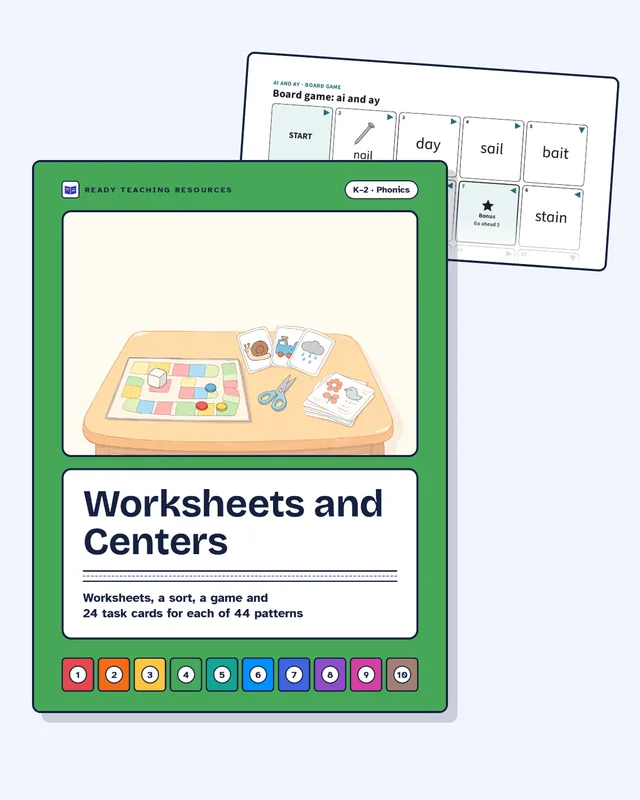
The K-2 Phonics Worksheets and Centers Mega Pack includes, for each of 44 phonics patterns, a word-sort center, a worksheet set, a board game, task cards and an exit ticket. Its children's reading text is drawn as vector outlines, so it cannot be searched or copied.
Sort cards by the word part you taught this week. Then have students write the base and the part on a line, the way the first-grade guide asks them to break the word apart.
What are prefixes and suffixes in English grammar?
A prefix is a meaningful part added to the front of a base word, such as un- in undo. A suffix is a meaningful part added to the end, such as -ful in helpful.
What are prefixes?
A prefix is a word part that carries meaning and is attached to the front of a base word. Un- means not or opposite, as in unlock. Re- means again or back, as in rewrite.
What is the study of prefixes and suffixes called?
The practice guide calls this knowledge morphology: the knowledge of meaningful word parts, typically prefixes, suffixes, and roots or base words.
What are base words?
A base word can stand alone and has meaning, such as help. Helpful adds the suffix -ful. Unhelpful adds the prefix un- as well.
Sources
-
Worksheets and Centers
Worksheets, a word sort, a board game and 24 task cards for each of 44 patterns