Multisyllabic Words: A Division Routine for Second Grade
Published 2026-10-27 · Updated 2026-10-27

A multisyllabic word has more than one vowel sound, and so more than one syllable. The practice guide defines it that way. Teach second graders syllable division with three cuts for two-syllable words.
| Cut | Where to split | First vowel | Words |
|---|---|---|---|
| VC/CV | between the two consonants | short | napkin (nap/kin), rabbit (rab/bit), picnic (pic/nic) |
| V/CV | before the consonant | long | tiger (ti/ger), solo (so/lo), tulip (tu/lip) |
| VC/V | after the consonant | short | camel (cam/el), visit (vis/it), cabin (cab/in) |
Try V/CV before VC/V. V/CV is the more common cut when one consonant sits between the vowels, as Empire State Educate notes. Use VC/V when that first vowel is short.
Three cuts for two-syllable words
Underline the vowel spellings first. Count the consonants between them. Then cut.
VC/CV. Two consonants between the vowels. Split between those consonants. Empire State Educate calls this the rabbit rule: rabbit is rab/bit, napkin is nap/kin, picnic is pic/nic. Both syllables are closed, so both vowels are short. Sunset follows the same cut: sun/set.
A VC/CV word can end in a different syllable type. Lasso is las/so. The second syllable is open. Reptile is rep/tile. The second syllable is magic e. On the first week, stay with napkin, rabbit, and picnic, where both syllables are closed.
V/CV. One consonant between the vowels. Split before that consonant. The first syllable is open, so the vowel is long. Empire State Educate calls this the tiger rule: tiger is ti/ger, solo is so/lo, tulip is tu/lip. Hotel follows the same cut: ho/tel. The open and closed syllables guide tells you the vowel once the cut is marked.
VC/V. Same one consonant, but the first vowel is short. Split after the consonant. The first syllable is closed. The same page calls this the camel rule: camel is cam/el, visit is vis/it. Cabin follows the same cut: cab/in. Robin is rob/in.
Worked word: tiger. Vowels i and e. One consonant, g, between them. Try V/CV: ti/ger. Ti is open, so the i is long. That matches the word. Ger is r-controlled, so the second vowel is not a plain short e.
Worked word: camel. Vowels a and e. One consonant, m, between them. V/CV would be ca/mel, with a long a. The word has a short a, so use VC/V: cam/el.
Worked word: napkin. Vowels a and i. Two consonants, p and k, between them. Split between them: nap/kin. Both vowels are short.
Keep digraphs together. In rocket, ck is one consonant spelling. The cut is rock/et, with ck in the first syllable, the camel pattern. Keep the ck together.
Words that end in consonant-le use a different cut: count back three letters. That routine is on the consonant-le guide. Apple is ap/ple. The cut is the consonant-le cut, rather than app/le.
A second-grade lesson
Students are ready for VC/CV when they can read closed syllables and can count syllables they hear, which is the checkpoint on the rabbit-rule page. Teach one pattern at a time. The tiger and camel page says to keep the two VCV cuts separate until both feel comfortable.
A short sequence:
- Say the word. Students clap or tap the beats. Napkin has two. Tiger has two.
- Show the print. Students underline each vowel spelling.
- Ask how many consonants sit between the vowels.
- Two consonants: cut between them. Read each syllable. Blend.
- One consonant: try the open cut first (V/CV). Read it. If the first vowel should be short, move the cut after the consonant (VC/V) and read again.
- Sort a small pile: napkin and rabbit in one column, tiger and solo in another, camel and cabin in a third.
- Then read a phrase that uses only those words: a rabbit in a cabin, a tulip on a napkin.
Stay with two-syllable words until the three cuts are easy. The other syllable types, if you need the names, are in the syllable types guide.
One honest limit: the cut predicts a stressed vowel more reliably than an unstressed one. Cam/el and vis/it often soften the second vowel. Have the student try the sound the cut predicts, then flex it if the word is known. The labels are a decoding tool, not a promise that every English vowel stays short or long.
Longer words, same cuts
Three-syllable words use the same cuts more than once. Easy ones for this stage:
- hamburger: ham/bur/ger
- basketball: bas/ket/ball
- umbrella: um/brel/la
- animal: an/i/mal
Four-syllable words work the same way:
- watermelon: wa/ter/mel/on
- caterpillar: cat/er/pil/lar
- helicopter: hel/i/cop/ter
- alligator: al/li/ga/tor
Mark every vowel, then cut one gap at a time. Students divide a four-syllable word before they are asked to read it as a whole.
Polysyllabic means the same thing as multisyllabic here: more than one syllable. A search for "poly syllable words" is this same job.
Printed sorts for the pattern you just taught
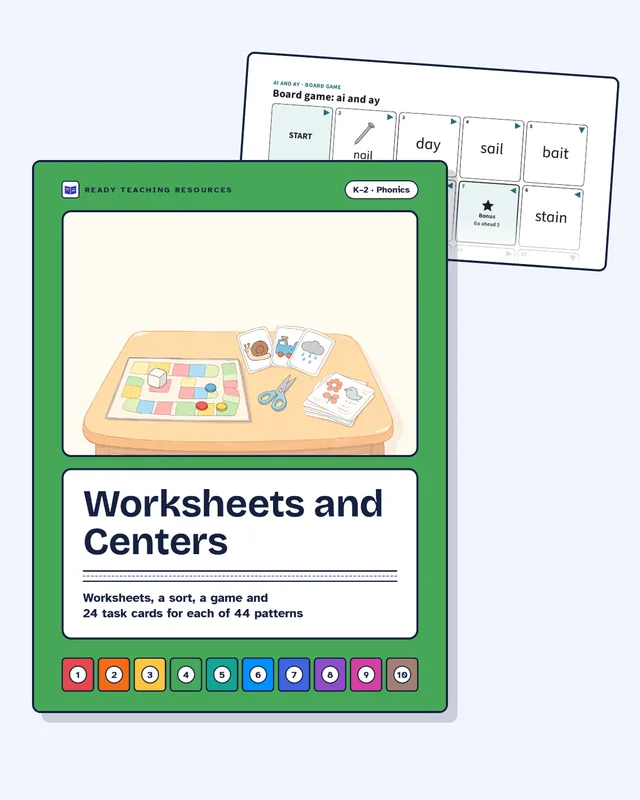
The K-2 Phonics Worksheets and Centers Mega Pack includes a word-sort center, a board game, task cards and an exit ticket, plus a worksheet set, for every pattern in the 10-unit phonics sequence. It is an instant digital download, and nothing ships.
Use the sort after the oral clap and the three cuts, not instead of them.
How to teach multisyllabic words?
Clap the syllables first. Then mark the vowels and use one cut: VC/CV between two consonants, V/CV before the single consonant, or VC/V after it when the first vowel is short. Teach one cut at a time, then blend.
What is syllable division?
Syllable division is the cut that turns a long word into smaller syllables. For two-syllable words the three cuts are VC/CV, V/CV, and VC/V.
What are some easy three-syllable words for kids?
Hamburger (ham/bur/ger), basketball (bas/ket/ball), umbrella (um/brel/la), and animal (an/i/mal). Each cut uses the same two-syllable rules more than once.
Can you give me some examples of four-syllable words?
Watermelon (wa/ter/mel/on), caterpillar (cat/er/pil/lar), helicopter (hel/i/cop/ter), and alligator (al/li/ga/tor).
What are poly syllable words?
Polysyllabic words are words with more than one syllable. That is the same job as multisyllabic: more than one vowel sound, so more than one syllable.
Sources
-
Worksheets and Centers
Worksheets, a word sort, a board game and 24 task cards for each of 44 patterns