Six Syllable Types With K-2 Example Words
Published 2026-10-27 · Updated 2026-10-27
Reading Universe teaches six syllable types: closed, open, magic e, vowel teams, r-controlled, and consonant-le. The Institute of Education Sciences practice guide lists the same six as syllable-construction patterns: closed, VCe, open, vowel team, vowel-r, and consonant-le. Label a word from the vowel and what comes after it. Teach one type at a time.
| Type | Vowel test | One-syllable words | Two-syllable words |
|---|---|---|---|
| Closed | one vowel letter, then a consonant that ends the syllable; short vowel | cat, ship, tent | napkin (nap/kin), rabbit (rab/bit) |
| Open | syllable ends in a single vowel letter; long vowel | me, go, hi | hotel (ho/tel), basic (ba/sic) |
| Magic e | vowel, consonant, silent e; long vowel | cake, bike, home | cupcake (cup/cake), invite (in/vite) |
| Vowel team | two to four vowel letters for one vowel sound, including diphthongs | rain, boat, coin | peanut (pea/nut), trainer (train/er) |
| R-controlled | a vowel followed by r; the r changes the vowel | car, bird, fork | market (mar/ket), farmer (farm/er) |
| Consonant-le | consonant plus le in an unaccented final syllable; the e is silent | rare as a whole word | apple (ap/ple), table (ta/ble), puzzle (puz/zle) |
The two-syllable splits above are the ones that match those vowel sounds. The routine for choosing VC/CV, V/CV, or VC/V is in the multisyllabic words guide.
What each type looks like
A syllable is a segment of a word that contains one vowel sound. The practice guide says that vowel sound may be one letter or more than one letter, and consonants may sit on either side of it. Boat is one syllable. It has one vowel sound, even though it has two vowel letters.
Closed. A closed syllable has one vowel letter and ends in a consonant. The vowel is short, as in cat, shed, and last. Ship and tent pass the same test. A digraph such as sh still closes the vowel. In napkin, nap and kin are both closed. In rabbit, rab and bit are both closed. The doubled consonant keeps the first vowel closed.
Open. Open syllables end with a single vowel letter, and that vowel says its long sound, as in me, she, and go. Hi passes the same test. She is open, not closed: it ends in a vowel letter, and the vowel is long. In hotel, ho is open and tel is closed. In basic, ba is open and sic is closed. Day is not open. It ends in the vowel team ay, not in a single vowel letter.
Magic e. Magic e, also called silent e, is a vowel, a consonant, and a final e. The e is silent and the middle vowel is long, as in mice, note, and race. Cake, bike, and home are the same pattern. In cupcake, cup is closed and cake is magic e. In invite, in is closed and vite is magic e. Have, come, give, and love do not fit. Their vowels are short, so they are not the mice, note, and race pattern.
Vowel team. A vowel team is spelled with two to four vowel letters and may spell a long or a short vowel. Diphthongs such as oi/oy and ow/ou are included in this type, as in cloud, window, and employment. Rain and boat are long-vowel teams. Coin is the oi diphthong, so it stays in this type rather than becoming a seventh type. Book is a vowel team with a short sound, which the glossary allows. In peanut, pea is a vowel team and nut is closed. In trainer, train is a vowel team and er is r-controlled. Keep the team together. Do not split rain into ra and in.
R-controlled. The practice guide describes vowel-r as a vowel pronunciation that changes before /r/, as in charter and circus, and lists ar, er, ir, or, and ur. Car, bird, and fork are one-syllable words that follow that description. In market, mar is r-controlled and ket is closed. In farmer, farm and er are both r-controlled.
Consonant-le. The practice guide describes consonant-le as an unaccented final syllable with a consonant before l and a silent e, as in dribble and puzzle. Apple splits as ap/ple. Table splits as ta/ble, and ta is open. Puzzle splits as puz/zle. The le does not stand alone. The consonant before it stays in the final syllable. How to count back three letters is on the consonant-le guide.
Why some charts list seven
The question "what are the seven types" has a short answer: the two lists above have six. Reading Universe names closed, magic e, vowel teams, r-controlled, and consonant-le, plus open, as the six it teaches. It puts diphthongs inside the vowel-team type. The practice guide lists vowel diphthongs (oi, ou) as a vowel pattern separate from vowel teams (ea, oo, oa, igh), and it still lists six syllable-construction patterns, not seven.
If a poster shows seven, look for a split of vowel teams and diphthongs. Teach the six. Put oi, oy, ow, and ou with vowel teams unless the sequence you already use has split them on purpose. Do not add a seventh label for schwa. Schwa is a vowel sound in an unstressed syllable, not a spelling type of its own.
How to label a syllable
Reading Universe teaches students to move left to right, stop at the vowel, and see what comes immediately after it. Use that test on every syllable.
- Say the word and count vowel sounds, not vowel letters. Cupcake has two. Boat has one.
- Find the vowel spelling. Ai, oa, and oi are one spelling each.
- Name what follows that spelling, then label the type from the table.
- Read the syllable, then blend.
Worked word: cupcake. Cup has one vowel letter closed by p, so the u is short. Cake has a, then k, then silent e, so the a is long. Blend cup and cake.
Worked word: table. Ta ends in a single vowel letter, so the a is long. Ble is consonant-le, not a separate "le" with the b left behind. Blend ta and ble.
The open-versus-closed contrast, including words such as nap and day, is the job of the open and closed syllables guide.
Teach one type at a time in kindergarten through grade 2
Do not ask students to memorize all six labels before they can read the words. The practice guide is for kindergarten through 3rd grade, and it says to present letter combinations one at a time, with time to focus on each pattern. Syllable types are one group of those patterns. Knowing them helps students figure out what the vowel will say, which is how Reading Universe frames the six types.
Start with closed syllables. Students who can read cat, shed, and tent already read this type. Sort a few closed words against a word that is not closed, and say why the vowel is short: a consonant ends the syllable.
Add open syllables next. Reading Universe says to begin open syllables once students can read closed syllables, and that this pattern should be their first decoding of long vowel sounds. Use me, go, she, and hi, then hotel and basic. Keep the contrast oral: go is open, got is closed.
Build magic e from a closed word: cap to cape, kit to kite, hop to hope. Then read cupcake and invite, and label each syllable before blending.
Vowel teams and r-controlled vowels can wait until short vowels, open syllables, and magic e are in place. Teach one team at a time, such as ai in rain, then oa in boat. For r-controlled, start with ar in car, then or, then er, ir, and ur, which share a sound.
Consonant-le comes after students can read the first syllable of apple, table, and little. It is a final syllable in a longer word, not a one-syllable pattern to introduce in the first weeks of phonics.
One honest limit: these labels predict a stressed vowel more reliably than an unstressed one. Reading Universe names schwa as the sound in an unstressed syllable, as in balloon. When the sound the type predicts does not match a word the student knows, have the student try that sound, then flex the vowel. Do not treat the six labels as a rule that every English syllable obeys.
Mistakes that scramble the vowel
- Counting vowel letters. Boat and rain are one syllable each.
- Calling day an open syllable. Day ends in the team ay. Open syllables end in one vowel letter, as me and go do.
- Treating every final-e word as magic e. Have, come, give, and love keep a short vowel. They are not mice, note, or race.
- Cutting le off its consonant. Table is ta/ble, not tab/le. Little is lit/tle, not litt/le.
- Teaching all six labels in one week. Label the type you are teaching now.
- Forcing a clear short or long vowel in an unstressed syllable. That is where schwa shows up, as in balloon.
Practice after the label is clear
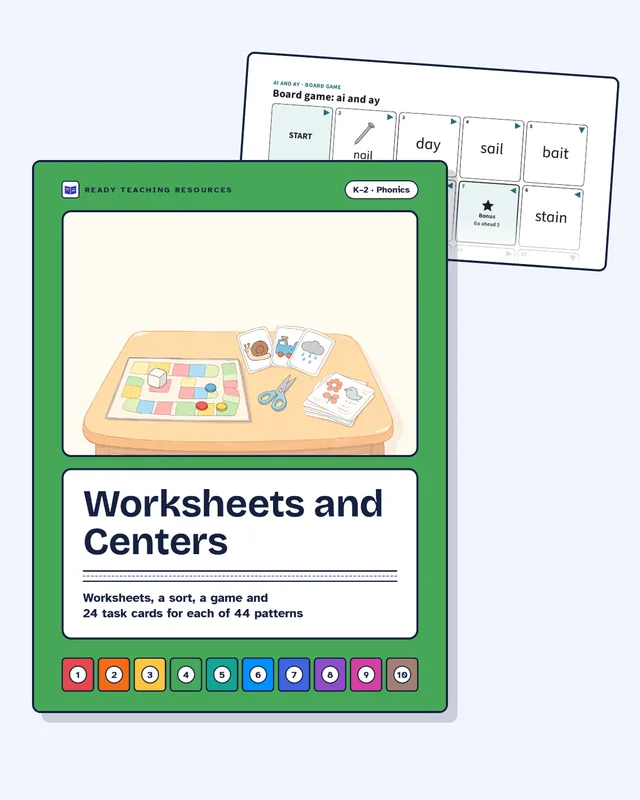
A poster is not enough once students can name a type. They need to sort and read words that use it. The K-2 Phonics Worksheets and Centers Mega Pack is practice, centers and quick checks for every pattern in the 10-unit phonics sequence. It includes, for each of 44 phonics patterns, a worksheet set, a word-sort center, a board game, 24 task cards and an exit ticket, plus answer keys for every page with an answer. It is an instant download after checkout: one ZIP with a Start Here guide and one ZIP per unit. Its print PDFs are US Letter only.
Use a sort for the type you taught this week. When a word does not match that type, send students back to the vowel test in the table, not to a guess from the picture.
How many syllable types are there?
Reading Universe teaches six syllable types: closed, open, magic e, vowel teams, r-controlled, and consonant-le. The Institute of Education Sciences practice guide lists those same six as syllable-construction patterns.
What are the six syllable spelling patterns?
Closed (cat, ship), open (me, go), magic e (cake, bike), vowel team (rain, boat), r-controlled (car, bird), and consonant-le (apple, table). Reading Universe names those six, and the table in this guide labels both syllables of a two-syllable word for each type.
What are the seven types of syllables?
The lists cited here have six, not seven. Reading Universe includes diphthongs such as oi/oy and ow/ou in the vowel-team type, as in cloud, rather than as a seventh type. The Institute of Education Sciences guide lists vowel diphthongs as their own vowel pattern and still keeps six syllable-construction patterns.
Sources
-
Worksheets and Centers
Worksheets, a word sort, a board game and 24 task cards for each of 44 patterns