Open and Closed Syllables: The Vowel Test
Published 2026-10-27 · Updated 2026-10-27
An open syllable ends in a single vowel letter, and that vowel is long. A closed syllable has one vowel letter and ends in a consonant, and that vowel is short. Me, she, and go are open. Cat, dog, and nap are closed. The test is what comes right after the vowel.
| Open | Closed | |
|---|---|---|
| Ends with | the vowel letter | a consonant |
| Vowel sound | long | short |
| One-syllable examples | me, go, she, hi, we | cat, dog, nap, ship, tent |
| In a longer word | ho in hotel, pro in program | nap in napkin, bit in rabbit |
These two are the first of the six types in the syllable types guide.
The difference in one test
Reading Universe says open syllables end with a single vowel and the vowel says its long sound, as in me, she, and go. A closed syllable has one vowel letter and ends in a consonant, and the vowel is short, as in cat, shed, and last. Students look left to right, stop at the vowel, and name what comes immediately after it.
- A consonant ends the syllable, and there is one vowel letter: closed, short vowel. Dog ends in g, so the o is short. Nap ends in p, so the a is short.
- The syllable ends on the vowel letter: open, long vowel. She ends in e, so the e is long. Go ends in o, so the o is long.
- The vowel spelling is two letters, such as ay in day: that is a vowel team, a different type. Reading Universe includes diphthongs and other multi-letter vowel spellings in the vowel-team type, as in cloud and window.
Dog is a closed syllable word. She is an open syllable word. Nap is closed. Day is a vowel team.
One limit of the test: an unstressed syllable often uses a soft vowel. Reading Universe names that sound schwa, as in balloon. Try the short or long sound the type predicts, then flex the vowel if the word is one the student knows.
Five open syllables, and a few more
These one-syllable words are open. Each ends in one vowel letter, and that vowel is long.
- me
- go
- she
- hi
- we
- so, no, be, he
She belongs on the open list. The syllable ends in e. The open-syllable overview groups she with me and go.
Day stays off this list. It ends in ay, a vowel team, and the a is long because of that team. Play and rain work the same way.
Do and to end in o, and a reader may expect long o. In ordinary speech the vowel is different. Keep them off the first open-syllable list. Teach go, so, and no first.
A starter list of closed syllables
A closed syllable is a word or word part with one vowel letter and a consonant at the end. The vowel is short. Any word that passes that test is closed, so a complete English list would run for pages. This is a K-2 starter list.
| Vowel | Closed words |
|---|---|
| short a | cat, nap, map, hat, bag, last |
| short e | bed, red, tent, shed, pen |
| short i | sit, pig, ship, fish, thin |
| short o | dog, hot, mop, stop, pot |
| short u | sun, cup, bug, run, up |
Ship and shed are closed even though sh is two letters. One vowel letter, a consonant at the end, short vowel. The same test covers tent and last, where a blend follows the vowel.
Two closed syllables in one word: napkin (nap/kin), rabbit (rab/bit), sunset (sun/set), picnic (pic/nic), basket (bas/ket). These are the short-vowel words students already meet as CVC words, plus a second syllable of the same type.
Two-syllable words split both ways
For a closed-plus-closed starter word, split between the two consonants that sit between the vowels.
- napkin: nap / kin
- rabbit: rab / bit
- sunset: sun / set
- picnic: pic / nic
- insect: in / sect
- basket: bas / ket
That cut is only for this starter set. It does not mean both syllables stay closed whenever two consonants sit between the vowels. Tempo is tem / po. Tem ends in m, so the e is short and the syllable is closed. Po ends in o, so the o is long and the syllable is open.
Keep an onset blend with the vowel it starts when that cut matches the word. Program has the blend gr. Split pro / gram, not prog / ram. Pro ends in o, so it is open. Gram ends in m, so it is closed. Do not pull a consonant back just to build a blend: basket is bas / ket, not ba / sket, because the a is short. A digraph stays in one syllable. Panther is pan / ther, not pant / her. The practice guide lists program as an open syllable plus a closed syllable (pro-gram). It lists insect with closed syllables (in-sect). Hotel follows the program pattern: ho is open, tel is closed. Napkin follows the insect pattern: both syllables end in a consonant. Student does not: stu ends in the vowel u, so it is open, and dent is closed.
When one consonant stands between the vowels, try the split that keeps the first vowel long. That split is before the consonant. The first syllable is open. The second is closed if it ends in a consonant.
- hotel: ho / tel
- basic: ba / sic
- robot: ro / bot
- music: mu / sic
- unit: u / nit
Words that contain both types, in either order:
- Open then closed: hotel, program, basic, robot, music, unit
- Closed then open: tempo (tem/po). Tem ends in m, so the e is short. Po ends in o, so the o is long.
- Open then open: hobo (ho/bo), photo (pho/to). Both syllables end in a vowel letter.
Worked word: hotel. One consonant, t, sits between o and e. Split before the t: ho / tel. Ho ends in o, so the o is long. Tel ends in l, so the e is short. The other split, hot / el, would make the o short and would not match the word.
Worked word: napkin. Two consonants, p and k, sit between the vowels. Split between them: nap / kin. Both vowels are short. Both syllables are closed.
The third common split, VC/V, as in cam/el, is in the multisyllabic words guide, with VC/CV and V/CV in one routine.
Teach closed first, then open
Closed syllables are the short-vowel words students already blend: cat, dog, ship, tent. Sort those before you add a label. Say the test out loud: a consonant ends the syllable, so the vowel is short.
Add open syllables once closed words are easy to read. Reading Universe says this pattern should be the first decoding of long vowel sounds. Use me, go, she, and hi. Then contrast a pair: go is open, got is closed. She is open, shed is closed.
A simple gesture helps the contrast. Hands close together for a closed syllable. Arms open for an open syllable. Students show the gesture as you say cat, then me, then dog, then go.
Move to two-syllable words only after the one-syllable sort is solid. Start with napkin and rabbit, both closed. Then hotel and program, open then closed. Label each syllable before you blend.
Skip do, to, and the word a on the first open list. Skip day, play, and rain as well. Those are vowel teams. The other four syllable types can wait until these two are secure.
Practice pages for the sort
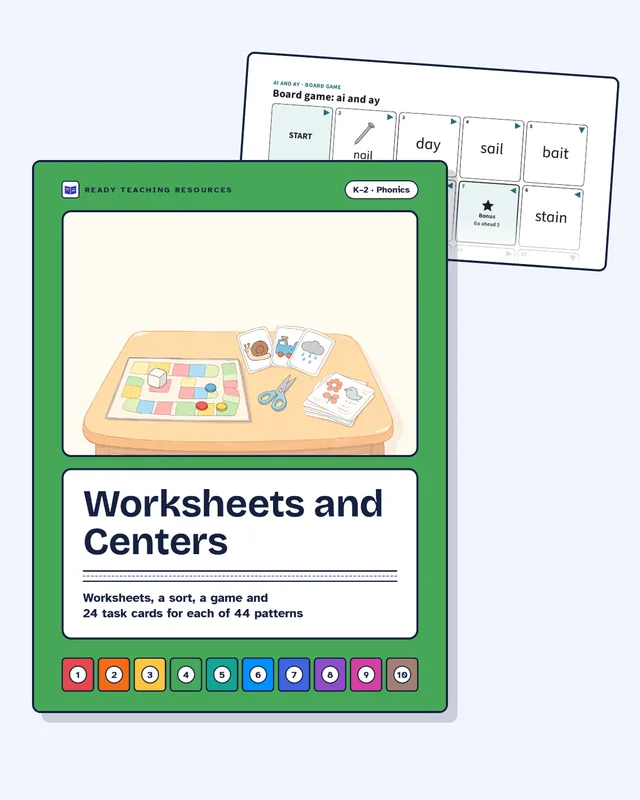
The K-2 Phonics Worksheets and Centers Mega Pack gives a worksheet set, a word-sort center, a board game, task cards and an exit ticket for every pattern in the 10-unit phonics sequence. It includes answer keys for every page with an answer. It has a teacher page, print list and contents for each unit. It has a single-classroom license: one teacher, one classroom.
Print the sort for closed and open words, cut the cards, and have students place each word by the vowel test above.
What is an open syllable?
An open syllable ends in a single vowel letter, and that vowel is long. Me, she, and go are open syllables.
Is dog a closed syllable word?
Dog is closed. One vowel letter, a consonant at the end, and a short vowel.
Is she a closed syllable word?
She is open. The syllable ends in the vowel letter e, and that vowel is long.
What words have both open and closed syllables?
Hotel (ho/tel), program (pro/gram), and basic (ba/sic) are open then closed. Tempo (tem/po) is closed then open.
What are five examples of open syllables?
Me, go, she, hi, and we. Each ends in one vowel letter, and that vowel is long.
Can you give me a list of closed syllables?
A starter list: cat, nap, map, bed, tent, ship, fish, dog, hot, sun, cup. Two-syllable closed words include napkin, rabbit, and sunset.
Is nap an open or closed syllable?
Nap is closed. It has one vowel letter, and p ends the syllable, so the a is short.
Is day an open syllable word?
Day is a vowel-team syllable. It ends in the team ay. An open syllable ends in one vowel letter, as me and go do.
Sources
-
Worksheets and Centers
Worksheets, a word sort, a board game and 24 task cards for each of 44 patterns