Phonics activities that practice a real skill
Published 2026-10-27 · Updated 2026-10-27

Sort phonics practice by the job: linking a sound to its letter, building a word, reading a word, or writing a word. A step that uses only the ear is a phonemic-awareness warm-up inside the lesson, not phonics. National Reading Panel findings say phonics instruction uses letter-sound relations to read or spell, and that sound work counts as phonics only when children use letters. If an activity does none of those jobs, it is busywork, even when the class likes it.
Use the warm-up, then one build, read, or write activity, after you have taught the spelling. This classroom guide says letter-sound relationships need practice opportunities every day, both for the new letter and for letters already taught. The lesson that comes before the game is in a phonics lesson plan.
Hearing
A step with no letters is a phonemic-awareness warm-up inside the lesson. Children listen, then show what they heard. Link the sound to its letter before you count the step as phonics practice.
First-sound tap. Say sun, sit, and map. Children tap the table when the word starts with /s/. Sun and sit get a tap. Map does not. Say the sound again if the taps scatter. Then show the letter s, so the warm-up ends on the spelling.
Picture sort. The practice guide has students sort picture cards by the beginning, middle, or ending sound of the word the picture shows. Post two sounds, such as /m/ and /s/. The child names the picture, says the target sound, and places the card. A picture they cannot name stays out. That picture sort is the warm-up. Match each pile to the letter you have taught before you call the step phonics.
Raise the card. Give each child one letter card for a sound you have taught. You say the sound. They raise the card if it matches, and keep it down if it does not. The letter is already in the child's hand, so this check is phonics, not a sound-only warm-up.
This games site offers listening games, songs, and sound-play typically taught in pre-K and kindergarten, then letter-sound games typically taught in kindergarten. A class can run the letter-sound game with cards you already have.
Building
Building activities turn the sound into letters. Children make the word, then change one sound.
Tiles for a known word. Say mat. Children pull m, a, and t and read the word. Then say, "Change the last sound to /p/." They build map and read it. A full line of those changes is a word chain.
Sound boxes. One box per sound. Children push a tile or write a letter as they say each sound. Digraphs that spell one sound share a box. The box routine is in Elkonin boxes.
Build, then show. You say the word. They build it face-down, then turn the tiles when you say "show." You see the spelling at the same moment, so a wrong letter is easy to catch.
Reading
Reading activities ask children to say a word from print, blending left to right.
A short column. Write four words that use only taught spellings. For a short-a day: mat, map, sat, sam. Children blend each word, then read the column faster. This classroom guide describes blending from left to right by linking each letter, or each letter group, to its sound.
Partner read. One child points to each letter. The partner says the sounds and blends the word. Then they switch. You listen for the vowel, which is the sound they most often skip.
One decodable line. After the column, read one sentence that uses those words. On a short-a day, that sentence can be "Sam sat." Add a heart word only after you have taught it. If a word in the line is not yet taught, take it out.
Writing
Writing activities spell from the sound. Children hear the word and put the letters down.
Two-word dictation. Say map. Children repeat it, stretch it, and write it. Say sat. They write it. Check the vowel before you move on.
Write from the chain. After the tile chain, children write the last two words from memory. If the spelling slips, they rebuild it with tiles, then write it again.
A short sentence. Dictate "Sam sat." They write both words. This is still phonics practice if every pattern in the sentence has been taught. A sentence full of new spellings is a copying task, not encoding.
Kindergarten games and later grades
Kindergarten phonics practice stays on sounds and short words. This activity roundup starts with letter sounds and with beginning, middle, and ending sounds, then CVC words and word families, then beginning blends and digraphs, then silent-e words. That order keeps the game on a pattern the child can already use.
| Grade | Hearing | Building | Reading | Writing |
|---|---|---|---|---|
| Kindergarten | First-sound tap, then match the sound to its letter | Three tiles for a CVC word | A column of CVC words | Write the word they just built |
| 1st grade | Hear /sh/ or /ch/, then show the taught spelling | Chain that adds a blend | Column of blend or silent-e words | Dictate two words with the new spelling |
| 2nd grade | Identify the vowel sound, then show its taught vowel-team spelling | Build the team as one spelling | Read a short line with that team | Write the team word, then one sentence |
Phonics games for kindergarten work when the move is the skill. Raising a letter card and building cat are phonics games. A picture sort with no letters is the warm-up. Coloring a letter with no sound attached is not phonics practice.
In a class, pick one job and run it for a few minutes. At a small table, you can run the warm-up and the three jobs on the same pattern: show the letter a for /a/, build mat, read the column, write mat. That loop is the practice. A new game every day, with a new pattern every day, does not give the review the new letter still needs.
What to drop
Drop an activity when you cannot name the job. If children are cutting, coloring, or clicking and you cannot point to the sound or the spelling, save it for art time.
Drop a word list that includes spellings you have not taught. Children will guess. Guessing looks busy and teaches the wrong habit.
Drop a game that rewards speed before accuracy. Read the word correctly first. Speed can come on a second read of the same column.
Printed practice for the same four jobs
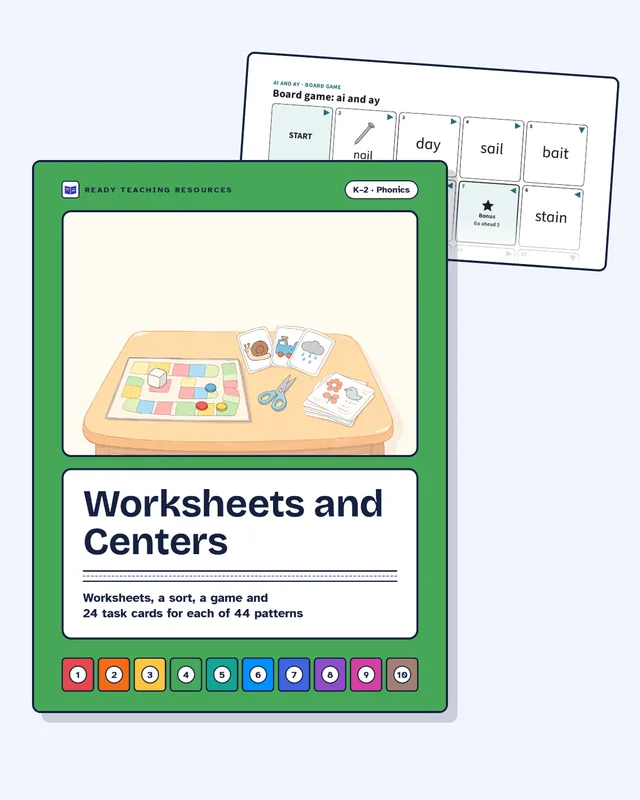
The K-2 Phonics Worksheets and Centers Mega Pack includes, for each of 44 phonics patterns, a worksheet set, a word-sort center, a board game, 24 task cards and an exit ticket. Every page that has an answer comes with an answer key. It lists a teacher page, print list and contents for each unit. It needs a printer, paper and scissors, plus one die and game counters. It is tagged for kindergarten, 1st grade, and 2nd grade. It has task cards and centers for the teacher to cut out. It is delivered as an instant download after checkout, and nothing ships.
The four jobs on this page need cards, tiles, and a board. The pack is the printed set for the pattern you are teaching that week.
The limit
An activity practices a spelling children have already been taught. It will not introduce the sound. Teach the sound, show the letters, and blend one word before the game starts. One pattern, one of the four jobs, and a check you can hear or see: that is as far as a phonics activity should go.
What are some fun activities for a phonics class?
A playful class activity links a sound to its letter, builds a word, reads a word, or writes a word. A listening game with no letters is a phonemic-awareness warm-up, not the practice. Try a letter-card raise, a tile chain the class reads aloud, a column of words, or a two-word dictation. A craft that never uses the spelling is not the practice.
What are phonics activities for kindergarten?
Start by matching a first sound to its letter. A picture sort with no letters is the warm-up, not the practice. Raising a letter card and building three-sound words with tiles are kindergarten phonics practice. Blends and silent e wait until those spellings have been taught.
What counts as phonics practice?
Practice uses a spelling children have already been taught. They say its sound, build the spelling, read the word, or write it, then you check the word. A game that skips the sound or the spelling is busywork, even if the class enjoys it.
Sources
- Institute of Education Sciences: Foundational Skills to Support Reading for Understanding in Kindergarten Through 3rd Grade
- National Center on Improving Literacy: How to Use Systematic Phonics Instruction in Your Classroom
- Fun Learning for Kids: 100+ Phonics Activities for Kids Learning to Read
- Phonics Bloom: Phonics Games for Classroom and Home
- Eunice Kennedy Shriver National Institute of Child Health and Human Development: Findings and Determinations of the National Reading Panel
-
Worksheets and Centers
Worksheets, a word sort, a board game and 24 task cards for each of 44 patterns