What goes in a phonics lesson plan
Published 2026-10-27 · Updated 2026-10-27
A phonics lesson plan names one spelling and the moves that teach it: review, model, read, spell, then a short decodable line and a check. It is not a list of activities. Little Lions Literacy uses a 25- to 35-minute frame for a kindergarten lesson and says the time for each part depends on the group.
Copy the outline. Fill the blanks. The filled short-i plan below is one way the blanks look on paper.
Copy this outline
Leave the time column empty until you know the group.
| Blank | What you write |
|---|---|
| Date and group | Whole class, or the small group, and the day |
| Pattern | One new spelling only |
| Already taught | Letters and patterns the words may use |
| Objective | What children will read and spell by the end |
| Materials | Cards or tiles, a board, a word list, a decodable line |
| Review | Two or three known sounds or words |
| Teach | You say the sound, show the spelling, blend one word |
| Read | Children blend new words that use only taught spellings |
| Spell | Sound, word, then a sentence from dictation |
| Text | One decodable line or a short page |
| Check | One fresh word, read or spelled, that you did not model |
Little Lions Literacy says children need to hear and say sounds, connect them to letters, blend to read, and segment to spell, then use the skill in words and sentences. The practice guide puts the same jobs in this order: blend sound-spelling patterns from left to right, teach common patterns, read decodable words in isolation and in text, and teach high-frequency words, including irregular ones, so children can recognize them efficiently. Reading Universe keeps a listening game and dictation inside the lesson, including sound, word, and sentence dictation.
Decide these four things before you fill a box
One pattern. A plan that introduces sh and silent e on the same day is two lessons. Little Lions Literacy says to choose one focus and to avoid several new correspondences in one short lesson.
Who it is for. Write "whole class" or the names of the small group. A child who cannot yet blend a three-sound word needs that plan, not the grade-level pattern. The daily routine for that choice is in teaching phonics.
What success is. "Reads three new words with this spelling and spells one from dictation" is a check. "Understands phonics" is not.
The text. The line may use the new spelling, earlier patterns, and a word you will teach as a whole word. If the page needs a spelling you have not taught, pick a different page.
Some free plans online are for older learners. Off2Class wrote its four sample plans for secondary English learners, including newcomers. A K-2 plan uses a shorter word list and a decodable line, not an older-student vowel survey. The order of patterns for kindergarten through 2nd grade is in phonics scope and sequence.
A filled short-i plan (illustrative words)
This script is a sample, not a scored lesson. Known already: s, a, t, p, m, n, and short a. New pattern: short i.
| Blank | Filled |
|---|---|
| Date and group | Tuesday, whole class, with a table group that still confuses i and a |
| Pattern | short i, spelled i |
| Objective | Children read sit, sip, and pin, and spell pit from dictation |
| Materials | Letter tiles, a board, the word list, the sentence below |
| Review | s, a, t, p. Read sat and map |
| Teach | "I spells /i/, as in igloo. Sit. /s/ /i/ /t/. Sit." Children watch, then repeat |
| Read | sip, tip, tin, pin. Change one sound from the word before |
| Spell | /i/, then pit, then "Tim sat." |
| Text | "Tim sat." Both words use only letters from this plan |
| Check | Children read nip, which was not in the model |
If a child reads sat for sit, point to the vowel and say the sound again. Do not add a second new spelling to rescue the miss. What "explicit" means in that model is in explicit, systematic phonics instruction.
Slides are not the plan
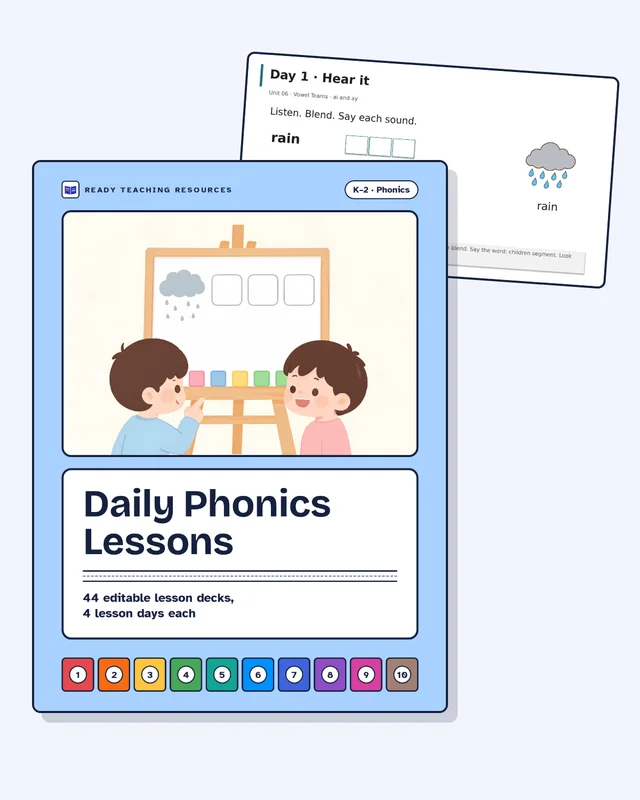
The K-2 Daily Phonics Lessons are PowerPoint decks made for Google Slides, one per phonics pattern, with 4 lesson days each. They include a Start Here guide carrying the routine, pacing and scope and sequence. The grade span is kindergarten through 2nd grade. They need PowerPoint, Keynote or a Google account to open. Delivery is an instant digital download; nothing is shipped. The set holds lessons only, without assessments or a tracker. The outline above is still the page you write. The decks do not replace the group, the objective, or the check.
What should I write in a phonics lesson plan?
One spelling, who the lesson is for, what is already taught, materials, a review, a model, word reading, dictation, a decodable line, and a check on a new word.
How long should a phonics lesson be?
One kindergarten write-up uses a 25- to 35-minute frame and says each part's time depends on the group. Leave the minutes blank until you know the children.
Can I use a phonics lesson plan with a small group?
Yes. Write the group on the plan, start at the spelling they can almost do, and keep the same parts. Each child blends and spells in turn.
Sources
-
Daily Phonics Lessons
44 editable lesson decks, 4 lesson days each