Phonics vs Whole Language
Published 2026-10-27 · Updated 2026-10-27

Phonics and whole language answer a different question at an unknown word. Phonics says sound the letters. Whole language says use the story, the sentence, and the word as a whole. A K-2 classroom can keep stories. It should not drop the code.
Two approaches, side by side
Little Lions Literacy calls phonics a bottom-up approach: children connect letters to sounds, blend those sounds into words, then meet sentences and stories. It calls whole language the opposite, a top-down approach that starts from stories and discovery rather than from the smallest parts.
The National Reading Panel findings draw the teaching line this way. Systematic phonics sets out a sequence of elements and teaches them. Incidental phonics does not follow a planned sequence. The teacher highlights a pattern when it happens to appear in a text. Whole language lessons often land on that incidental side: the book leads, and phonics shows up if it shows up.
| Phonics lesson | Whole language lesson | |
|---|---|---|
| Starts with | A sound and the letters that spell it | A story, a sentence, or a whole word |
| Unknown word | Sound it, left to right | Use meaning, the sentence, or the word's shape |
| Order | A set sequence, simple to longer | Whatever the book needs that day |
| Text the child reads | Pages built from taught patterns | Books chosen for the story, even if the child cannot yet decode them |
| What still belongs | Read-alouds, talk, writing | A planned code lesson, if you keep the good part |
A Hechinger Report essay argues for phonics along with other supports, not for a pile of worksheets and not for picture books alone. That is the useful middle. Code in the child's hands. Stories in the teacher's voice. The prompt swap when a child guesses is in three cueing.
A phonics lesson minute
A minute of phonics, done as systematic instruction, looks like this:
- Show sh. Say /sh/. Children say /sh/.
- Build ship. Sound /sh/ /i/ /p/. Blend ship.
- Write ship from the sounds.
- Read one sentence that uses ship and words already taught.
The child leaves knowing a pattern they can use on a word they have never seen. That is the point of the sequence. How the full order runs is in what is phonics.
A whole-language minute
A minute in the other approach looks like this. The teacher opens a picture book. The child is asked to read a sentence. At an unknown word, the prompt is "what would make sense?" or "look at the picture." There is no planned sound for the day.
An ERIC record of a 2013 first-grade study describes that contrast in a classroom: one group read words only in the context of a story, and phonics was not part of that group's instruction. The children still heard stories. They did not get a planned sound lesson. The other group received explicit phonics. That story-only condition is a clear example of a whole language approach. It is not a cartoon. It is a real instructional choice: words appear inside books, and the code is not taught on purpose.
Some of that choice is worth keeping. Reading aloud, talking about characters, and writing about a book build language. None of that requires you to skip the sound lesson. The Hechinger piece is right that the debate stays muddy when "phonics" means worksheets only and "whole language" means any book. Name the minute. Then you can see which one you taught.
Whole word and sight reading
Whole word reading treats the word as the unit. Children are shown the word, often on a card, and asked to remember it. Sight reading, in this argument, is that habit: recognize the shape, say the word, move on.
Phonics can still end in a word the child knows at a glance. The path is different. The child has sounded the word, spelled it, and met it again. Familiarity comes after the map, not instead of it. The panel's incidental approach, highlighting a pattern only when a book presents it, is closer to whole word teaching than to a sequence. If the only words a child can read are the ones you have held up on cards, the code was never taught.
If you are unsure which column a lesson sits in, record two minutes. Listen for a sound that was named on purpose. Listen for a prompt at an unknown word. A named sound plus "sound it" is the phonics minute. A story plus "what would make sense?" with no sound named is the whole-language minute. Both can happen in one day. They should not be the same minute.
What each keeps
Keep from whole language: real books read aloud, talk about meaning, writing that uses the words you care about. Keep from phonics: a sequence, a model, a blend, and text the child can sound.
Drop from whole language: guessing a word from the picture before the letters are tried. Drop from a thin phonics program: a stack of pattern worksheets with no sentence and no story in the day.
The honest limit: this page will not settle a fifty-year argument by declaring a winner. It will show you the minute. If your minute has no sound, you are in the whole-language column, whatever the poster says. If your minute has sounds and no books anywhere in the day, you have kept the code and lost the reason to read.
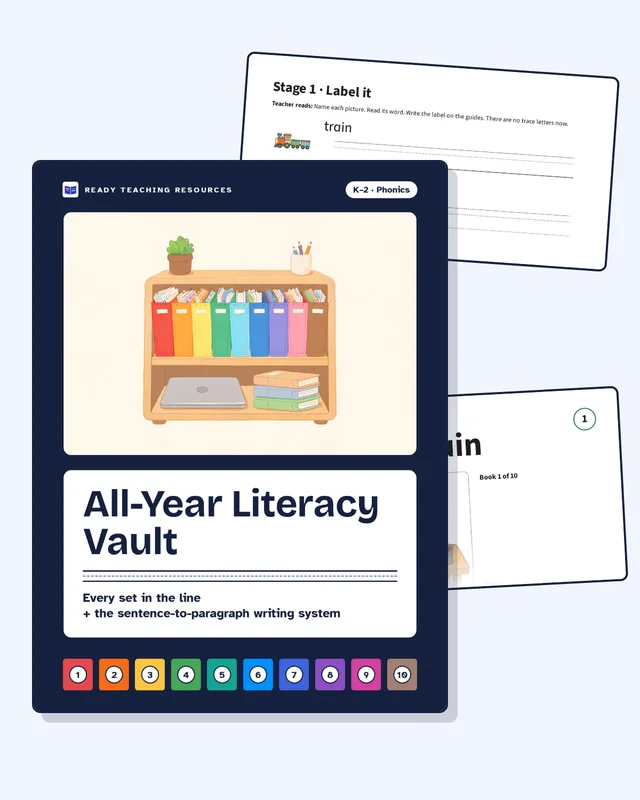
The All-Year K-2 Literacy Vault holds decodable books, fluency passages, lesson decks, and a writing system in one download, organized by unit, for kindergarten, 1st grade, and 2nd grade. It is an instant download after checkout. Later school-year units still belong to this purchase and are delivered after the first files.
What is sight reading versus phonics?
Sight reading, in this debate, means recognizing a word as a whole, often from memory of its shape. Phonics means sounding the letters and blending. A word can become familiar after it has been sounded. That is not the same as skipping the sounds.
What are the key differences between whole word reading and phonics?
Whole word reading starts with the word as a unit. Phonics starts with sounds and letters and builds the word. Systematic phonics follows a planned sequence. Incidental teaching mentions a pattern only when a book happens to show it.
What is a whole language approach example?
One published example is a first-grade group that read words only inside stories and received no phonics instruction. That is the whole-language condition in a 2013 study summarized on ERIC. The other group received explicit phonics.
Sources
- ERIC: Whole Language Instruction vs. Phonics Instruction
- The Hechinger Report: We need phonics, along with other supports, for reading
- Little Lions Literacy: Phonics vs Whole Language
- Eunice Kennedy Shriver National Institute of Child Health and Human Development: Findings and Determinations of the National Reading Panel
-
All-Year Literacy Vault
Every set in the line, plus the sentence-to-paragraph writing system