What Is Three Cueing?
Published 2026-10-27 · Updated 2026-10-27

Three cueing is a way of prompting a child at an unknown word. The child is told to use meaning, sentence structure, or the look of the word, often the picture or the first letter, instead of sounding through the spelling. The replacement is simple: sound the word, then use meaning as a check.
Three old prompts
Reading Universe describes the three-cueing system as a word-reading model that treats accurate decoding as optional at the first step. In that model, meaning and sentence structure play a larger role than decoding. Beginning readers are told to use cues: whether the word makes sense, whether it sounds right, and whether the spelling looks right.
Edwards names the same three as MSV: meaning cues, structural or syntax cues, and visual cues. The prompts a teacher is trained to say are familiar:
- "Does that make sense?"
- "Look at the picture."
- "What word would fit there?"
Edwards' example is the sentence "The horse ran across the field." A child says "house." A cueing prompt asks whether that makes sense or points at the picture. The letters still say horse.
Why those prompts fail
The habit can look fine in a patterned book. The picture shows a horse. The sentence repeats. The child can guess. Edwards notes that the trouble shows up when the pictures thin out and the sentences get harder. Guessing from context does not build the letter-sound pathways skilled reading uses. Students skip parts of words or swap in a word that fits the sentence and not the spelling.
The practice guide on foundational skills tells teachers to discourage guessing strategies for unfamiliar words, including guessing from the first letters or the picture. After a word is sounded, a reread can check that it makes sense. Meaning is the check. It is not the way to choose the word.
Reading Universe puts the same limit in one line: relying on cues cannot stand in for weak decoding. A child who cannot yet blend needs the letters, not a better guess.
Say this instead
Keep the child's attention on the spelling. Then use the sentence.
| Old cue | What it trains | Say this instead |
|---|---|---|
| Does that make sense? | A word that fits the sentence, even if the letters disagree | Sound it. Then reread and see if the word you sounded makes sense |
| Look at the picture | A word from the illustration | Look at every letter. The picture can wait until the word is read |
| What word would fit? | A guess from syntax and the first letter | Say the sounds in order, then ask if that word fits |
| Get your mouth ready | Only the first sound, then a guess | Say each sound, including the last one, and blend |
"Does that make sense?" is still a useful question after the blend. It is a useless first question. If the child said house for horse, the sentence might still "make sense" if the picture is a barn. The spelling does not. Send the child back to the letters.
A page for this practice should be one the child can sound. Patterned books that can be recited from the picture train the old cues. How a decodable page is built is in what are decodable books. The wider contrast with whole language is in phonics versus whole language.
Watch your own mouth for a week. The old prompts are habits. You will hear yourself say "look at the picture" when the room is noisy and you want the child to move on. Replace it in the moment: "sound the first letter." You do not need a new poster to start. You need the next unknown word. After a few days the new line is the habit, and the picture goes back to being a picture.
At the reading table
A short routine when a child stops:
- Point to the first letter. Ask for the sound, not a word.
- Move through the word. Ask for each sound, including the last letter.
- Blend. If the blend is not a word the child knows, blend again before you offer the word.
- Reread the sentence. Now ask whether it makes sense.
- If the word is one you have not taught, tell it, mark it, and teach the pattern later. Do not turn the stop into a guessing game.
Kindergarten needs this every time the child is about to look up at you or at the picture. First and second grade need it when the word is long and the child grabs the first syllable and invents the rest. The prompt does not change. The words do.
Pictures and sentence meaning still have a job. Use the picture to talk about the story after the page is read. Use "does that make sense?" after the blend, when a child has said a word the letters support and you want to know if they followed the sentence. The ban is on using those cues to invent the word. It is not a ban on thinking.
The honest limit: dropping the three cues does not, by itself, teach the code. Children still need a sequence of sound-spellings and text that uses those spellings. A new prompt on a book they cannot decode only swaps one stuck moment for another.
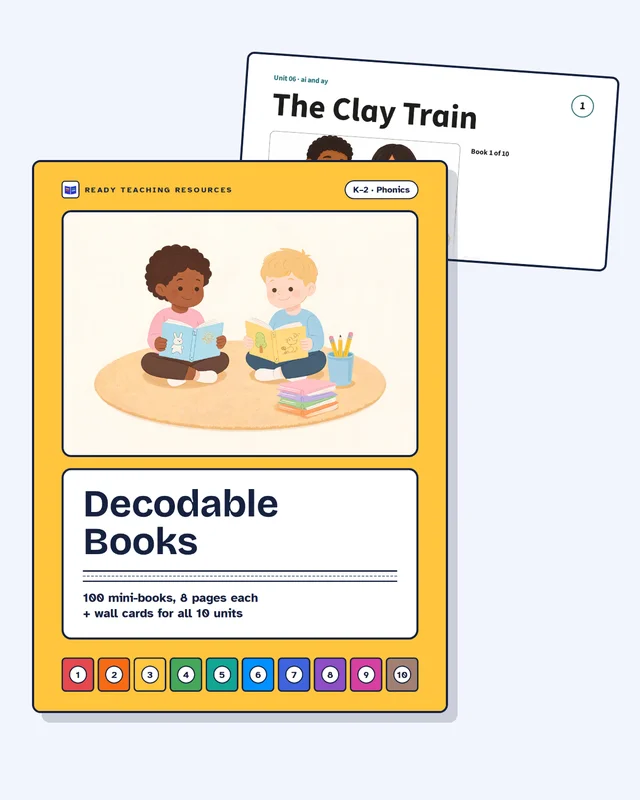
The K-2 Decodable Books give a printed book for every phonics pattern, in teaching order, ready to print, for kindergarten, 1st grade, and 2nd grade. Each book has a word list and comprehension questions. They are an instant download. Print PDFs are US Letter only, and books print single-sided, two half pages per sheet, to cut and staple.
What is cueing in reading?
A prompt that sends the child to meaning, sentence structure, or the look of a word instead of through the letters. The three-cueing model treats those prompts as the way to identify an unknown word.
How many states have banned three-cueing?
These pages do not give a count of state bans. What they do specify is the classroom move: stop using meaning, syntax, or a picture as the first way to name a word.
Which statement about the three-cueing model is true?
It treats accurate decoding as optional at the first step and gives meaning and sentence structure a larger role. That is the description in the Reading Universe glossary. It is not a model that starts with every letter.
Sources
-
Decodable Books
100 mini-books, 8 pages each, plus wall cards for all 10 units