What Is Phonics?
Published 2026-10-27 · Updated 2026-10-27
Phonics is a method of teaching people to read by learning the sounds that letters represent. In kindergarten through 2nd grade that means a set order of sound-spellings, blended and spelled, then read in short text. It is not the study of speech sounds, and it is not a list of six slogans.
Phonics in one sentence
The Cambridge dictionary defines phonics as "a method of teaching people to read, based on learning the sounds that letters represent." Sadlier adds the classroom job: instruction that helps readers acquire letter-sound correspondences and apply them to decode (read) and encode (spell).
In English, the match is not one letter to one sound. Sadlier notes that the English language has 26 letters, but 44 phonemes. A phoneme is the smallest unit of sound in spoken language. Some sounds need two letters, such as sh. Some letters stand for more than one sound, such as a in cat and a in cake. Phonics is the teaching of those links, in an order children can use.
Systematic phonics, in the National Reading Panel findings, means a sequential set of elements is set out and taught. Incidental phonics waits until a word in a book happens to need a pattern. For beginners, use the planned sequence. How that sequence differs from guessing a word is part of what decoding is.
Not the same as phonetics
Phonetics and phonics share a root and confuse people for that reason. Cambridge defines phonetics as "the study of the sounds made by the human voice in speech." That is a field of linguistics. A phonetics chart describes how a sound is made in the mouth. It does not tell a six-year-old how to read shop.
Phonics uses a small part of that knowledge, the part that maps print to sound, and turns it into lessons. A teacher does not need a phonetics course to teach short a. The teacher does need to say the sound cleanly, show the letter, and have children blend and spell.
A K-2 pattern order
The practice guide on foundational skills tells teachers to blend letter sounds from left to right, starting with simple consonant-vowel-consonant words once a few consonants and a vowel are known, then to teach common sound-spelling patterns. It lists consonant digraphs, blends, silent-letter spellings, vowel teams, r-controlled vowels, and syllable patterns. A single national scope is not in that list. This order follows those pattern types, from simpler to longer. Adjust the pace to the children. Do not skip the blend-and-spell step to "cover" the list.
- A handful of consonants and the short vowels, blended as words such as top, cat, and map.
- Digraphs that stand for one sound, such as sh, ch, and th.
- Blends, such as st and bl, only after the single consonants are secure.
- Silent e, as in make and like, once short vowels are steady.
- Vowel teams, such as rain and boat.
- R-controlled spellings, such as car and bird.
- Two-syllable words and a few common endings, such as -ing, when the base word is already readable.
One pattern at a time. Read it, spell it, then meet it in a sentence that uses only patterns already taught. A full scope, week by week, is in phonics scope and sequence. What "explicit" and "systematic" ask of a lesson is in explicit systematic phonics instruction.
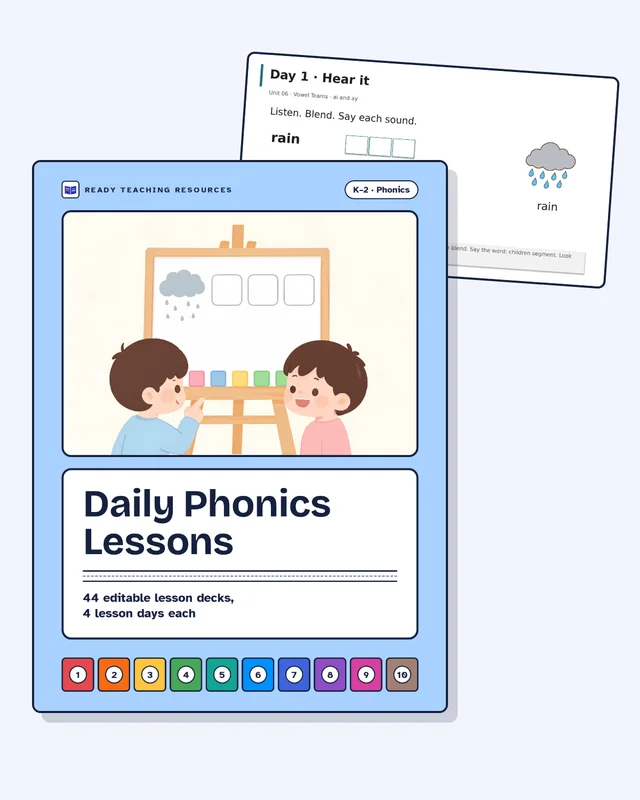
Teachers who want that routine already built, one pattern at a time, can use the K-2 Daily Phonics Lessons. Every pattern gets the same daily routine in those lessons: Hear it, Build it, Read it, Write it. Checkout delivers one ZIP with a Start Here guide, the routine, pacing, and scope and sequence, plus PowerPoint decks made for Google Slides, for kindergarten, 1st grade, and 2nd grade. It is lessons only: no assessments or tracker.
Four labels, one routine
People ask for four types of phonics. The sources do not agree on a set of four.
The National Reading Panel findings name these approaches:
- Synthetic phonics: convert letters into sounds, then blend the sounds into a word.
- Analytic phonics: start from a known word and break it into smaller sound units.
- Analogy phonics: read an unfamiliar word by using a known word part, such as reading brick because kick is known.
- Phonics through spelling: segment a word into sounds and choose letters for those sounds.
- Embedded phonics: teach patterns while children read connected text. The findings page describes this approach as less explicit and as using decodable text less often, though its phonics concepts can still be presented systematically.
Sadlier uses a similar set and adds linguistic phonics as a subset of analytic phonics. It describes embedded phonics as closer to whole language, and as neither systematic nor explicit.
For K-2, use synthetic phonics as the daily routine, and use spelling beside it. Analogy can help later, once children have a bank of known word parts. If embedded lessons wait for whatever pattern a book happens to contain, the teaching becomes incidental rather than following a planned sequence.
When teaching begins
Reading Programs sketches the usual US run. Kindergarten is letters, hearing sounds in words, and matching the two, until children can sound out words like cat or bed. First grade moves from easy words like bat to long-vowel words like shake and vowel combinations like train. Second grade strengthens that work and adds longer words, syllables, prefixes, and suffixes. The page says the main phonics teaching wraps up by the end of second grade, as fluency becomes the milestone.
The National Reading Panel findings are wider than that classroom sketch. They report that systematic phonics instruction was studied for students in kindergarten through 6th grade, and they describe results for kindergartners and for first graders in particular. If the planned sequence was thin in kindergarten and 1st grade, later grades still need the missing patterns. They do not need a restart of the alphabet for children who already blend.
A guide for educator-preparation programs says many schools adopted methods that prioritize whole language and balanced literacy. In those rooms, phonics was often incidental rather than a planned sequence. These pages name grades, not a birthday. Kindergarten is the usual start in a US school. A child who is younger and cannot yet hear the sounds in a spoken word needs more sound play before print. A child who is older and cannot yet blend short words needs the same first patterns, not a harder list.
At home, for free
A parent can teach the same idea without a program. A parent who is not a classroom teacher can still support the work. Try this with a word the child already says:
- Say the sounds in top, one after another, with no letters yet.
- Show t, o, and p. Say each sound as you point.
- Push the sounds together until the child hears top.
- Have the child write top from the sounds.
- Read one short sentence that uses only letters the child has been shown.
That is free. It is also slow on purpose. One new sound, a few words, then stop. If the school already teaches a sequence, follow that sequence at home so the child is not learning two orders at once.
The honest limit: a home routine like this supports the code. It does not replace a full school day of talk, read-alouds, and writing. And it will not, by itself, tell you which pattern to teach next if the child is already past simple words. Ask the teacher for the current pattern, then practice that one.
What is the difference between phonics and phonetics?
Phonics is a way of teaching reading from letter-sound links. Phonetics is the study of speech sounds themselves. One is a classroom method. The other is a field of linguistics.
What are the four types of phonics?
There is not one official list of four. The National Reading Panel findings name synthetic, analytic, analogy, embedded, and phonics through spelling. For K-2, teach synthetic phonics: say the sound, show the letters, and blend.
What are the six basic rules of phonics?
Neither the National Reading Panel findings nor the practice guide publishes one set of six rules. What they do specify is a planned sequence of sound-spellings, from simple words to longer ones. Use that sequence instead of a slogan list.
Why did some classrooms stop teaching phonics as a planned sequence?
They did not all stop. A guide for educator-preparation programs says many schools adopted methods that prioritize whole language and balanced literacy. Letter-sound work in those rooms was often incidental, not a set order.
What grade is phonics, and at what age should it start?
These sources name grades, not a birthday. The main teaching run described for beginners is kindergarten through the end of second grade. Kindergarten is the usual US start.
How can I teach my child phonics for free?
Use a known word such as top. Say the sounds, show the letters, blend, and have the child write the word. A pencil and paper are enough. No program is required for that routine.
Sources
- Cambridge University Press: phonics
- Cambridge University Press: phonetics
- Sadlier School: What Is Phonics
- Eunice Kennedy Shriver National Institute of Child Health and Human Development: Findings and Determinations of the National Reading Panel
- Institute of Education Sciences: Foundational Skills to Support Reading for Understanding in Kindergarten Through 3rd Grade
- Council for the Accreditation of Educator Preparation: The Science of Reading: The Basics
- Reading Programs: Phonics: The Most Important Skill Beginning Readers Learn
-
Daily Phonics Lessons
44 editable lesson decks, 4 lesson days each