Scarborough's Reading Rope
Published 2026-10-27 · Updated 2026-10-27
Scarborough's Reading Rope is a metaphor for skilled reading. Hollis Scarborough pictured skilled reading as strands of a rope that twist together. The lower strands are word recognition. The upper strands are language comprehension. Phonics sits on one lower strand, decoding. It is not the whole rope.
Rope, not a checklist
The International Dyslexia Association describes the origin: Scarborough talked to parents about learning to read and used pipe cleaners to show strands that depend on one another. The rope has lower and upper strands. Word recognition and language comprehension weave together to produce a skilled reader. That weaving takes instruction and practice over time.
A Teaching Strategies overview calls the rope a visual representation of the cognitive skills required for fluent reading. A rope is a bad checklist. You do not pull one strand until it is finished and then start the next. In a K-2 day, a child can blend a word and also hear a story. The picture is there so a teacher sees which strand a lesson is pulling, and which strand it is leaving slack.
Lower strands
The International Dyslexia Association names three word-recognition strands: phonological awareness, decoding, and sight recognition of familiar words. They work together as reading becomes accurate, fluent, and more automatic with practice. Structural Learning uses the same three: understanding and manipulating sounds, sounding out words with phonics knowledge, and recognizing familiar words at once.
Phonological awareness. Hear and move the sounds in spoken words. In kindergarten this is oral first: blend /m/ /a/ /p/ into map, or segment map into three sounds. Add letters as soon as a sound has a grapheme. Rhyming can be a game. Segmenting is the strand that feeds decoding.
Decoding. Use the letter-sound links to pronounce a written word. This is where phonics lives. Teach one pattern, blend it, spell it. A child who can hear the sounds and still cannot read map needs this strand, not more rhyming. The steps for one word are in what is decoding.
Sight recognition. Know some words at once, without sounding every letter every time. Build that by decoding the word correctly, several times, not by flashing a card the child has never sounded. A few high-frequency words that the current pattern cannot spell, such as said, are taught as wholes and then reread in a sentence. Automaticity is the result of practice. It is not a separate method that skips the code.
Upper strands
The same IDA account names five language-comprehension strands: background knowledge, vocabulary, language structures, verbal reasoning, and literacy knowledge. They reinforce one another, then weave with word recognition.
Background knowledge. What the child already knows about the topic. A read-aloud about a farm lands better if the class has talked about barns and animals first. K-2 builds this by listening and talking, not by decoding a hard chapter.
Vocabulary. Word meanings. Teach a few words from the read-aloud and use them again the next day. A child can decode a word and still not know it. That gap is this strand, not a phonics failure.
Language structures. How sentences are built: who did what, word order, a phrase that changes the meaning. Have children build a short sentence with the pattern words they just read, then hear a longer sentence in the read-aloud.
Verbal reasoning. Putting ideas together: why a character acted, what is not said. Ask one why question after the read-aloud. Kindergarten can answer in talk. The question is the strand.
Literacy knowledge. How books and print work: a title, a page, a sentence, a list, a letter. Point to those parts while you read aloud. Children who can blend and still get lost in a book often need this, not another sound.
Phonics on the rope
Phonics is the teaching that feeds the decoding strand. It also leans on phonological awareness, because children map sounds they can hear. It does not feed background knowledge, vocabulary, or verbal reasoning by itself. A classroom that calls a phonics packet "the rope" has picked up one strand and dropped the rest.
A K-2 day can touch both halves without a long new block:
- Ten minutes on the lower strands: hear sounds, blend and spell the pattern, reread two or three words that should be getting easier.
- A read-aloud that carries the upper strands: a known topic, two taught words, one why question, a glance at the title and the pages.
The lower work should use text the child can decode. The upper work can use books the teacher reads. Mixing those jobs is how the rope gets twisted. Leaving one half out is how it stays a pile of threads. How the science of reading uses this picture is in what is the science of reading. The formula that multiplies word recognition by language comprehension is the simple view of reading.
One activity per strand
| Strand | A K-2 activity |
|---|---|
| Phonological awareness | Blend or segment a spoken word, then match the sounds to letters |
| Decoding | Sound a pattern word and write it |
| Sight recognition | Reread a word the child has already decoded, inside a sentence |
| Background knowledge | Talk about the topic before the read-aloud |
| Vocabulary | Teach a word from the read-aloud and use it again tomorrow |
| Language structures | Build one sentence with the pattern words |
| Verbal reasoning | Ask why after the story |
| Literacy knowledge | Name the title, a page, and a sentence while you read aloud |
The honest limit: the rope is a model, not a lesson plan with minutes attached. It will not tell you which phonics pattern comes next. It tells you which kind of work a confused child is missing. If the child cannot blend, pull the lower strands. If the child blends and still cannot say what happened, pull the upper strands.
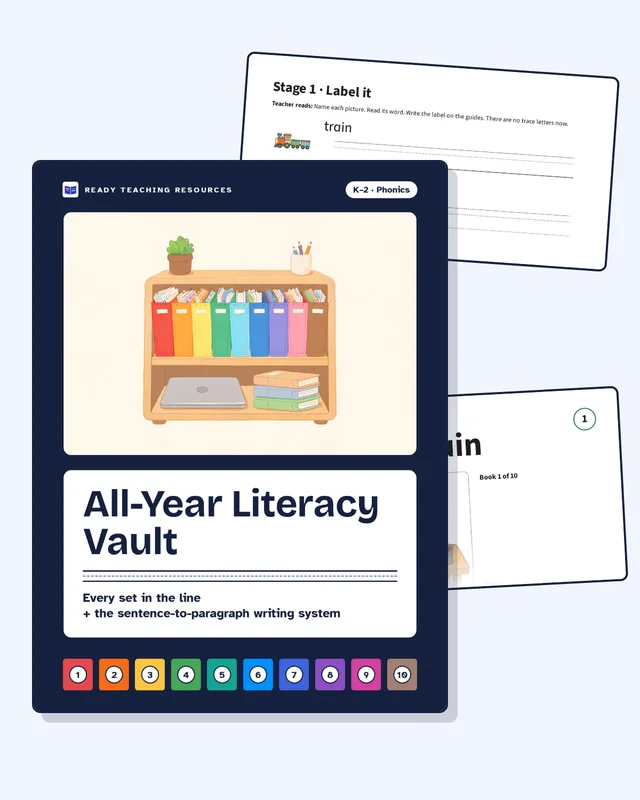
Printed phonics sets serve the lower, word-recognition strands; the upper, language-comprehension strands still need your own read-alouds and talk. The All-Year K-2 Literacy Vault is the complete K-2 phonics year in one download, organized by unit, plus a writing system, for kindergarten, 1st grade, and 2nd grade. It includes decodable books, fluency passages, worksheets, lesson decks, assessments, and a class tracker. New units released during the school year are delivered later as part of this purchase; they are not in this download.
What is Scarborough's reading rope a metaphor for?
Skilled reading. Hollis Scarborough compared skilled reading to strands of a rope: word recognition and language comprehension woven together, tighter with instruction and practice.
Where does phonics fit on the rope?
On the decoding strand, in the lower, word-recognition half. Phonics is necessary there. It is not the upper strands, and it is not the whole rope.
Sources
-
All-Year Literacy Vault
Every set in the line, plus the sentence-to-paragraph writing system