What Is Decoding in Reading?
Published 2026-10-27 · Updated 2026-10-27

Decoding is reading a written word by saying its sounds and blending them into a pronunciation. "Decode the words" means do that to the print in front of you, left to right, instead of guessing from the picture. Encoding is the reverse: spelling.
Decode one real word
Nessy defines decoding as reading by understanding and blending the sounds in a word. The same page says a child sounds out and blends the phonemes from left to right. The Education Endowment Foundation puts the knowledge under that act: letter-sound relationships and letter patterns, used to identify the pronunciation of written words.
Take hat, the simple word the practice guide uses when it shows blending.
- Point to h. Say /h/. Do not add a vowel after the sound.
- Point to a. Say /a/, the short sound.
- Point to t. Say /t/.
- Blend the three sounds into hat. If the result is not a word the child knows, blend again before you give the word.
The practice guide also warns that an extra uh after a stop sound, such as buh for /b/, makes the blend hard to hear as a word. Ask for a shorter sound. That is decoding. The child did not memorize hat as a picture. The child used the code. Once a few consonants and a vowel are known, this is the kindergarten move. The University of Florida Literacy Institute says children can begin decoding and encoding once they know some phoneme-grapheme correspondences. A few correspondences are enough to begin. The rest of the code can wait.
Encoding sits beside it
Encoding means spelling. Nessy calls it the opposite of decoding: the child says the whole word, breaks it into sounds, and writes those sounds. UFLI pairs the two jobs. After hat is blended, say hat and have the child write it. Then change one sound. UFLI's blending drill does this in a chain: him to hip, hip to tip, tip to top. Kindergarten can stay with three-sound words. First grade can run the same chain on the pattern of the week, such as a silent-e set, only if those spellings have been taught.
Phonics is not the same job. The National Reading Panel findings describe phonics instruction as teaching letter-sound correspondences and their use in reading and spelling. Decoding is that use, on a word. A lesson can teach the sound of sh and still leave children unable to decode shop until they blend it. How the teaching itself is defined is in what is phonics.
Kindergarten moves
Keep the work short and tied to sounds the child can already hear.
- Oral blend first, no print: /h/ /a/ /t/ becomes hat.
- Then letters. Point, sound, blend, as above.
- Write the word from the sounds.
- Read one sentence that uses only those letters, plus a word or two you have taught as wholes.
- Change one letter and blend again: hat, hot, hop. That is the word-chain idea from UFLI, kept to patterns already taught.
"Decode the words" in a kindergarten book means this, not "look at the picture and say something that fits." If the page has words the child has no spelling for, it is the wrong page for decoding practice. Simple three-sound words are the place to start. A list of those patterns is in CVC words.
First-grade moves
The steps do not change. The patterns do. First grade still points, sounds, and blends. The words get a new piece: a digraph, a blend, silent e, or a vowel team, one piece at a time. A word chain still changes one sound, but the words match the new pattern. shop, ship, chip is a chain only after sh and the short vowels are secure.
Read a short page every day that the child can actually decode. The Education Endowment Foundation says children should practise using their phonics knowledge to decode books. The practice guide says each student should read connected text every day to support accuracy, fluency, and comprehension, and it describes decodable text as text with a controlled vocabulary for applying the phonics just taught.
A page the child can recite from the picture is not decoding practice. A page whose words follow taught patterns is. What that page looks like is in what are decodable books.
Decodable pages as practice
Use decodable text for the practice, not as the only reading the child ever hears. Read-alouds can be richer than the child can decode. The child's own reading, while the code is new, should be text the code can unlock.
A workable check before you hand over a page:
- Every pattern in the page has been taught, or the word is one you have taught as a whole.
- The child can blend a word from the page in isolation before meeting it in the sentence.
- After the read, ask who and what. Meaning is the check, not the way to guess the word.
The honest limit: decoding a word is not the same as understanding a chapter. A child can say every word and still miss the point if the topic is unfamiliar. Keep the read-aloud. Do not treat a clean blend as the end of reading.
Common slips are easy to hear. The child says the word from memory and never touches the last letter. Or the child sounds each letter and then says a different word. Send them back to the last letter, then blend again. One clean blend beats five rushed ones.
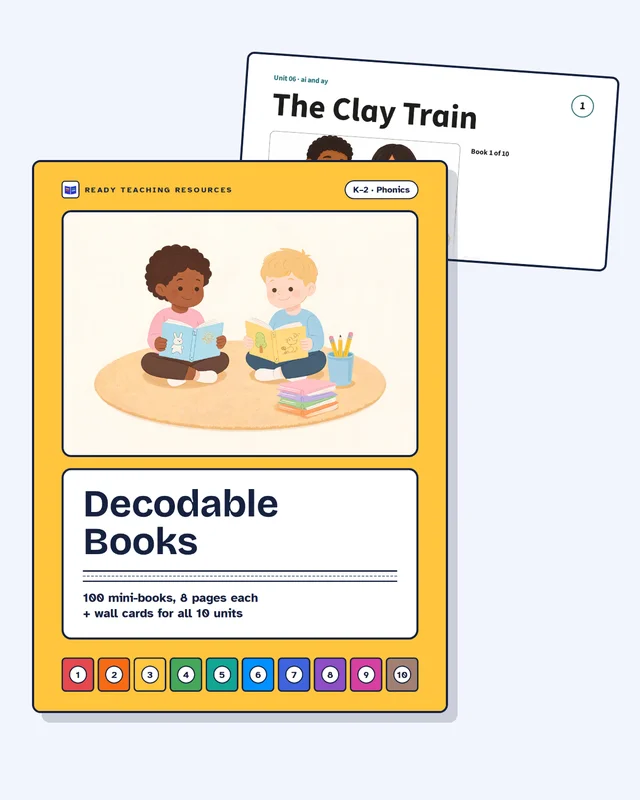
Teachers who want a printed book for each pattern, in teaching order, can use the K-2 Decodable Books. They give K-2 readers a decodable book for every phonics pattern, in teaching order, ready to print. Each book includes a word list and comprehension questions, and the set includes phonics wall cards for the units. They are an instant download. They print single-sided, two half pages per sheet, to cut and staple, and the print PDFs are US Letter only.
What does decode the words mean?
It means to turn the letters of a written word into sounds and blend those sounds into a pronunciation. It is the reading direction. Spelling, or encoding, runs the other way.
What is the difference between phonics and decoding?
Phonics is the teaching of letter-sound links. Decoding is using those links to pronounce a written word. A child can know a sound in isolation and still need practice blending it inside a word.
What are some decoding activities for kindergarten and first grade?
Kindergarten: blend three-sound words such as hat, then write them. First grade: keep the same blend, and change one sound at a time on the new pattern, as in a word chain. Both grades should read a short page that uses only taught patterns.
Sources
- Nessy: Decoding and Encoding
- University of Florida Literacy Institute: Decoding and Encoding
- Education Endowment Foundation: Decoding
- Institute of Education Sciences: Foundational Skills to Support Reading for Understanding in Kindergarten Through 3rd Grade
- Eunice Kennedy Shriver National Institute of Child Health and Human Development: Findings and Determinations of the National Reading Panel
-
Decodable Books
100 mini-books, 8 pages each, plus wall cards for all 10 units