What Is the Science of Reading?
Published 2026-10-27 · Updated 2026-10-27
The science of reading is a body of research about how reading and writing develop, why some children have difficulty, and which kinds of teaching match that evidence. It is not a curriculum you can buy and it is not a synonym for phonics alone. In a K-2 classroom the change that shows up tomorrow is the phonics block: sounds and spellings are taught on purpose, in a set order, and children read text built from patterns they have been taught.
The short answer
The Reading League defines the science of reading as "a vast, interdisciplinary body of scientifically-based research about reading and issues related to reading and writing." The work draws on cognitive psychology, linguistics, education, neuroscience, and related fields. It is about prevention and intervention as well as ordinary classroom teaching.
A guide for educator-preparation programs names five pillars: phonemic awareness, phonics, fluency, vocabulary, and comprehension. The same guide says the science of reading is not a single program you can buy. It is a data-informed way of teaching. Harvard Graduate School of Education puts the same limit in classroom language: the science of reading is not a single curriculum or method, but a broad body of research on how reading develops, meant to inform a teacher's judgment.
Spoken language can grow from conversation. Print does not arrive the same way. The educator-preparation guide says direct instruction in phonics, phonemic awareness, vocabulary, and comprehension is part of how children become proficient readers. Book corners and read-alouds still matter. They do not replace a planned code lesson.
Daily block changes
The What Works Clearinghouse practice guide on foundational skills for kindergarten through 3rd grade makes four recommendations: academic language, linking sounds to letters, decoding and word recognition, and daily connected text. The phonics block below is our adaptation of the second, third and fourth; language work needs its own time.
Hear the sounds, then attach letters. Children need to notice the parts of spoken words and then see how those parts map to print. Phonemic awareness with no letters is a warm-up. It is not the whole lesson. The National Reading Panel findings keep the two jobs separate: phonemic awareness is work on sounds in speech, and phonics is teaching letter-sound relations so children can read and spell.
Blend from left to right. The practice guide tells teachers to blend letter sounds and sound-spelling patterns from left to right until the pronunciation is a word the child knows. Once a few consonants and a vowel are known, start with a simple consonant-vowel-consonant word. The guide's own example is hat. Say the first sound, add the vowel, add the last sound, and check that the result is a real word. Teach one pattern in a sitting. When short a is new, leave long a, vowel teams, and r-controlled vowels for later lessons.
Spell what you just read. After children blend hat, have them write hat from the sounds, then one more word with the same pattern, such as map. If a sound has not been taught, keep it off that day's spelling list. Reading the pattern and writing the pattern are the same map, used in two directions.
Read connected text that uses the pattern. The practice guide says each student should read connected text every day to support accuracy, fluency, and comprehension. For beginners, that page should follow patterns already taught, plus a few high-frequency words taught as wholes. The guide notes that recognizing high-frequency words right away supports fluent reading. A page the child can sound out is practice. A patterned book the child can recite from the picture is not practice in decoding.
A block that has become routine can run like this:
- A minute or two of oral blending or segmenting, three sounds, no print yet.
- The new or review grapheme: say the sound, name the letters, write them.
- Blend and spell a handful of words with that pattern.
- Read a sentence or a short page that sticks to taught patterns.
- One vocabulary beat from the day's read-aloud, so meaning is not saved for a later unit.
Kindergarten spends more of the block on hearing sounds and a few letter-sound links, then simple CVC words. Later grades keep that routine and move the pattern forward, into digraphs, silent e, and longer words. How phonics is defined is in what is phonics.
The honest limit of this block is narrow. It teaches the code and gives practice. Background knowledge and oral language still need a read-aloud and a conversation somewhere else in the day. The practice guide's first recommendation is academic language, including inferential and narrative talk and vocabulary knowledge. A code lesson does not stand in for that talk.
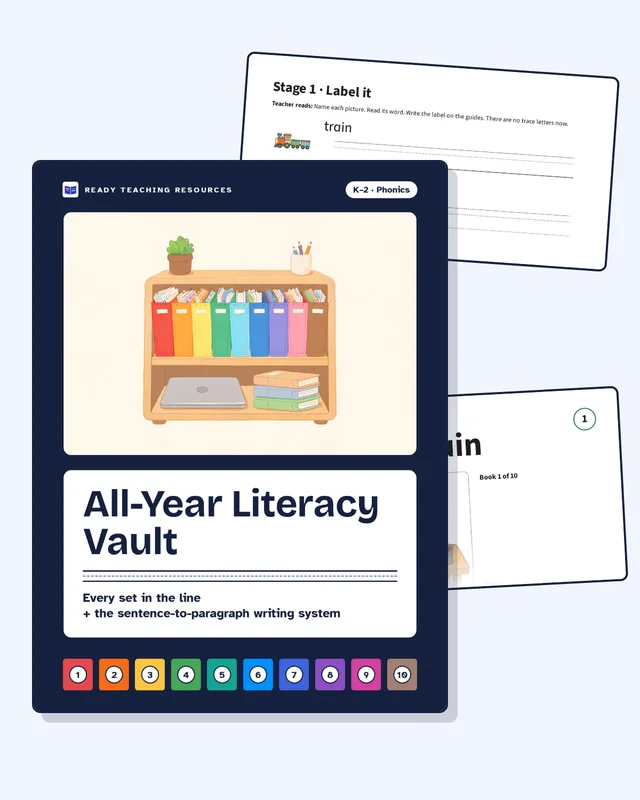
Teachers who want the phonics year gathered by unit can use the All-Year K-2 Literacy Vault. It is an instant download after checkout: one ZIP with a Start Here guide and one ZIP per unit, with decodable books, fluency passages, worksheets, lesson decks, assessments and a class tracker for kindergarten, 1st grade and 2nd grade. It delivers new units released during the school year later, as part of this purchase, and those units are not in this download.
Versus balanced literacy
Balanced literacy versus the science of reading is a prompt difference, not a slogan difference. At an unknown word, the two approaches tell the child to look in different places.
The educator-preparation guide says many schools adopted methods that prioritize whole language and balanced literacy, and that those methods often leave systematic phonics thin. Practices the evidence base does not support include implicit word reading, memorizing whole words as the main strategy, guessing from context, and picture cues. The practice guide is plain about the habit to drop: children should not guess an unfamiliar word from the first letters or the picture. Sound the word, then reread the sentence to check that it makes sense.
| At an unknown word | Science of reading move | Cue that does not hold |
|---|---|---|
| First look | Sound the letters from left to right | Picture, or a word that would fit the sentence |
| After a try | Reread and check meaning | Keep a word that fits the sentence and ignores the letters |
| What is planned | A set sequence of sound-spellings | Phonics only when a book happens to need it |
| Text for practice | Text the child can decode from taught patterns | Leveled text the child cannot yet sound out |
Meaning still matters. It is the check after decoding, not the way to identify the word. A child who reads "horse" for "house" because the picture shows a barn has followed a cue the letters do not support. Stop and look at the spelling.
The same split, told as two whole approaches, is in phonics versus whole language. The model that keeps word recognition and language comprehension in one picture is Scarborough's Reading Rope.
Five ideas to use
The five pillars are daily work, not five posters. The National Reading Panel organized its findings under alphabetics (phonemic awareness and phonics), fluency, vocabulary, and text comprehension. Here is what each one asks of a K-2 day.
Phonemic awareness. Phonemes are the smallest units of spoken language. The National Reading Panel findings note that the words "go" and "she" each consist of two sounds. Kindergarten work is isolate, blend, and segment, with letters added as soon as a sound has a grapheme. Rhyming can be a game. It is not a substitute for segmenting the sounds in a word.
Phonics. Phonics, in the panel's terms, is teaching that stresses letter-sound correspondences and their use in reading and spelling. The hallmark of a systematic approach is a sequential set of elements, taught in order, rather than only when a word in a book happens to need them. Synthetic phonics, as the panel describes it, links a letter or letter group to a sound and then blends. That is the routine in the block above.
Fluency. The panel describes fluent reading as oral reading with speed, accuracy, and proper expression. Accuracy comes before speed. A child who races and swaps words is not fluent yet. Reread a short page the child can already decode, and listen for phrasing. A timer is optional. A wrong word is not.
Vocabulary. Teach a few words on purpose from the read-aloud, and use them again the next day. The practice guide treats vocabulary as part of academic language, used in talk, not as a list copied with no sentence around it.
Comprehension. For beginners, comprehension is talk about a text they have heard or a sentence they have just decoded: who, what, why, and what a word means. Harvard's summary is the right scale. Foundational skills such as phonemic awareness, phonics, and decoding are essential, and so are vocabulary, background knowledge, oral language, and comprehension. Calling a phonics packet "the science of reading" and dropping the language work is the phonics-only myth both Harvard and the educator-preparation guide warn against.
Mistakes to drop
- Treating the phrase as a product category. The research is a body of evidence. A set of materials can follow it or ignore it. The words on the cover do not decide.
- Prompting "what would make sense?" before the child has looked through the word.
- Naming many patterns in one week so the plan looks full. One pattern, read and spelled, beats a list of patterns the child cannot yet blend.
- Saving every comprehension question for a separate block and never talking about the sentence the child just read.
A teacher can run this block with a whiteboard, letter tiles, and a page of decodable text. No purchase is required for the routine itself.
What are the five key concepts of the science of reading?
Phonemic awareness, phonics, fluency, vocabulary, and comprehension. A guide for educator-preparation programs lists those five as the pillars of instruction, and the National Reading Panel reported on the same topics.
How is the science of reading different from balanced literacy?
At an unknown word, science-of-reading instruction starts with the letters. Balanced literacy often starts with the picture or with what would make sense in the sentence. Meaning is a check after the word is sounded, not the way to name the word.
Sources
- The Reading League: What is the Science of Reading
- Council for the Accreditation of Educator Preparation: The Science of Reading: The Basics
- Harvard Graduate School of Education: Unlocking the Science of Reading
- Institute of Education Sciences: Foundational Skills to Support Reading for Understanding in Kindergarten Through 3rd Grade
- Eunice Kennedy Shriver National Institute of Child Health and Human Development: Findings and Determinations of the National Reading Panel
-
All-Year Literacy Vault
Every set in the line, plus the sentence-to-paragraph writing system