What Is a Sound Wall, and How Do You Set One Up?
Published 2026-10-27 · Updated 2026-10-27

A sound wall is a classroom display organized by sounds. Students go to it to find a sound, see how the mouth makes that sound, and choose a spelling. Differentiation Corner describes that use: during writing, the teacher stops and checks the sound wall to solve a spelling, and students are shown how to walk over, find a sound, and use it. A word wall does a different job. The Institute of Education Sciences practice guide defines a word wall as a space for high-frequency irregular words and for words that contain the sound-spelling patterns students have learned. One wall is filed by sound. The other is filed by whole words.
Hang the sound wall only if you will teach from it. A display nobody walks to is wallpaper.
Sound wall and word wall, side by side
| Sound wall | Word wall | |
|---|---|---|
| Organized by | The sound | The whole word |
| What is on the card | A mouth picture for the phoneme, a keyword, and the spellings for that sound | The word itself, often an irregular high-frequency word or a word that uses a taught pattern |
| Student move | "What sound do I hear? Which spelling can I use?" | "Have I seen this word? How is it spelled?" |
| When it grows | When a new sound or spelling is taught | When a new irregular word or pattern word is taught |
Differentiation Corner says a static word wall is easy to walk past, and pairs each phoneme with a mouth picture and a keyword students already know. Vowels get their own stretch of the wall, a vowel valley, because vowels are made with an open mouth. The example on that page is cap and cape: the silent e changes the vowel, and the wall is where students see that. The Institute of Education Sciences practice guide still wants a place for irregular high-frequency words such as the, was, and said. Keep those on the word wall, or on a heart-word spot. Do not file "said" under a sound card as if every letter were predictable. See heart words for the mark, and high-frequency words for which common words are regular.
Set it up in the order you teach
Differentiation Corner says to build the wall in real time: cover sounds that are too advanced for the grade or that you will introduce later, and let the wall grow with the lessons. Students unlock a card when the sound is taught. That is the setup order. It follows the phonics sequence, not a poster that shows every spelling in August.
The National Center on Improving Literacy says to teach consonants and short vowels first, in words where the letters have their most common sound, such as a in bat, and to teach more complex patterns next: blends, digraphs, vowel teams, and silent e. Uncover a card only for a new phoneme or a new spelling.
- Before the first lesson, post the frame and cover the cards you will not teach yet. Leave the wall usable, not finished.
- Kindergarten, as each letter-sound group is taught: uncover that consonant or short vowel. Add a mouth picture and one keyword the children know. Differentiation Corner wants both. A keyword the class has never heard does not help them hold the sound.
- When a new phoneme or a new spelling is taught, uncover that card. A blend does not get its own sound card: point to the single-sound cards already on the wall, the day you teach the blend, not the week after.
- First grade: uncover silent e and the vowel teams on the vowel valley as those units start. Use the wall to compare a short vowel and the same vowel with silent e, the cap and cape contrast from the page above.
- Second grade: uncover the remaining vowel spellings and the less common consonants as the units arrive. Do not unveil the whole valley in September of kindergarten.
- Each day, walk to the wall during the phonics lesson and during writing. Differentiation Corner makes daily use the point. A card that is never pointed at might as well stay covered.
A personal copy at the desk, a simplified version of the same wall, lets a child check a spelling without crossing the room. That page should match the classroom wall. If the class has not unlocked a sound, the desk copy should not show it either.
How a child uses it
During spelling, the child says the word, taps the sounds, and finds each sound on the wall. Regular sounds have a spelling on the card. If the sound has more than one spelling, the child uses the one the current unit is teaching, not every spelling on a finished chart. Irregular parts are not solved by the sound wall. Those go to the heart-word card. See sight words for why the instant word is still built from sounds, not from a guess at the shape.
During reading, the wall is a check, not a search through every card for a word the child does not know. If the pattern was taught, the child should try the word first. The wall confirms the spelling. It does not replace blending.
Mistakes that turn the wall into decor
- Unveiling every card in the first week. The child cannot use spellings that have not been taught, and the wall becomes noise.
- Posting whole irregular words on the sound wall and calling that phonics. Those words belong on the word wall.
- Skipping the mouth picture. Differentiation Corner says many students need to see how a sound is formed, not only hear it.
- Never walking to the wall during the lesson. The introduction has to be modeled, the same way any other tool is introduced.
- Buying a finished poster and stopping there. The shopping pages for this search are product grids. They do not tell you which card to uncover in October.
One limit of this advice: a sound wall shows spellings you have taught. It does not teach the sound by itself, and it does not tell you that a child who can point to a card can read a book. The lesson still has to include hearing the sound, building the word, and reading it in text.
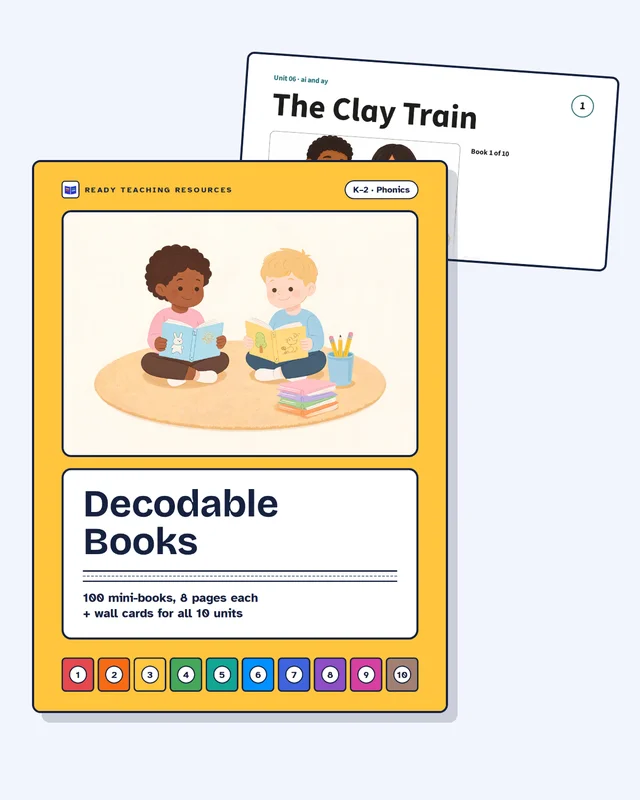
Sound cards on the phonics wall cards for all units are in the K-2 Decodable Books download, and the license is a single-classroom license.
What is the purpose of a sound wall?
Students use it to find a sound when they are reading or spelling. A mouth picture and a keyword sit with the spellings for that sound. It is a tool in the lesson, not wallpaper.
How do you set up a sound wall?
Cover the sounds you have not taught. Reveal consonants and short vowels as those lessons start, each with a mouth picture and a known keyword. Add later patterns when the unit arrives. Use the wall in the phonics lesson every day.
How is a sound wall different from a word wall?
A word wall displays whole words, often irregular high-frequency words or words that use a pattern already taught. A sound wall is organized by the sound. Students look up the sound, then choose a spelling.
Sources
-
Decodable Books
100 mini-books, 8 pages each, plus wall cards for all 10 units