Spelling activities for K-2, from sound boxes to dictation
Published 2026-10-27 · Updated 2026-10-27

The search for activities spelling turns up list games. The spelling activities that teach K-2 children to spell are encoding: they hear a word from the pattern just taught and write the letters. Start with sound boxes. Change one sound. Then dictate a few words and one sentence that use only that pattern.
Encoding is speech turned into print. The Institute of Education Sciences practice guide defines encoding as converting from speech to print, and decoding as converting from print to speech. The University of Florida Literacy Institute says that once children learn some phoneme-grapheme correspondences, they can begin decoding, which is reading, and encoding, which is spelling.
A posted list, a craft, or a relay can come later in the week. The lesson is the mapping.
Spelling activities that follow the pattern
Use these in order. Every word uses spellings the class has already been taught.
Sound boxes. The practice guide has students use Elkonin sound boxes to mark the phonemes in two- or three-phoneme words. If they use letter tiles, the guide says to select words that contain letter sounds they have already learned. Say the word. Students repeat it and pull one tile, or write one spelling, for each sound. A consonant digraph that spells one sound shares one box. The guide places silent e outside the boxes, since that letter adds no sound in that position. The box routine is in Elkonin boxes.
One-sound change. The practice guide has students add, move, or replace one letter tile at a time, as in fat, fan, can, and cat. Say the new word before they move the tile. They read the new word before the next change. A longer line of those changes is a word chain. The University of Florida Literacy Institute describes a blending drill that changes one sound at a time, and it lists word chains for decoding and encoding practice.
Sort, then spell. After children can read the pattern, they sort words that have it from words that use a different spelling. Then they spell. The University of Florida Literacy Institute lists word sorts and a regular-word spelling activity for that job. You say the word. They write it. They read it back.
Dictation. The practice guide has students write the words in the boxes as you say them, or move letter tiles into the boxes. Say the words one at a time, from the pattern just taught. Keep the set short. For a short-a day: map, sat, tap. Check the vowel before you add another word. Then dictate one sentence using taught spellings, such as "Sam sat." Add a heart word only after teaching it. If a word in the sentence uses a spelling the class has not had, take that word out.
A heart word is a high-frequency word with a part that is irregular or not yet taught. The practice guide tells teachers to teach regular and irregular high-frequency words so students recognize them quickly. Regular words are spelled by the patterns, and the guide's regular examples include in, and, and did. Irregular words have exceptions to the typical sound-spelling patterns. The guide's irregular column includes the, was, and said. The UF Literacy Institute notes that most of such a word can still be decoded, so children learn only one or two letters "by heart." Teach the irregular part that way and read the rest by sound.
| Activity | When to use it | What you say |
|---|---|---|
| Sound boxes | The pattern is new, and every sound in the word has been taught | "Say the sounds. One box for each sound." |
| One-sound change | The first word is built and read | "Change the last sound to /p/. Read the new word." |
| Dictation | Children can build the words with tiles | "Write map. Read it back." |
| Movement review | The writing is done, and the words are the same ones | "Spell the word you just wrote." |
How the lesson runs
- Say the new sound or pattern. Students repeat it.
- Build two or three words in sound boxes. You model the first word.
- Change one sound and read the new word.
- Dictate those words. Students write them and read them back.
- Dictate one sentence. Students write it and read it aloud.
Reading the sentence back is the fluency step for that pattern: accurate words, then one smooth line. It is still the same spelling lesson. It is not a speed drill.
Kindergarten stays on two- and three-sound words once a few letter sounds are known. That slice is in kindergarten phonics. First grade uses the same five steps on the pattern of the week: a digraph in one box, a blend as separate sounds, silent e outside the boxes. Second grade uses the same steps on the week's vowel team, r-controlled spelling, or word part. The words change with the pattern. The order of the lesson stays put.
Active spelling activities
Active spelling activities get children moving while they spell a word they can already map.
Edutopia describes a game in which partners make letters with their bodies and then spell a word, and a relay in which a team collects letter cards and lines them up. The class names each letter as it appears. Those games review a spelling. Run them after the sound-box lesson, on words from that lesson.
Other active reviews still follow the sound. Children hop once for each sound while they segment the word, then write it. They write the word in chalk and read it aloud. They pass a tile set, change one sound, and pass it on. A relay on a silent-e word the class has not been taught is a memory race. Save the running for words the dictation already checked.
Fun spelling activities for kids
Fun spelling activities for kids can still be the encoding routine. Tiles, chalk boxes, and a one-sound change are the game. Children like the change because the word becomes a new word they can read.
Memory games ask a child to picture the whole word, post the list where they will see it, color the vowels, or build the letters from pasta. Those games review how a word looks. Use them for a heart word whose irregular part you have already taught, or for review at the end of the week. They are a weak first lesson for a new pattern, because the child is not asked to hear the sounds and choose the letters.
An online game that sorts lists by pattern, such as short vowels or digraphs, is extra practice after the lesson, if every word on the list uses spellings you have taught. A mixed list from several future units is the wrong game for this week.
First grade spelling activities
Good spelling activities for 1st grade students stay on one pattern.
- Sound boxes for the week's spelling, with a digraph in one box or silent e outside the boxes.
- A chain that changes one sound: ship, shop, chop, chip.
- Dictation of those words and one sentence, such as "The ship is big," only after "the" and "is" are taught. If they are not taught, dictate "Chip can chop."
- A movement review of those same words, after the writing.
A first grader who still cannot spell a short-vowel word belongs on short vowels, not on vowel teams. The pattern of the week is the one they can use, not the one on a downloaded list.
Common mistakes
The spelling lesson uses taught patterns so you can check the letters against the sounds. Independent writing is a different job. The practice guide tells teachers, when kindergartners and 1st-graders are writing independently, to encourage them to try to spell words on their own, even if they might spell the word incorrectly, and to remind them to use the sound-spelling patterns they know. That try belongs in their own writing. The dictation in the phonics lesson stays on words you can check against the pattern.
Another mistake is treating every word as a shape. Regular words get sound boxes. Only the irregular part of a heart word is learned as a unit.
A third mistake is a sentence full of new spellings. If the child has to copy words they cannot segment, the page is handwriting, not spelling.
These activities teach the pattern in front of you. They assume the child can hear the sounds in the spoken word. A child who cannot yet separate those sounds needs that listening work before letter tiles will show you what they know. You still choose the next pattern from the scope you are following. The activities apply that choice.
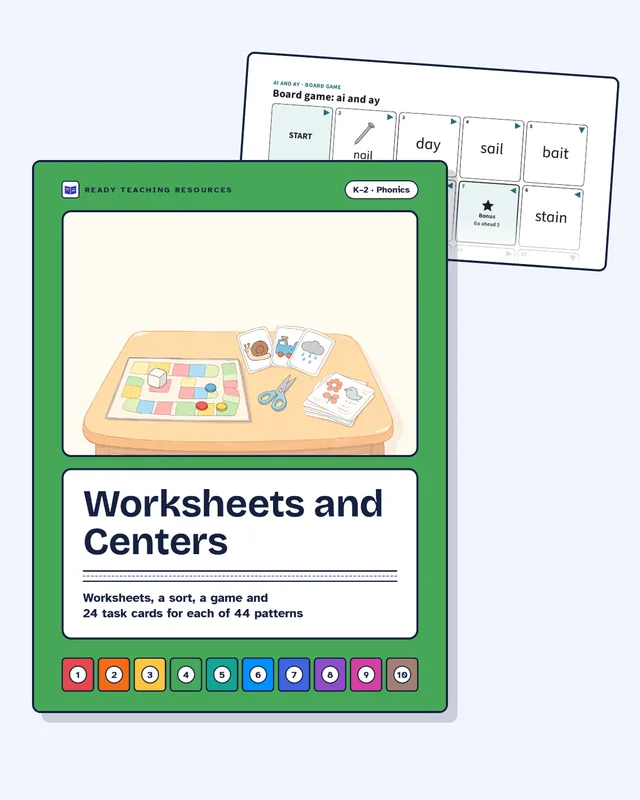
Printed pattern practice for that same sequence is in the K-2 Phonics Worksheets and Centers Mega Pack. It gives practice, centers and quick checks for every pattern in the 10-unit phonics sequence. It holds, for each of 44 phonics patterns, a worksheet set, a word-sort center, a board game, 24 task cards and an exit ticket. It provides answer keys for every page with an answer. It lists a teacher page together with a print list and contents for each unit. It needs a printer, paper, scissors, one die and game counters for the centers. It covers kindergarten, 1st grade, and 2nd grade in the same sequence. It has centers and task cards for the teacher to cut out.
What are some spelling activities?
Use sound boxes for the pattern just taught, change one sound, then dictate those words and one sentence. A movement game fits after the writing, on the same words.
What are some fun spelling activities for kids?
Tile changes, chalk sound boxes, and a dictated sentence the child can read back are the fun that still teaches the pattern. Picture-the-word games and pasta letters fit as review after the sounds are mapped.
What are some good spelling activities for 1st grade students?
Stay on one pattern: sound boxes, a chain that changes one sound, then a short dictation and one sentence. A first grader who still cannot spell short-vowel words stays on short vowels.
What are some examples of active spelling activities?
Partners make letters with their bodies and spell a known word, or a team collects letter cards and lines them up. Use words from the sound-box lesson, after the children have written them.
Sources
- Institute of Education Sciences: Foundational Skills to Support Reading for Understanding in Kindergarten Through 3rd Grade
- University of Florida Literacy Institute: Decoding and Encoding
- University of Florida Literacy Institute: Irregular and High Frequency Words
- Edutopia: Movement-Based Games That Improve Spelling
-
Worksheets and Centers
Worksheets, a word sort, a board game and 24 task cards for each of 44 patterns