Kindergarten phonics: what to teach and in what order
Published 2026-10-27 · Updated 2026-10-27

Kindergarten phonics is letter sounds, then simple words. Children learn which sound a letter stands for, blend those sounds to read a short word, and spell a short word they can hear. The North Carolina Department of Public Instruction says kindergarten children learn the relationship between letters and the sounds they represent, and then blend the sounds to read simple words.
There is no single required order for those letter sounds. The National Center on Improving Literacy says phonics is not a particular reading program. It is an essential part of explicit, systematic instruction in how letters and groups of letters link to sounds. The same page says there is no single instructional sequence, and it names a practical start: high-utility sounds such as m, a, and s, a few sounds at a time, each letter with its most common sound.
What kindergarteners should know
Phonics for kindergarten is that start, not a full set of long-vowel rules. By the time simple words are the daily work, a kindergartener can:
- Say the most common sound for the letters that have been taught, and name the letter.
- Hear the sounds in a spoken word and blend them back together.
- Read and spell short CVC words, such as top, cat, and fog, using those sounds.
- Read a short sentence made of those words, from the letters.
- Read a few irregular words by learning the unexpected part, and sounding out the rest.
The North Carolina Department of Public Instruction puts the kindergarten practice on letter sounds and on short CVC words: break the word into sounds, then blend the sounds back into the word. The Institute of Education Sciences practice guide is written for kindergarten through 3rd grade. It tells teachers to begin linking sounds to letters as soon as possible. Once students know a few consonant and vowel sounds and their corresponding letters, they can start to sound out and blend those letters into simple words.
Phonics here also means encoding, not only reading. The National Center on Improving Literacy says phonics helps children decode words and encode words, which is knowing which letters to use when writing. Spelling those same CVC words is the writing half. The spelling routine is in spelling activities.
Fluency in kindergarten is accurate reading of those decodable words, in a list and in a sentence. The National Center on Improving Literacy connects phonics to fluency: reading words, phrases, and sentences accurately, at an appropriate speed, and with expression. Speed comes after the words are readable. For this kind of introductory lesson, listen for accurate blending rather than racing a timer.
Pictures can introduce a new sound. The National Center on Improving Literacy says pictures help children associate sounds with letters, and that once students read connected text the focus is letters and sounds, rather than pictures. The sentence is read from the letters.
The order to teach it
The National Center on Improving Literacy says systematic phonics begins with basic letter-sound correspondences and progresses to more complex letter-sound relationships. Stagger letters that look or sound alike, such as b and d, or b and v, until the first of the pair is solid. Teach uppercase and lowercase together. Show the letter, say its name and its sound, and give children several turns to say it.
Use this order. It follows that progression and the map in phonics scope and sequence. Treat it as a teaching map; it is not a state standard.
| When | What you teach | What the child does |
|---|---|---|
| First weeks | A few high-utility sounds, such as m, a, and s, then more letters in small sets | Says the sound for the letter, and hears it at the start of a word |
| As soon as a vowel is known | Short-vowel CVC words | Blends sat and spells a spoken word with known letters |
| After CVC words are steady | Digraphs such as sh, ch, th, wh, and ck, when your sequence places them in kindergarten | Reads sh as one sound |
| Across the year | A few irregular words the books actually use | Sounds out the regular letters and learns the irregular part |
Letter-by-letter teaching, including how to introduce one sound, is in how to teach letter sounds.
Some sequences teach a few digraphs before the kindergarten year ends. Some stay on CVC words until blending is steady and leave digraphs for first grade. Both can be systematic if you pick one sequence and keep it. Mixing silent e into a short-vowel week is the move that confuses children.
Blends and vowel teams are later work in the map we use. A kindergartener who blends CVC words is ready for the next unit in that map. A stack of long-vowel rules is a different year.
Kindergarten phonics lessons
Kindergarten phonics lessons can be short and daily. The North Carolina Department of Public Instruction suggests talking or playing games about letter sounds for a few minutes each day, and keeping that practice light.
One lesson:
- Hear it. Show the letter or the digraph. Say the sound. Students say it. Name the letter while you teach the sound.
- Build it. Say a word that uses only known sounds. Students place one tile per sound. The practice guide uses Elkonin sound boxes for two- or three-phoneme words, and letter tiles only for sounds already learned.
- Read it. Students blend the word from left to right. Then they read two more words with the same pattern.
- Write it. You say the word. They write it. The North Carolina Department of Public Instruction has families spell a two-letter or three-letter word, such as it, in, rip, top, or cap.
Then read one sentence that uses those words. If a word uses a spelling you have not taught, take it out. "Sam sat." is enough on a short-a day. "The cat sat." waits until "the" has been taught as a word with an irregular part.
Heart words in kindergarten are that small set: the irregular part is learned, and the other letters are still read by sound. A few words the books need is enough. A long list of words to memorize as shapes is a different job, and it is the wrong job for this lesson.
Fun activities for kindergarten phonics
Fun activities for kindergarteners stay on the sound you are teaching.
- Sound bag. The North Carolina Department of Public Instruction describes a bag of items that start with the same sound. The child names each item, then names the sound and the letter.
- Break and blend. Say top. The child says the three sounds, then blends top. Use cat and fog the same way. That is the page's CVC practice.
- Spell a short word. Say a two-letter or three-letter word the child can already sound, such as in or cap. They spell it aloud. Keep it to one skill.
- Chalk boxes. Draw three boxes. Say map. The child writes one letter in each box. Read the word together. This is the sound-box step on the sidewalk.
- Tile change. Build map. Change the last sound and read mat. One change is enough for a kindergarten turn.
Songs that name a letter and its sound fit the first weeks. A song that races through the whole alphabet is a review. It is a weak stand-in for blending sat.
What to check by the end of the year
A kindergarten check asks whether the child can do the jobs above. It is a listen, not a score report.
Show a taught letter and listen for the common sound. Ask the child to blend a CVC word and to spell one you say. Ask for a sentence of taught words read from the letters. For an irregular word you have taught, listen for the regular letters read by sound.
If the blend falls apart, stay on CVC words and letter sounds. Digraphs can wait. The early steps in the practice guide are the ones kindergarten needs every day.
This page cannot name one end-of-year list that every district uses. The National Center on Improving Literacy says there is no single instructional sequence. The honest limit is that a finished letter song is not the same as blending. A child can name every letter and still be unable to read sat. The check is the blend and the spelling.
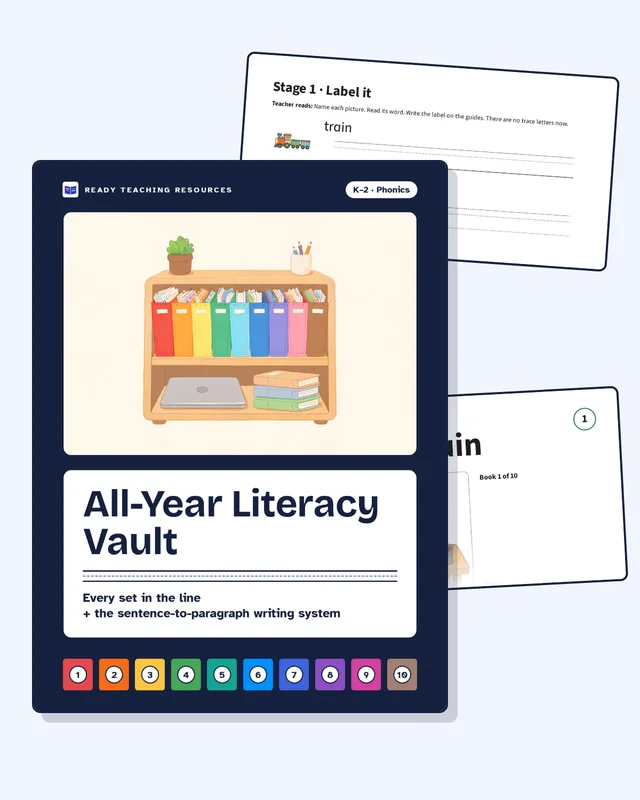
Teachers who want the kindergarten units and the assessments in one set can use the All-Year K-2 Literacy Vault. It holds the complete K-2 phonics year in one download, organized by unit, plus a writing system. It includes everything in the line: decodable books and wall cards, sentences and fluency passages, the worksheets and centers mega pack, lesson decks, assessments and a class tracker. It includes a Sentence-to-Paragraph Writing System for all 10 units. It includes a Vault Start Here guide with a pattern index. The Vault covers kindergarten, 1st grade, and 2nd grade. It has new units released during the school year delivered later as part of this purchase, and they are not in this download.
What phonics should kindergarteners know?
The common sound for letters that have been taught, how to blend those sounds into a short CVC word, and how to spell a short word they can hear. Digraphs can follow once those words are steady. There is no single national list.
What are some fun activities for kindergarteners to learn phonics?
A bag of items that start with one sound, breaking a CVC word into sounds and blending it back, spelling a two-letter or three-letter word aloud, and writing one word in sound boxes. Keep the game on the sound you are teaching.
What are kindergarten phonics lessons?
A short daily lesson: hear the sound, build a word with one tile per sound, read the word, then write it. Add one sentence made of words the child can already sound out.
Is there one order for phonics for kindergarten?
No single instructional sequence is required. Start with a few high-utility sounds, teach a few at a time, and move to short CVC words as soon as children can blend them. Then stay with one sequence.
Sources
-
All-Year Literacy Vault
Every set in the line, plus the sentence-to-paragraph writing system