What Are Decodable Books?
Published 2026-10-27 · Updated 2026-10-27

A decodable book is a book the child can read with the letter sounds and high-frequency words already taught. The Institute of Education Sciences practice guide defines decodable text that way: text written so students can read it using the letter sounds and high-frequency sight words they have learned. It is not a brand, and it is not a letter level. It is a match between the page and the lessons.
If the child has to guess from the picture, the book is not decodable for that child yet.
Phonics, decodable words, and the book
Phonics is the instruction. A decodable word is a word the reader can sound out with patterns from that instruction. The Institute of Education Sciences practice guide calls a non-decodable word a word the reader is unable to decode, including a pattern not yet learned. The same spelling can move from one group to the other. "Me" is non-decodable before open syllables and decodable after them.
A decodable book is the connected text for that practice. The practice guide tells teachers to have students read decodable words in word lists, decodable sentences, and short decodable texts that contain the letter sounds just taught. The book is the last step of the phonics lesson, not a separate subject. See sight words for the instant words, and heart words for the few irregular words you may put in the book on purpose.
How to tell if a book fits your students
Cover labels are not the test. A publisher can call a book decodable and still fill it with patterns your class has not had. The Reading League keeps a directory of decodable text sources and says the list is not an endorsement of any option. A name on a list is a starting point. The page in your hand is the test.
Run this check on one page before you assign the book.
- Write the letter sounds and heart words the child has been taught. Nothing else counts.
- Read the page yourself and mark every word the child cannot yet build from that list.
- If the leftovers are only the heart words you already taught, the page is decodable for that child.
- If the child would have to guess at other words, or lean on the picture to name them, the book is ahead of the class. The Institute of Education Sciences practice guide warns that early readers who rely on illustrations are not applying word-identification strategies. Put the book aside until the patterns arrive.
- Repeat for a second page. One easy page can hide a hard one.
Worked check, from a pattern set Little Lions Literacy uses: a child who has learned s, a, t, p, i, and n can read sat, pin, tap, and sit. A page built from those words, plus a heart word you have taught, passes. A page that adds "said," "phone," or "night" fails for that child, even if another class is ready for it.
An illustrative kindergarten line, not a published passage: "Sam sat. Pat sat." It passes only if s, a, t, m, and p are taught and the names are known. Change one word to "said" and the line fails until that heart word has been taught.
Decodable books and leveled readers
Little Lions Literacy contrasts the two. A decodable reader is a practice book for a specific skill, written with the letter-sound patterns already taught. A leveled reader is organized by overall difficulty, often with a letter or number, and does not stick to those patterns. A level A book can include tricky spellings because they are common, which pushes the child toward memorizing the word or guessing.
Use leveled books as read-alouds if you like the story. Do not hand them to a beginner as the independent reading if the spellings are untaught. The practice guide's reason for decodable text is practical: in the early stages, students know only a few letter sounds, so most ordinary books contain words they cannot yet decode.
Kindergarten, first grade, and when to stop
Kindergarten decodables follow the letter sounds of those weeks, usually consonants and short vowels, plus a small set of heart words. A passage is decodable for kindergarten when it passes the page test above, not when a catalog says "level K." Little Lions Literacy describes the fit as the phonics skills already taught, so the child can succeed on the page.
First grade adds digraphs, blends, and silent e. A book that was too hard in October can pass in January if those patterns are now taught. Re-run the test. Do not trust last term's label.
Second grade uses decodable pages for the new patterns, such as vowel teams and two-syllable words, then reads those patterns in less controlled books. The Institute of Education Sciences practice guide places decodable text in the early stages of reading development. Stop using a controlled book as the only independent reading once the child can read uncontrolled books with the patterns taught so far. Keep a decodable page when you introduce a new pattern. You are not finished with phonics because you stopped one series.
The real limits
Decodable text has limits, and they matter.
- The story is fenced by the patterns. It will not carry the vocabulary of a rich read-aloud. Little Lions Literacy says to use decodable books for the child's own practice and to keep reading more complex stories aloud. Do both.
- A few non-decodable words can be taught on purpose when the story needs them. The practice guide says to introduce those words before the reading and to limit how many, because learning them as wholes is a heavy memory load. A page full of untaught words is not a decodable page with a few extras.
- The book that fits your sequence may not fit the class next door. Decodable is a relation, not a permanent property of the file.
One limit of this advice: the page test tells you whether this child can read this page with what has been taught. It does not score comprehension, and it does not choose a series for you. You still have to know your own scope and sequence.
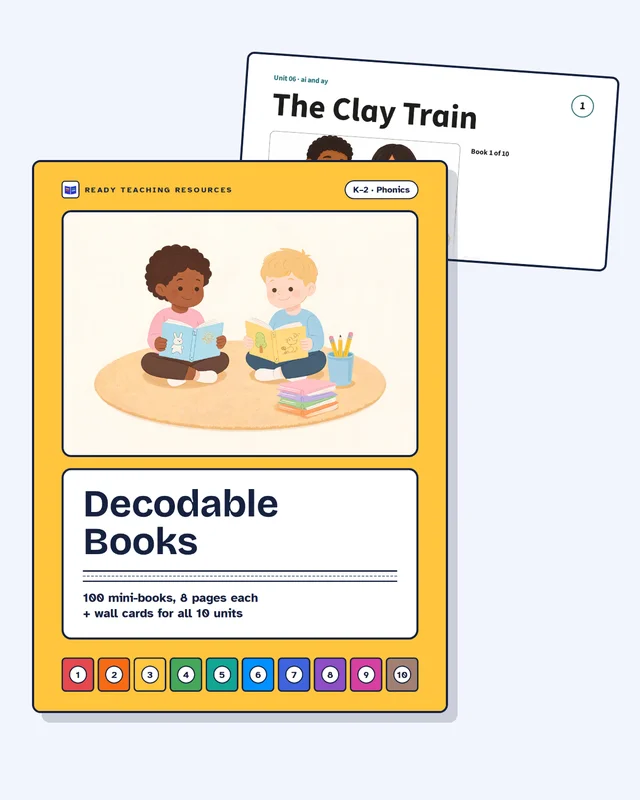
100 decodable mini-books, 10 per unit, are in the K-2 Decodable Books download. They print single-sided, two half pages per sheet, to cut and staple.
What does a decodable book mean?
It means the child can read the book with the letter sounds and high-frequency words already taught. The label on the cover is not enough. The match is to your sequence, not to a letter level.
What is the difference between phonics and decodables?
Phonics is the lesson on how letters map to sounds. A decodable book is the practice text for patterns from that lesson. One is instruction. The other is the page the child reads.
How can I tell if a book is decodable?
List the sounds and heart words the child has had. Read a page. If the child must guess at more than those heart words, the book is ahead of the child, whatever the cover says.
What are decodable words?
A decodable word is a word the reader can sound out with patterns already taught. A non-decodable word is one the reader cannot yet decode. The same spelling can switch groups after a new pattern is taught.
What are the main disadvantages of decodable texts?
The stories are limited to taught patterns, so they are practice books, not the only books children should hear. Pair them with read-alouds of richer stories. A book that fits one class can be too hard for another.
What are decodables in kindergarten?
Kindergarten decodables use the letter sounds taught so far, usually consonants and short vowels, plus a few heart words. A page of sat, pin, and tap is decodable only after those sounds are in the lessons.
What level are decodable readers?
They are not A-to-Z levels. They follow a phonics sequence. A leveled reader is sorted by general difficulty and may include spellings the child has not been taught.
When should you stop using decodables?
Use them in the early stages, while the child knows only some letter sounds, and again when a new pattern is taught. Stop relying on them as the only independent reading once the child can read books that are not controlled.
What are some good phonics books for early readers?
The useful book is the one that matches the patterns just taught and the heart words already practiced. A famous series is not automatically a fit. Run the page test before you buy a set.
Sources
-
Decodable Books
100 mini-books, 8 pages each, plus wall cards for all 10 units