What Is Structured Literacy?
Published 2026-10-27 · Updated 2026-10-27

Structured literacy is a way of teaching reading, not a program name you can buy. It means the teacher explains the code directly, in a planned order, and checks who still needs the last step. A K-2 phonics lesson can show every principle in one sitting.
Principles, not a brand
Nearpod describes structured literacy as explicit, systematic, and sequential, with a focus on phonological awareness, phonics, decoding, and spelling. The same page says learning should be cumulative, building on what came before, and diagnostic, so teaching changes when a child has not yet got the step. A Texas Association for Literacy Education yearbook chapter calls structured literacy a blueprint for literacy instruction, tied to standards for teachers of reading, and says formal reading instruction often begins with phonological awareness: hearing and moving sounds in words.
The Virginia branch of the International Dyslexia Association quotes a 2019 brief: highly explicit instruction covers foundational skills such as decoding and spelling, and also syntax, reading comprehension, and writing. Phonics is inside the approach. It is not the whole of it. How phonics itself is defined is in what is phonics.
The name is newer than the practices. The Virginia page says the label was chosen after members weighed several names for this kind of explicit, systematic teaching. Treating the label as a brand, or as a test a child must pass, misses the point. The point is how the lesson is built.
Parts of one daily lesson
Put the principles in order. This is one K-2 sitting, not a new method.
Cumulative review. Start with a pattern from yesterday. Two or three words, blended and spelled. If yesterday's pattern is shaky, today is not the day for a new one. Cumulative means the old work stays in the lesson.
Explicit new step. Name the pattern. Say the sound. Show the letters. Model one word. Children should not have to guess what you are teaching. Nearpod's contrast is the right one: word study that waits for children to notice a pattern on their own is not this approach.
Guided blend and spell. Children do the word, with you close enough to hear the sounds. One pattern, a handful of words. The detail of explicit and systematic phonics is in explicit systematic phonics instruction.
Read it in text. A sentence or a short page that uses the pattern, plus words already taught. Decoding in isolation and decoding in a sentence are both part of the sitting.
Diagnostic close. Note who blended and who did not. Tomorrow's review comes from that note, not from the calendar. Diagnostic here means you change the next lesson. It does not mean a formal test every day.
If the review shows the pattern is not secure, repeat it with new words rather than opening the next spelling. A child who blends the words and then loses them in a sentence needs the page, not a harder pattern. A child who cannot hear the sounds needs oral work before more print. That is the diagnostic principle in the room, not a score.
That sitting is the pedagogy in miniature. Review is cumulative. The model is explicit. The order is systematic. The note at the end is diagnostic. Language work still belongs in the day: a read-aloud, a sentence built on purpose, a why question. The Virginia quote puts syntax, comprehension, and writing in the same approach as decoding. A phonics sitting that never talks about meaning has dropped half the brief.
A sitting that follows the principles still has to fit a real morning. If the review takes the whole block because the pattern is new, stop there. Cumulative work that is unfinished is more structured than a new pattern taught in a rush. If the review is quick, teach the new step and still leave time to read one sentence. Diagnostic does not require a spreadsheet. A mark next to three names is enough to plan tomorrow.
Pedagogy or method
Is structured literacy a pedagogy? In the ordinary sense, yes: it is a way of teaching, with principles a teacher can point to. It is not a textbook series, and it is not a claim that one publisher owns the steps. The yearbook chapter calls it an instructional model and a blueprint. Nearpod calls it an approach. You can use the principles with materials you already have, as long as the lesson stays explicit, ordered, and checked.
What it is not: a cue to look at the picture before the letters, a hope that children will discover the code, or a scope that jumps to a new pattern every day with no review. Those moves break the principles even if the cover says the right words.
What to skip
- A new pattern before the last one is secure.
- Asking children to find the pattern with no model.
- A page full of words they cannot yet sound.
- A review that is only a game and never a blend.
- Saving every comprehension question for a different subject. The read-aloud can carry syntax and meaning the same day.
The honest limit: principles do not pick the next spelling for you. You still need a scope, from simple words toward longer ones, and you still need to watch the children. Structured literacy tells you how to teach the step. It does not hand you the step.
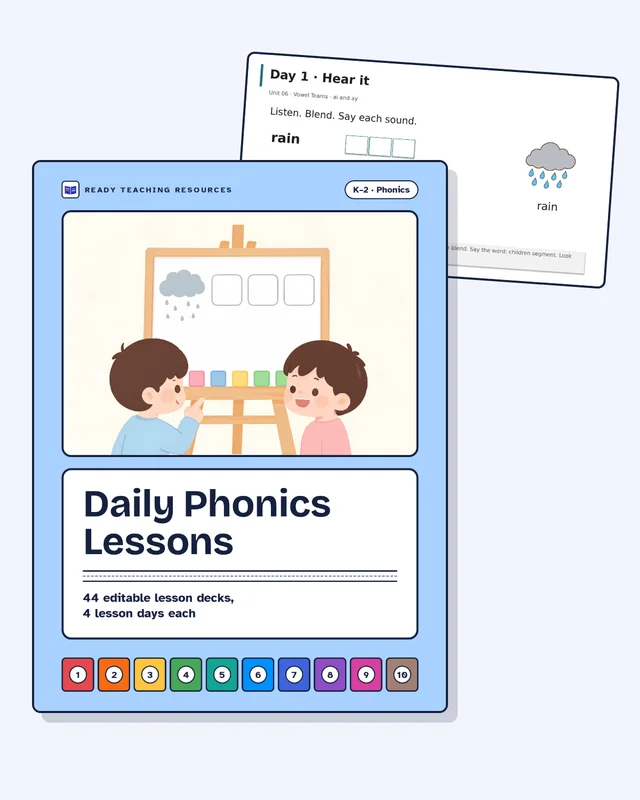
The K-2 Daily Phonics Lessons keep one pattern to a deck, as PowerPoint decks made for Google Slides, with a Start Here guide for the routine, pacing, and scope and sequence. Delivery is an instant download after checkout: one ZIP with a Start Here guide, for kindergarten, 1st grade, and 2nd grade. This download is lessons only. Assessments and a class tracker sit outside it.
Is structured literacy a pedagogy?
It is an instructional approach, not a single published program. Sources call it a model and a blueprint: explicit, systematic teaching of foundational skills and of meaning, syntax, and writing.
What does a structured phonics lesson look like?
Review what was taught, model one new pattern, have children blend and spell it, read a short page that uses it, and note who needs the same pattern again. That is cumulative, explicit, and diagnostic in one sitting.
Sources
-
Daily Phonics Lessons
44 editable lesson decks, 4 lesson days each