What explicit, systematic phonics instruction looks like
Published 2026-10-27 · Updated 2026-10-27

Explicit phonics instruction shows the sound and the spelling, out loud, before children try the word. Systematic phonics instruction uses one planned order, and each new spelling builds on the last. A lesson needs both. Showing sh clearly, then jumping to vowel teams the next day, is explicit and not systematic. Following a chart and never saying the sound is systematic on paper and not explicit in the room.
National Reading Panel findings define phonics instruction as teaching letter-sound correspondences and their use in reading and spelling. The hallmark of a systematic approach, on that page, is a sequential set of elements taught with a stated level of directness. Incidental phonics, by contrast, highlights a spelling when it happens to appear in a book.
What explicit looks like in the minute
Voyager Sopris describes explicit instruction as clearly and directly teaching the skill so students understand the sound-letter match, and it pairs that with gradual release: I do, we do, you do.
I do. You say the sound, show the letters, and blend one word while the class watches. Children are not guessing the rule from a worksheet.
We do. The class says the sound with you and blends the next word while you point.
You do. Children read a new word with that spelling, then spell one from dictation, while you listen.
If you skip the model, the lesson is practice, not instruction. If you never hand the word to the child, the lesson is a lecture.
What systematic looks like across the weeks
Systematic means the sequence is chosen before the week starts. Voyager Sopris calls that a logical sequence that builds on skills already learned. The National Center on Improving Literacy says systematic phonics begins with letter-sound correspondence and moves on to regular and irregular word reading. There is no single agreed letter order, the center says, but high-utility sounds such as m, a, and s come early so words can appear soon. Harder spellings such as sh, a_e, and igh wait until one-letter sounds are in place.
A new pattern should use old ones. When sh is new, ship uses short i and p, which the class already reads. The day you teach sh is the wrong day to open silent e.
Review is part of the sequence, not a filler. Voyager Sopris says that once a skill is introduced, review it for four to six weeks, because one day on a spelling is only the start. Keep a few old words in the warm-up. The full K-2 order is in phonics scope and sequence.
What the instruction includes
Phonics instruction is more than a sound card. Put these jobs in the lesson:
- Hear and name the new spelling, in uppercase and lowercase when it is a single letter.
- Blend from left to right, which the practice guide requires for letter sounds and sound-spelling patterns.
- Build words by changing one sound, the practice guide's word-building move.
- Read the words alone and in a decodable line.
- Spell from dictation.
- Teach a high-frequency word the line needs, including an irregular one, so children can recognize it efficiently.
Waterford describes the early piece as the alphabetic principle: letters represent sounds in a predictable way, plus letter recognition and basic correspondences. Once a small set of those correspondences is known, children pair them with hearing sounds in words to decode and encode. That pairing is the rest of the lesson, not a later unit.
The day-to-day version of these jobs is in teaching phonics.
An explicit sh lesson (illustrative words)
Known already: short vowels and the consonants in these words. New spelling: sh for /sh/.
I do. "S and h together spell /sh/. Watch. Ship. /sh/ /i/ /p/. Ship." Write sh. Point under each spelling as you blend.
We do. Children say /sh/. Together: shop. /sh/ /o/ /p/. Shop. Ask why sh is one sound here, not /s/ then /h/.
You do. Children read shut. Then they write sh, then shut, from your voice only.
A child who says "s-h" as two sounds needs the model again, not a harder word. A child who reads ship and writes sip needs the dictation, because the spelling has not stuck.
Cumulative text, not a new game
After the isolated words, read a line that uses sh and earlier patterns. Voyager Sopris says decodable text should practice the new skill and pull in words from patterns already taught. Dictation does the same job in writing: a word or a sentence, with you modeling the first one and children applying the spelling.
A sort, a chain, or a game can carry the you-do turn. The game is not a second objective. If the chain changes two sounds at once, it is no longer practice of this spelling.
Where a deck fits, and where the advice stops
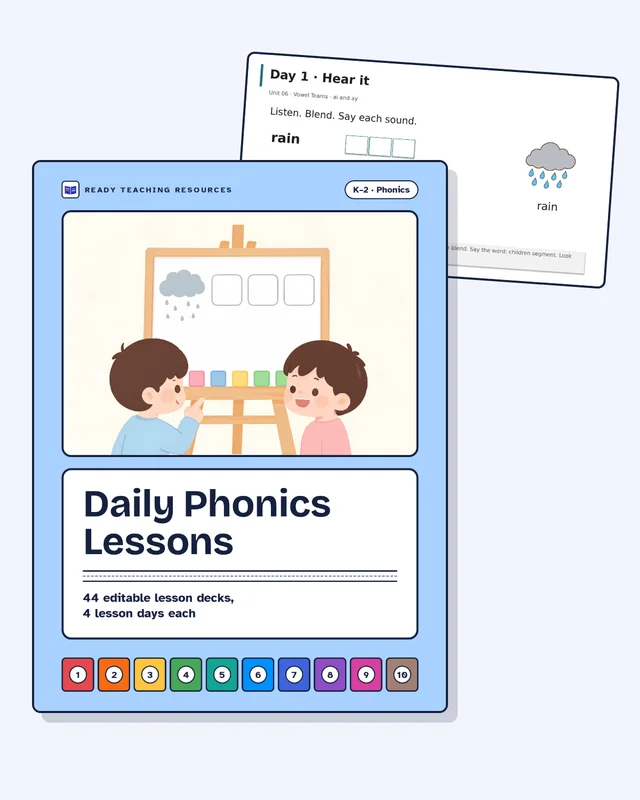
The K-2 Daily Phonics Lessons hold PowerPoint decks made for Google Slides, one per phonics pattern. They include the routine, pacing and scope and sequence inside a Start Here guide. They are for kindergarten, 1st grade, and 2nd grade. They open with PowerPoint, Keynote or a Google account. They are an instant download after checkout, and nothing ships. They are lessons only and include no assessments or tracker. How to write the plan around that routine is in phonics lesson plan.
One limit: explicit, systematic phonics teaches the code. It does not replace daily reading of connected text. The practice guide still asks that each student read connected text every day for accuracy, fluency, and comprehension. Sound cards with no book still leave the purpose unused.
Can you give me an example of explicit phonics instruction?
For sh, the teacher says the sound, shows the two letters, and blends ship while the class watches. Then the class blends shop with the teacher. Then children read and spell shut on their own.
What does it mean to teach systematically?
You follow one sequence. Each new spelling uses sounds already taught, and you keep reviewing the old spelling for several weeks instead of dropping it the next day.
What does phonics instruction include?
Letter-sound teaching, blending and word building, reading decodable words and a short text, spelling from dictation, and a planned review of patterns already taught.
What is systematic phonics instruction?
A planned list of spellings, taught in order, from simple letter sounds toward harder patterns and irregular words. The teacher does the teaching. The book does not choose the skill.
Sources
- Eunice Kennedy Shriver National Institute of Child Health and Human Development: Findings and Determinations of the National Reading Panel
- National Center on Improving Literacy: How to Use Systematic Phonics Instruction in Your Classroom
- Institute of Education Sciences: Foundational Skills to Support Reading for Understanding in Kindergarten Through 3rd Grade
- Voyager Sopris Learning: Phonics Road Map: 5 Essential Strategies for Effective Instruction
- Waterford: Phonics and Decoding Skills for Reading Fluency
-
Daily Phonics Lessons
44 editable lesson decks, 4 lesson days each