A K-2 phonics scope and sequence
Published 2026-10-27 · Updated 2026-10-27

A phonics scope and sequence is the skill list and the order you teach it. Scope is which spellings you will cover. Sequence is the order, so each new spelling uses sounds children already know. There is no single agreed order for every letter. This guide uses ten units, simple to complex, with a grade band on each. Other published orders differ. Pick one and stay with it.
Ten units
Literacy Edventures says to teach easier skills first, such as letters, sounds, and CVC words, then harder skills such as digraphs, blends, and long vowels. The National Center on Improving Literacy says there is no single agreed letter order, but high-utility sounds come early, and spellings such as sh, a_e, and igh wait until one-letter sounds are in place. The table below is this guide's proposed map, consistent with those principles. It is a teaching map, not a state standard.
| Unit | Patterns | Grade band |
|---|---|---|
| 1 | Letter sounds in five groups, plus hearing sounds in words: m s a t p, then i n f c, o d g h l, u b r k j, e w v y z x qu | K |
| 2 | Short vowels in CVC words: a, i, o, u, e | K, 1st |
| 3 | Digraphs: sh, ch, th, wh, ck | K, 1st |
| 4 | l-blends, r-blends, s-blends, and other final blends; ng (digraph, one sound); nk (/ŋ/ plus /k/) | 1st |
| 5 | Long vowels with silent e: a_e, i_e, o_e, u_e, e_e | 1st |
| 6 | Vowel teams: ai/ay, ee/ea, oa/ow, igh/ie, ue/ew | 1st, 2nd |
| 7 | R-controlled vowels: ar, or, er/ir/ur | 1st, 2nd |
| 8 | Diphthongs and other vowels: oi/oy, ou/ow, oo, au/aw | 2nd |
| 9 | Syllable types: closed, open, consonant-le, and mixed two-syllable words | 2nd |
| 10 | Prefixes and suffixes: -s and -es, -ed, -ing, un- and re-, and -er, -est, -ful, -less, -ly | 2nd |
Kindergarten detail is in kindergarten phonics. The daily routine that carries any row is in teaching phonics.
The letter-sound unit is not a year of letter names alone. As soon as a vowel is in the set, children read words. The short-vowel unit sorts those words by vowel. Digraphs are one sound for two letters. Blends keep every sound. In the blends row, final blends stay separate from ng and nk. Reading Universe calls ng a consonant digraph for that nasal phoneme. The Reading Advice Hub says the same nasal, written ŋ, can be spelled by n alone before k, as in think, which leaves k as its own sound, so nk is /ŋ/ plus /k/. Silent e is the first long-vowel spelling, and vowel teams come after it, not before.
Some orders teach silent e before blends. This map teaches blends first, then silent e, because the blend words still use short vowels children already read. Open the next family only after those short-vowel words are readable.
What first graders learn
The units tagged 1st are short vowels, digraphs, blends, silent e, and the start of vowel teams and r-controlled vowels. A first grader who still cannot blend sat belongs in the short-vowel unit, not in blends.
The North Carolina Department of Public Instruction lists a related set for 1st grade readers: words with ch, th, sh, and ph, regularly spelled one-syllable words, long-vowel spellings, two-syllable words that follow basic patterns, and grade-appropriate irregular words. That page is a parent guide, not a national rule, and it is not a claim that these units match a state standard. Two differences are worth seeing. That page includes ph. These ten units do not give ph its own pattern. That page places some two-syllable words in 1st grade. This map holds syllable types for the 2nd grade unit.
To teach a first-grader, use one pattern and the same four steps: hear the sound, build words, read them, write them. At home, three words and one sentence are enough. Review yesterday before you add a sound. If the child guesses from the first letter, stay on blending. What explicit teaching looks like is in explicit, systematic phonics instruction.
What second graders learn
The units tagged 2nd finish vowel teams and r-controlled vowels, then teach diphthongs, syllable types, and prefixes and suffixes. Closed, open, and consonant-le syllables are how children read two-syllable words without guessing the middle. Prefixes and suffixes come after the base word is readable.
The North Carolina Department of Public Instruction says 2nd grade readers distinguish long and short vowels, read regularly spelled words with long vowels, read words with common prefixes and suffixes, and recognize grade-appropriate irregular words. Its practice notes also name multisyllabic words and syllable types. The practice guide tells teachers to teach common word parts, which is the job of the last unit.
After the letter sounds
After a few letter sounds, teach short-vowel CVC words. That is the short-vowel unit. The literacy center says relationships that let children read words quickly should come first, such as m, a, and s. Digraphs are the next family in this map, then blends, then silent e. A child who asks "what comes after the sound" needs the next row of the table, not a new activity on the same five letters.
One download, organized by unit
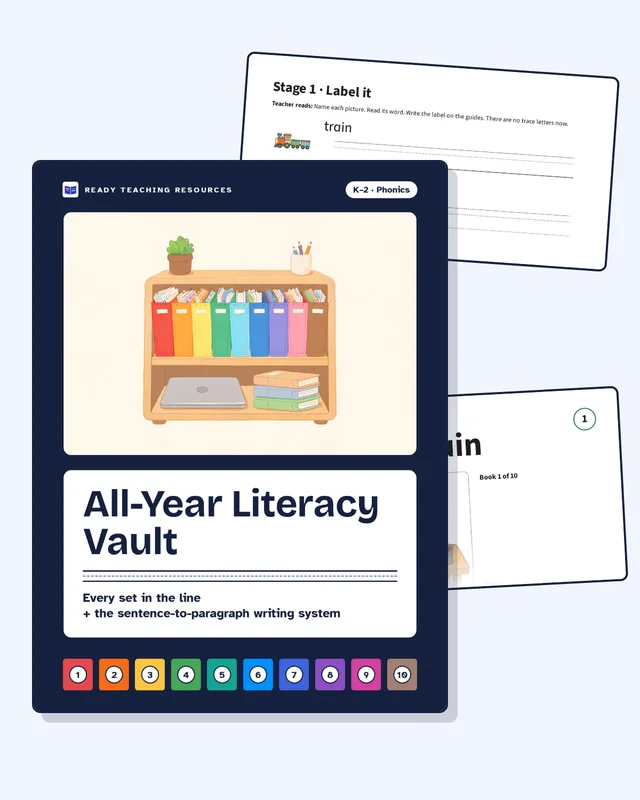
The All-Year K-2 Literacy Vault is the complete K-2 phonics year in one download, organized by unit, plus a writing system. It includes decodable books and wall cards, sentences and fluency passages, the worksheets and centers mega pack, lesson decks, assessments and a class tracker. It includes a Sentence-to-Paragraph Writing System for all 10 units, and a Vault Start Here guide with a pattern index. It is for kindergarten, 1st grade, and 2nd grade. Delivery is one instant digital download; nothing is shipped. The All-Year K-2 Literacy Vault delivers later any new units released during the school year, and they are not in this download.
What phonics do first graders learn?
In this map, first grade includes short vowels, digraphs, blends, silent e, and the start of vowel teams and r-controlled vowels. North Carolina's parent page also lists long-vowel spellings, one-syllable words, and some two-syllable words.
How can I teach phonics to my first-grader?
Use one pattern a day: hear it, build it, read it, write it. Start at the unit your child can almost read. Do not open blends if short-vowel words are still a guess.
What is scope and sequence in curriculum?
Scope is which skills you will teach. Sequence is the order. A phonics scope and sequence is that list, arranged so each new spelling uses sounds already taught.
What to teach after phonics sound?
After a few letter sounds, teach short-vowel CVC words such as sat and sip. Digraphs, blends, and silent e come after children can blend those words.
What phonics do second graders learn?
In this map, second grade includes diphthongs, syllable types, and prefixes and suffixes, and it finishes vowel teams and r-controlled vowels. North Carolina's parent page lists long vowels, prefixes and suffixes, and irregular words.
Sources
- Literacy Edventures: Choosing and Using a Phonics Scope and Sequence
- National Center on Improving Literacy: How to Use Systematic Phonics Instruction in Your Classroom
- North Carolina Department of Public Instruction: Phonics for 1st Grade
- North Carolina Department of Public Instruction: Phonics for 2nd Grade
- Institute of Education Sciences: Foundational Skills to Support Reading for Understanding in Kindergarten Through 3rd Grade
- Reading Universe: Overview of Consonant Digraphs
- The Reading Advice Hub: Ng Digraph Words and Sounds
-
All-Year Literacy Vault
Every set in the line, plus the sentence-to-paragraph writing system