Teaching phonics with one daily routine
Published 2026-10-27 · Updated 2026-10-27

Teach one pattern a day with the same four steps: hear the sound, build words, read the words, then write them. Repeat that order so children learn the spelling, not a new activity. You choose the minutes.
A phonics lesson is those four steps on one spelling. Readers who want one method should use this: a planned sequence, taught directly, then used to read and spell. National Reading Panel findings describe systematic phonics as a planned sequence of elements, taught explicitly, rather than a sound grabbed from whatever page is open. Synthetic phonics, the version this routine uses, links a letter or letter group to its sound and then blends the sounds into a word.
| Step | What you do | What the step is for |
|---|---|---|
| Hear it | Say the sound, show the spelling, have children repeat it | The sound is in the ear before it is on the page |
| Build it | Change one sound at a time and rebuild the word | Children assemble the pattern instead of only watching |
| Read it | Read the words, then a short decodable line | The spelling moves into actual reading |
| Write it | Spell the sound, a word, and a sentence from dictation | You can see whether the link is theirs |
Hear the sound, then show the spelling
Start with the ear. Reading Universe opens the lesson with a listening game: children hear the target sound in a spoken word before they see letters. A roller-coaster hand, sound boxes, or finger taps can mark beginning, middle, and end. For cat, they say /k/, /a/, /t/, then you ask for the beginning sound.
Then show the spelling. The National Center on Improving Literacy says to name the letter or letters, show uppercase and lowercase, and tie the sound to a picture, such as p, a pig, and /p/. Work with a few sounds at a time. Start with high-utility letters such as m, a, and s so words can appear soon. Hold back letters that look or sound alike, such as b and d, or b and v, until the first of the pair is solid. The center also says there is no single agreed order for letter sounds. Pick one order and keep it. A letter-by-letter start is in how to teach letter sounds.
This step is the setup. If children cannot hear the sound in a spoken word, more cards will not fix the lesson.
Build words by changing one sound
The Institute of Education Sciences practice guide tells teachers to blend letter sounds and sound-spelling patterns from left to right until the pronunciation is a word. It also tells teachers to use word-building to link letter-sound knowledge. Say the word, stretch the sounds, then match letters. Change one sound and build again: sat, mat, map.
Continuous sounds are easier to hold. The literacy center notes that /m/, /s/, and /f/ can be stretched, while stop sounds such as /b/, /p/, and /k/ are a quick puff. An easier first blend is a three-sound word of continuous sounds, such as man. A stop sound at the end is next, then a stop sound at the start. A beginning blend comes later. Stay with the easier words until the child can blend them, then move.
Prompt children to keep the voice moving through the word, then say it the fast way, without holding each sound. That is the center's blending cue. If a child says snake for sat, hide the last letter, blend the first two sounds, then add the last sound.
Read the words, then a decodable line
Read the same words in a list, then inside a line that uses only taught spellings. The practice guide says to have students read decodable words in isolation and in text. The same guide says to teach regular and irregular high-frequency words so students can recognize them efficiently, and to introduce a non-decodable word the line needs as a whole word. Keep the line inside spellings you have taught, plus that whole word.
The National Right to Read Foundation primer says each day the student reads lists of related words, and that phonics instruction must be reinforced by decodable text. A list without a sentence leaves the pattern on the card.
Write the sound, the word, and a sentence
Reading Universe treats dictation as a standing part of the lesson: sound dictation, word dictation, and sentence dictation. The primer says each day the student spells the related words from dictation. Say /a/. Children write a. Say mat. They write mat. Then one sentence that uses only taught patterns plus a word you have already taught as a whole word.
Writing is the check. A child who can read mat and cannot spell it still needs this step. The teacher taps left to right. Children may tap in whatever way lets them hear each sound.
You set the minutes
Reading Universe demonstrates the routines inside a 30-minute phonics block. Paige Bessick reports 15 to 20 minutes for the word-work portion in her first-grade day. Those clocks do not match, and neither one is a rule for your room. Shorten the word list before you drop a step. A lesson that hears and sorts, then skips reading and spelling, has not taught the pattern.
Bessick's own point is the reason for a stable routine: children should focus on the skill, not on learning a new activity for each spelling. Her updated list still includes blending, word building, sorts, dictation, and decodable text. A sort is one piece of the lesson, not the whole lesson.
A short-a turn (illustrative words)
Known for this turn: s, a, m, t, p. The words below are a teaching script, not a scored list.
Hear /a/ as in apple. Show Aa. Children say the sound.
Build sat, then mat, then map, then sap, then tap. Each change is one sound.
Read the list. Then read "Sam sat." Every word uses only s, a, m, and t.
Write /a/, then mat, then "Sam sat."
If the group already knows short a, run the same four steps on the new spelling, such as sh, and keep yesterday's words in the review.
Use the same steps in a small group
Phonics intervention, in a K-2 room, is the same routine with fewer children and more turns. Sit with the group that cannot yet do the whole-class pattern. Start where they can almost blend, not at the grade-level unit. Hear the sound, build three words, read them, write them, and stop. The next day, review that pattern before you add one sound.
One study summarized in the practice guide split a small-group session into phonics and word recognition, then fluency work, then short passages. You can mirror that shape without copying the study's clock: the four steps first, then a reread of a decodable line, then a sentence they already know. Give every child a turn to blend and to spell. A child who only watches the group has not had the lesson.
This routine is classroom teaching. It is not a published intervention program, and it does not screen children or replace a specialist's plan. A child who is far behind still needs the school's decision about extra time and about how progress will be checked.
Where to begin, at school or at home
Begin with letter sounds, not with a long-vowel rule. After a few sounds, teach short-vowel CVC words, then move to more complex spellings such as sh, a_e, and igh, which is the center's progression once one-letter sounds are in place. One public outline on the Science of Reading Formula page walks from letter sounds to CVC words, digraphs, silent e, beginning and ending blends, vowel teams, diphthongs, r-controlled vowels, and then prefixes and suffixes. Orders differ. The honest move is to pick one sequence and stay with it. The K-2 map we use is in phonics scope and sequence.
A parent can run the same four steps with one child and a shorter list. One pattern is enough. Read a decodable page that matches it. Fun is the listening game, the one-sound chain, or a picture sort, still on that pattern. A new worksheet theme each day is not a new lesson.
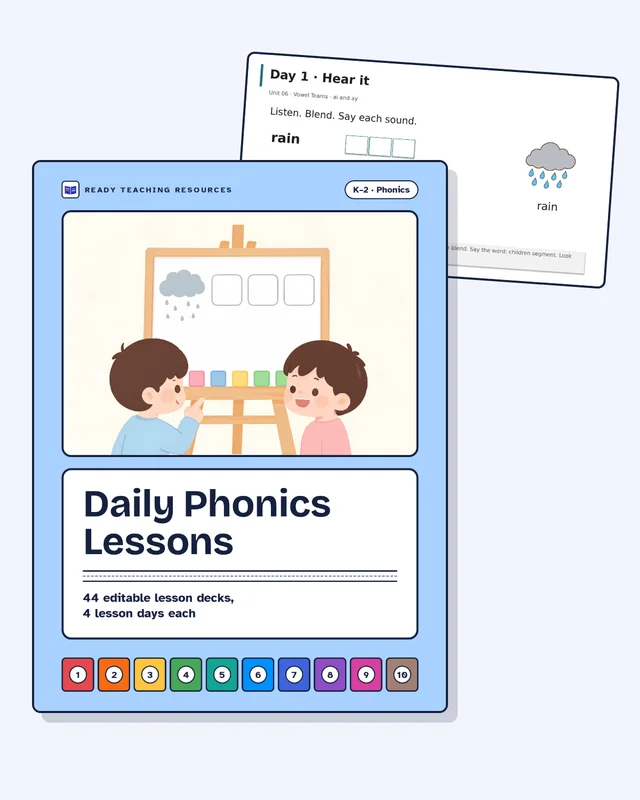
The K-2 Daily Phonics Lessons are PowerPoint decks made for Google Slides, one per phonics pattern, for kindergarten, 1st grade, and 2nd grade. They include the routine, pacing and scope and sequence in a Start Here guide. They need PowerPoint, Keynote or a Google account. They are lessons only, with no assessments and no tracker. They are an instant digital download, and nothing ships. What belongs in the written plan, beyond the slides, is in phonics lesson plan.
What the routine cannot finish
Phonics is a means to an end. The National Reading Panel findings say programs that focus too much on letter-sound relations and not enough on putting them to use are unlikely to be very effective. The practice guide's next job is connected text every day, for accuracy, fluency, and comprehension. A clean phonics block with no book still leaves reading unfinished.
Is there a free PDF resource for teaching phonics in English?
Yes. The National Right to Read Foundation phonics primer is a public PDF, and the Institute of Education Sciences practice guide is a public PDF. Both explain sounds, blending, dictation, and decodable reading. A full classroom set of lesson decks is a separate purchase.
What are some ideas for phonics interventions?
Keep the same four steps in a small group: hear the sound, build a few words, read them, write them. Start at the pattern the group can almost do, give every child a turn, and review yesterday before you add one sound. This is classroom teaching, not a published intervention program.
What are the steps to teach phonics?
Hear the target sound and show its spelling. Build words by changing one sound. Read those words, then a short decodable line. Spell the sound, a word, and a sentence from dictation.
What way of teaching phonics should a K-2 class use?
Teach a planned sequence directly, then use it to read and spell. That is explicit, systematic phonics. No single brand fits every class. The four steps are the daily version of that idea.
How can I teach phonics to my child?
Use one pattern and a short list. Hear the sound, build three words, read them, and have your child write them. Then read a decodable page that uses only that pattern plus words you have already taught.
How to teach phonics in a fun way?
Keep the four steps and change the motion, not the pattern. A listening game, a one-sound word chain, or a picture sort can carry the same spelling. A new craft each day teaches the craft.
How to begin teaching phonics?
Begin with a few high-utility letter sounds, including m, a, and s, so real words appear quickly. Then teach short-vowel CVC words before digraphs, silent e, and longer patterns. Stay with one sequence.
Sources
- Institute of Education Sciences: Foundational Skills to Support Reading for Understanding in Kindergarten Through 3rd Grade
- Eunice Kennedy Shriver National Institute of Child Health and Human Development: Findings and Determinations of the National Reading Panel
- National Center on Improving Literacy: How to Use Systematic Phonics Instruction in Your Classroom
- Reading Universe: How to Teach a Phonics Lesson
- National Right to Read Foundation: Phonics Primer
- Paige Bessick: How To Teach Phonics in the Primary Grades
- Science of Reading Formula: The Best Order to Teach Phonics Skills: A Step-by-Step Guide
-
Daily Phonics Lessons
44 editable lesson decks, 4 lesson days each