Oral Reading Fluency Norms for First and Second Grade
Published 2026-10-27 · Updated 2026-10-27

These are the 2017 compiled oral reading fluency norms from Hasbrouck and Tindal, Table 4 of that technical report. The cells are words correct per minute (WCPM) at the 90th, 75th, 50th, 25th, and 10th percentiles. The report's table starts at first grade. It does not include kindergarten. This page prints first grade and second grade, the grades this guide is for. Higher grades are in the same table and are not reprinted here.
A score is not "good" or "bad" by itself. Hasbrouck and Tindal say to compare a student's WCPM with the fall, winter, or spring benchmark for the grade, and to call the result significantly above benchmark, above benchmark, at the expected benchmark, below benchmark, or significantly below benchmark. Students below or significantly below benchmark, the report says, are at possible risk of reading difficulties and are candidates for further assessment. The minute does not diagnose. Compare a score with those benchmarks only when it comes from grade-level oral reading fluency assessment passages given under their standardized protocol. A classroom one-minute count on a decodable or practice passage tracks progress on that passage, and that count is not comparable to Table 4.
The Institute of Education Sciences practice guide defines oral reading fluency as accuracy, rate, and expression together, so a WCPM cell covers the timed accuracy count and still leaves expression to the ear.
First grade, Table 4
Fall cells for first grade are blank in Table 4. Winter and spring are listed.
| Percentile | Winter WCPM | Spring WCPM |
|---|---|---|
| 90th | 97 | 116 |
| 75th | 59 | 91 |
| 50th | 29 | 60 |
| 25th | 16 | 34 |
| 10th | 9 | 18 |
Second grade, Table 4
| Percentile | Fall WCPM | Winter WCPM | Spring WCPM |
|---|---|---|---|
| 90th | 111 | 131 | 148 |
| 75th | 84 | 109 | 124 |
| 50th | 50 | 84 | 100 |
| 25th | 36 | 59 | 72 |
| 10th | 23 | 35 | 43 |
How to read a cell
Read a cell only for a score from grade-level oral reading fluency assessment passages given under their standardized protocol. A classroom one-minute count on a decodable or practice passage is useful for tracking progress on that passage. That count is not a cell in this table. A passage printed for phonics practice is not comparable to Table 4.
- Use the child's grade placement on the assessment, not the grade you wish the text were. A second-grade assessment score is read against second grade.
- Use the season you actually tested: fall, winter, or spring. First grade has no fall number in this table. Do not borrow the winter cell for September.
- Find the percentile row. The 50th percentile is the middle of the norm sample in that cell: half the compiled scores sat at that WCPM or below. It is a description of the sample, not a passing score the report names.
- Read the cell as WCPM, words correct per minute, not as a percent and not as a grade-level label.
A second-grade spring score of 100 is the 50th percentile in this table. A first-grade spring score of 60 is the 50th percentile. A first-grade spring score of 100 sits between the 75th percentile (91) and the 90th percentile (116) in the same table. Same number, different meaning, because the grade and season changed.
How to get the number you compare
Hasbrouck and Tindal describe the score as a one-minute read of an unpracticed passage. The examiner notes errors (words read or pronounced incorrectly, missing words, words read out of order, or words the examiner says after a 3-second pause) and calculates words read correctly per minute. The steps for a classroom listen, and why expression is a separate note, are in what is reading fluency. That classroom listen is not the score for this table.
Hasbrouck and Tindal say curriculum-based measures were based on standard assessments that present tasks of equal difficulty, and they built Table 4 from standardized, commercially available oral reading fluency assessments. They also set aside one assessment after its scores differed from the others, perhaps because of how its passages were constructed. A count on a different kind of passage is a different task.
Compare a score with this table only when it comes from grade-level oral reading fluency assessment passages given under their standardized protocol. A read shorter than one minute, then doubled, or a passage the child has already practiced, is a different task. Say so on the record and do not drop that score into Table 4. Keep a decodable or practice count off Table 4 too. It can still show progress on that passage.
Kindergarten is not in the 2017 table. A one-minute grade-level passage is often too long for a kindergartner, and there is no kindergarten row here to force a comparison. Listen for accuracy on decodable lines instead. Use the first-grade winter column only when the child is in first grade and you scored grade-level oral reading fluency assessment passages under their standardized protocol.
What the table does not do
- It does not set a cutoff the report calls passing. "At the expected benchmark" is the report's phrase. It does not point to one percentile and name it the goal.
- It does not measure comprehension or expression. A child at the 50th percentile can still read in a flat voice or miss the point of the page.
- It is not the only reprint in circulation. Other pages show other cells. Use this 2017 table, name it, and do not mix a cell from a different figure into the same conversation.
- It is not a reason to race. If the child is missing many words, that passage is too hard for a rate comparison with this table. Teach the patterns, and use a decodable passage only for a practice count on that passage. Keep the practice count off Table 4. See fluency strategies and repeated reading.
One limit of this advice: Table 4 tells you where a score from that assessment protocol sits in a 2017 compiled sample. It does not tell you why the score is there, and it does not choose the next lesson by itself.
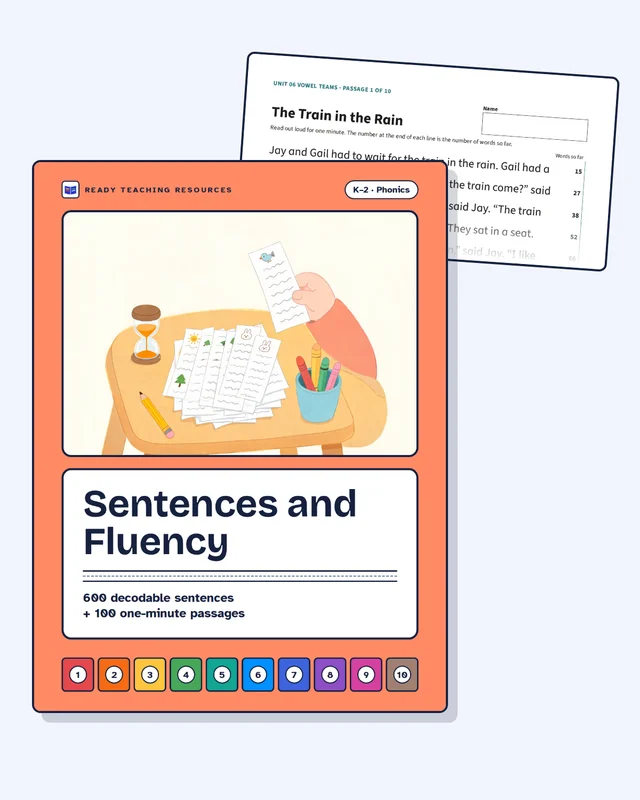
Running word counts are printed on the one-minute fluency passages in the K-2 Decodable Sentences and Fluency Strips download, with a one-minute reading record on every passage. The print files are US Letter, and there is no A4 edition.
Use those passages for a practice count on that page. A count from them is not a Table 4 score.
What is a good reading fluency score?
The 2017 report does not name one words-correct score as good. Compare a score with the same grade and season in the table only when it comes from grade-level oral reading fluency assessment passages given under their standardized protocol. A count on a decodable practice passage is not that score. A score below the benchmark, in the report's words, means possible risk of reading difficulties and a reason for a closer look, not a label from the minute alone.
What grade level is reading 100 words per minute?
In the 2017 table, 100 words correct per minute is the spring score at the 50th percentile in second grade. It is not the middle score for first grade. First-grade spring at the 50th percentile is 60.
Sources
-
Sentences and Fluency
600 decodable sentences and 100 one-minute passages