Fluency Strategies for K-2: Match the Practice to the Problem
Published 2026-10-27 · Updated 2026-10-27

A fluency strategy only helps if it matches the reason the reading is slow. Listen for one minute, or for a short decodable page. If many words are wrong, the child needs decoding work. If the words are right and the voice is flat or word by word, the child needs phrasing and repeated reading. Those are different lessons. A speed game on a too-hard page trains guessing.
The Institute of Education Sciences practice guide defines oral reading fluency as accuracy, rate, and expression together. NWEA describes reading comprehension as depending on both decoding and language comprehension. A fluency activity that skips the words, or that skips meaning, drops one of those parts. How to score the minute is in what is reading fluency. Where the score sits is in oral reading fluency norms.
If the errors are the problem
Stop the timer. The passage is ahead of the patterns the child has learned, or the heart words have not been taught.
- Teach the missed pattern, then reread a page that uses only taught sounds and taught heart words. The Institute of Education Sciences practice guide calls that decodable text: text the student can read with the letter sounds and high-frequency sight words already learned.
- When the child misses a word, have them sound it out, say it, and reread the sentence. That is the corrective feedback step the National Center on Improving Literacy lists.
- Keep the set small. A few sentences the child can decode beat a long page of guesses.
A fluency strip or a short passage is the right length here. A race is not. See heart words if the errors are irregular spellings.
If the words are right and the voice is not
Now repeated reading and phrasing are the strategies. The child can decode the page. The work is rate and expression.
The National Center on Improving Literacy lists four moves for fluency with text: read the same passage several times, set a goal for correct words in a minute or for reading farther, give feedback on an error, and graph the first read beside the next one. Use those on text the child already reads accurately. The full repeated-reading routine is in repeated reading.
Add a model so the child hears phrasing.
- Echo reading: you read a sentence or a phrase, the child reads it back. Curriculum Associates describes echo reading as a daily practice aimed at prosody, the expression in the voice. The page is about older students. The move is the same in K-2 if the text is decodable: you supply the phrasing, the child copies it, then the child tries the sentence alone.
- Alternated reading: you and the child take turns on continuous sections. The Institute of Education Sciences practice guide names alternated reading as the student and a more proficient reader taking turns on continuous sections of the text.
- Phrase scoops on a sentence the child can already decode. Mark a pause where the meaning breaks, read it that way, then have the child read it. This is a classroom mark, not a score.
A game counts as fluency practice only if the child reads the text. Partner rereading a passage, echo reading a silly voice on a sentence the child can decode, and coloring a square on a graph of the second read are enough. A board game that asks the child to shout a word from a picture is a different skill.
A one-page choice
| What you hear | Strategy | What to skip |
|---|---|---|
| Many words wrong | Teach the pattern, reread decodable text, sound-out feedback | A speed goal, a long uncontrolled page |
| Words right, word-by-word or flat | Repeated reading, echo a phrase, graph the next read | More phonics cards for a pattern the child already uses |
| Both | Decoding first, phrasing on a shorter page the same day | Treating the slow rate as the only problem |
Kindergarten often needs the first row. A full one-minute passage can wait. First and second grade use both rows, passage by passage. A child can be accurate on short vowels and inaccurate on vowel teams in the same week. Sort the page, not the child, into one row.
What to stop calling a fluency strategy
- Timed reading on text the child cannot decode.
- Round-robin of a hard page, which gives each child one cold sentence and no reread.
- Choral reading of words the class is guessing together. Choral reading helps after a model, on text the children can follow.
- A stack of fluency games with no passage. The strategy is the reread and the feedback, not the theme of the game.
One limit of this advice: matching the strategy to the listen tells you what to practice today. It does not tell you the child has finished learning to read, and it does not replace a phonics lesson when the errors are pattern errors. NWEA keeps decoding and language comprehension in the same picture. Fluency practice sits between them. It does not erase either one.
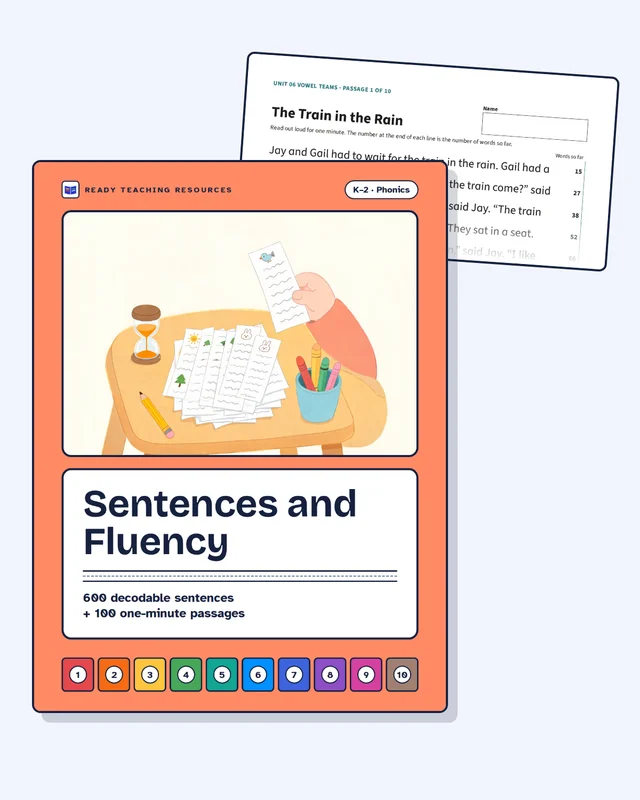
600 decodable sentences as fluency strips, 60 per unit, are in the K-2 Decodable Sentences and Fluency Strips download. The license is for one teacher and one classroom.
What are some fun activities to improve reading fluency?
Echo reading, a partner reread of a passage the child can decode, and a simple graph of the second read. The activity has to include reading the words. A game that rewards a guess from a picture is not a fluency activity.
How do you improve reading fluency?
Listen first. If many words are wrong, teach the pattern and reread decodable text. If the words are right and the voice is flat or word by word, reread the same passage, echo a phrase, and listen for expression.
Sources
- National Center on Improving Literacy: 4 Steps to Teach Reading Fluency
- Institute of Education Sciences: Foundational Skills to Support Reading for Understanding in Kindergarten Through 3rd Grade
- NWEA: Supporting fluency and comprehension using practices grounded in the science of reading
- Curriculum Associates: Fun Tips to Develop Reading Fluency with Middle Schoolers
-
Sentences and Fluency
600 decodable sentences and 100 one-minute passages