What Is Reading Fluency, and How Is It Measured?
Published 2026-10-27 · Updated 2026-10-27

Reading fluency is reading a passage aloud accurately, at an appropriate rate, and with expression. The Institute of Education Sciences practice guide defines oral reading fluency that way: accuracy, rate, and expression, including pausing and oral interpretation of the text. The Six Shifts uses the same three parts and adds that the reader is also understanding the text. Speed by itself is not the definition.
A fast reading full of errors is not fluent. A slow, accurate reading with no phrasing is not fluent either. You need all three parts, and you measure them in different ways.
The three parts, in the order you should check them
Accuracy. The child reads the words that are on the page. If many words are wrong, the child is not ready for a speed goal. The text is ahead of the patterns taught, or the heart words have not been taught. Fix that before you time anything. See heart words when the errors are irregular spellings, and high-frequency words when the errors are common words the class should already have sorted.
Rate. How many words the child reads correctly in a set time. Hasbrouck and Tindal describe the common check: the student reads aloud from an unpracticed passage for one minute, and the score is words read correctly per minute, often called WCPM. Rate is one part of fluency. It is not the whole thing.
Expression. Phrasing, stress, and pauses that match the meaning. The minute score does not record this. You listen for it. A child can post a solid WCPM and still read in a flat voice. That child needs phrasing practice, not a faster timer.
The Six Shifts calls fluency a bridging skill because it depends on decoding and on language comprehension. If decoding is shaky, the bridge is not up yet. Do not time a child on a page they cannot decode.
A one-minute words-correct check
Use this when you want a classroom count of rate and accuracy on one passage. Pick an unpracticed decodable or practice passage the child can mostly decode. The count tracks progress on that passage. It is not a score for a norms table.
A percentile comparison is a separate task. It needs grade-level oral reading fluency assessment passages, read under that assessment's standardized protocol. Hasbrouck and Tindal compiled their norms from standardized, commercially available oral reading fluency assessments, and they say curriculum-based measures were based on standard assessments that present tasks of equal difficulty. A decodable page, including a page sold for phonics practice, is not one of those assessment passages.
- Mark a starting point. Say you will listen for one minute and that you want the child's real reading, not a race.
- Start the timer when the child reads the first word. Stop at one minute. Draw a bracket at the last word read.
- While the child reads, mark errors. Hasbrouck and Tindal count these as errors: words read or pronounced incorrectly, missing words, words read out of order, and words you pronounce for the child after a 3-second pause.
- Count the words in the bracket. Subtract the errors. The remainder is words read correctly in that minute. That total is the WCPM.
- On a second listen, or during the same read, note expression in words, not in the WCPM box: phrased, word-by-word, or mixed. The score and the note answer different questions.
Self-corrections: the 2017 report's error list does not name them. When the score is from a standardized oral reading fluency assessment, Hasbrouck, writing for Learning Difficulties Australia counts a self-correction as correct if the child supplies it within 3 seconds. If that is not the protocol of the assessment you gave, follow that assessment's own administration rules. Do not add a rule that any later fix counts as correct. A practice-passage count still stays off the norms table. For how an assessment score sits against published norms, see oral reading fluency norms.
An illustrative minute, not a real child: the bracket holds forty words and you marked four errors. The result is 40 − 4 = 36 WCPM. The WCPM for that minute is the words correct, not the words attempted. Label the count illustrative and do not treat it as a norm.
What to do after the check
The next lesson depends on which part failed.
If accuracy is the problem, leave the timer. Teach the pattern or the heart word, then reread a shorter decodable passage. A speed drill on a too-hard page trains guessing.
If accuracy is solid and rate or expression is the problem, use the steps the National Center on Improving Literacy lists for fluency with text:
- Repeated readings of the same passage, aiming to reduce time and errors.
- A goal for correct words in a minute on that practice passage, or a goal to read farther in the passage, checked over weeks. A percentile from a norms table is a different comparison, and it is not this practice goal.
- Immediate feedback on an error: the child sounds out the word, repeats it, and rereads the sentence.
- A simple graph so the child can see the first read beside the next one.
Practice aloud, with feedback. Silent reading does not give you a WCPM, and it does not let you hear the phrasing. The National Center on Improving Literacy says students need chances to read aloud with teacher feedback, and that reading connected text daily supports accuracy, fluency, and comprehension.
For the repeated-reading routine itself, see repeated reading. For which practice fits which problem, see fluency strategies.
Kindergarten through second grade
In kindergarten, a full one-minute passage is often too long. Use a short decodable sentence or a few lines the child can decode, and still listen for accuracy before rate. The Hasbrouck and Tindal check is described for an unpracticed passage of one minute; if you shorten the text, say so on the record so that score stays off a one-minute norm table.
In first and second grade, a classroom one-minute count fits once the child can read a passage of connected text. For that practice count, keep the passage matched to taught patterns. A grade-level passage full of untaught spellings is a poor practice page: it shows frustration, not progress on the patterns taught. Percentile comparison still needs grade-level oral reading fluency assessment passages read under their standardized protocol.
One limit of this advice: a words-correct count on a practice passage shows rate and accuracy on that passage only. It is not a screening score, and it is not a full picture of reading. Hasbrouck and Tindal describe the screening score as one unpracticed minute on the assessment passage. Comprehension sits outside that minute, and expression still has to be heard. A child can be accurate and still not understand the page.
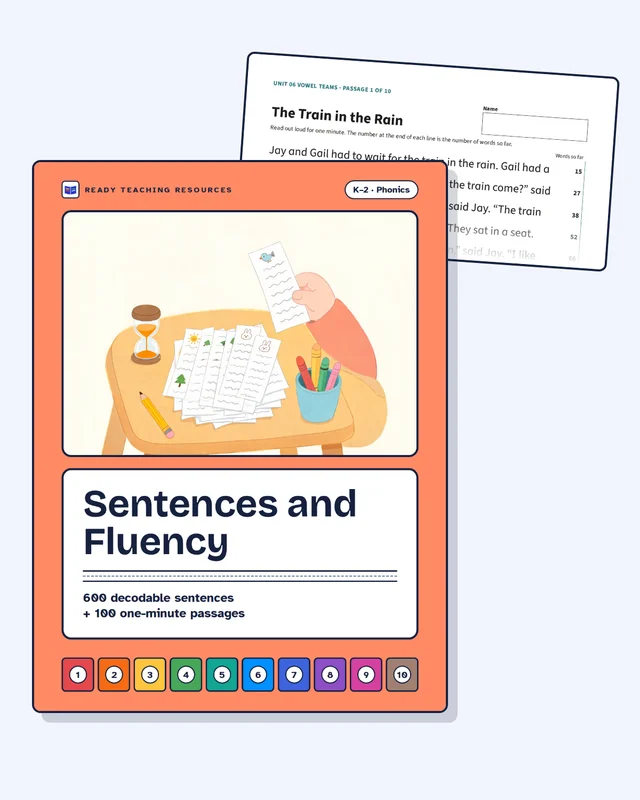
100 one-minute fluency passages, with a one-minute reading record on every passage, are in the K-2 Decodable Sentences and Fluency Strips download. A timer is needed to run the minute.
Those passages are for a practice count on that page. A count from them is not comparable to the norms table.
What are three elements of fluency?
Accuracy, rate, and expression. The child reads the words correctly, at a pace that fits the text, and with phrasing that sounds like talk. Speed alone is not fluency.
How can I teach reading fluency?
Use a passage the child can already decode. Read it more than once, give the word when there is an error and have the child reread the sentence, and keep a simple record of words correct in one minute. Listen for expression, which the minute score does not capture.
What causes trouble with fluency?
Many errors usually mean the text is ahead of the patterns the child has learned. Few errors and a flat, slow voice usually mean the child needs more practice on text they can already decode, including phrasing. Those are different lessons.
Sources
- Institute of Education Sciences: Foundational Skills to Support Reading for Understanding in Kindergarten Through 3rd Grade
- Hasbrouck and Tindal: An Update to Compiled ORF Norms
- Learning Difficulties Australia: Understanding reading fluency
- National Center on Improving Literacy: 4 Steps to Teach Reading Fluency
- The Six Shifts: What Fluency Is (and What It Isn't!)
-
Sentences and Fluency
600 decodable sentences and 100 one-minute passages