Repeated Reading: A K-2 Routine with a Three-Reading Record
Published 2026-10-27 · Updated 2026-10-27

Repeated reading is reading the same short passage aloud more than once, with feedback, until the reading is smoother. Roadways Literacy Academy describes two forms. In unassisted repeated reading, the child reads a short passage of recognizable words several times and can chart the readings. In assisted repeated reading, the teacher models the passage first, the group may read it together, and then the child practices. The National Center on Improving Literacy puts the same idea in four classroom steps: reread, set a goal, correct errors, and graph the reads.
Use it on text the child can decode. The Institute of Education Sciences practice guide defines decodable text as text the student can read with the letter sounds and high-frequency sight words already learned. A hard new page is the wrong material. See fluency strategies if you are not sure whether the problem is decoding or phrasing.
The routine
Keep one sitting short. Roadways Literacy Academy says students benefit from orally reading the passage three to five times. For K-2, plan three readings and record each one. That is enough to see a change, and it stays inside the range that page describes.
- Pick the passage. A few decodable sentences, or a short page of taught patterns. If the child missed many words on a cold listen, change the page before you start the rereads. The how-to for that listen is in what is reading fluency.
- Model it. Read the passage aloud with phrasing. Name one or two words the child will need. This is the assisted start.
- Reading one. The child reads. Mark errors. If the passage is long enough for a minute, you may time it. If it is only a few sentences, count errors and note whether the voice was word-by-word or phrased. Write that on line one of the record.
- Feedback. On each missed word, the child sounds it out, says the word, and rereads the sentence. The National Center on Improving Literacy lists that feedback. Then you read one sentence with expression and the child echoes it.
- Reading two. The child reads the whole passage again. Record errors and, if you timed it, words correct. Note expression in a word or two.
- Reading three. Same passage, same record. Stop. If the third read is still improving and the child wants another turn, a fourth reading is allowed. Five is the top of the range on the Roadways page. Do not push past a tired voice.
The record can be three lines under the date and the passage name:
| Errors | Words correct, if timed | Expression | |
|---|---|---|---|
| Reading one | |||
| Reading two | |||
| Reading three |
Leave the words-correct cell blank when you did not time a full minute. A blank is more honest than a doubled half-minute. How a timed score compares with published norms is in oral reading fluency norms.
Kindergarten, first grade, second grade
In kindergarten, three readings of two or three decodable sentences is a full session. Model every time. Count errors. Skip the minute unless the child is truly reading connected text for that long.
In first grade, a short passage of the current pattern, plus taught heart words, is the usual text. Time the minute only when the passage supports it. The record still has three lines, so you can see whether the reread reduced errors even when you do not have a words-correct cell.
In second grade, the same routine fits a longer decodable page or a paragraph of patterns already taught. The child can sometimes start unassisted: they read, record, get feedback, and reread. Put the model back in if the first reading is choppy or full of errors.
Move to a new passage when the third reading is accurate and phrased. If progress on the same page stalls, reassess the passage difficulty, the feedback, or the instruction before you keep repeating it. Roadways Literacy Academy says students move to another piece of text after they reach the goal. The goal in K-2 can be simple: fewer errors than reading one, and a voice that phrases at least one sentence. It does not have to be a percentile.
What goes wrong
- Repeating a page the child cannot decode. The errors stay, and the child memorizes the tune of the sentence. Change the page.
- Three cold readings with no model and no feedback. The reread needs the correction step, or the same mistake is practiced three times.
- Timing every kindergarten sentence and comparing it to a grade-level norm. The norm table is for a one-minute unpracticed passage. A practiced reread is a teaching score, not a screening score.
- Stopping after one smooth reading and never writing it down. The record is how you know the second and third reads helped.
One limit of this advice: three readings show whether this passage got smoother today. They do not show that the child will read a new page the same way tomorrow. Keep teaching new patterns. Repeated reading practices what is already taught. It does not replace the phonics lesson.
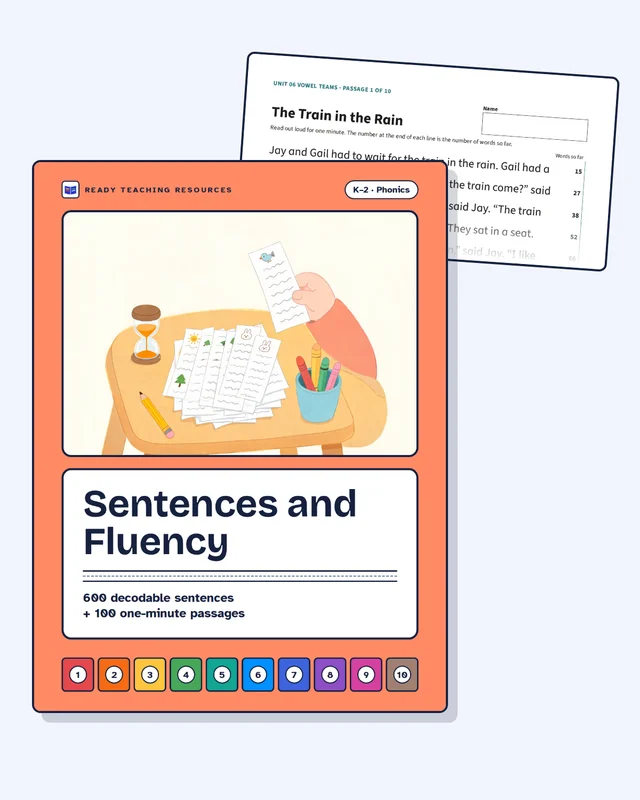
A class fluency record for each unit is in the K-2 Decodable Sentences and Fluency Strips download, beside the one-minute reading record on every passage. Nothing ships; the files are an instant download.
What is repeated reading?
The child reads the same short passage aloud more than once, with feedback on errors, until the reading is smoother. It is practice on text the child can already decode, not a race through a new hard page.
How many times should a K-2 student reread a passage?
Three oral readings in one sitting is a solid K-2 session. A published classroom description of the method says students benefit from reading the passage three to five times. Stop at three if the child is tired. Add a fourth or fifth only if the third read is still improving and the child is willing.
What do I write down?
Date, passage, and a line for each reading: words correct if you timed a minute, errors, and a word about expression. Three lines are enough to see whether the reread helped.
Sources
-
Sentences and Fluency
600 decodable sentences and 100 one-minute passages