What Should a Science of Reading Curriculum Include?
Published 2026-10-27 · Updated 2026-10-27
A science of reading curriculum for K-2 is not a logo. It is a set of materials and a daily plan that teach the code on purpose and still teach language. Use the checklist below on any program, including a download you already own. The name on the box does not decide.
Checklist for any program
Hold the materials next to these questions. A yes means the piece is there. A no means you have to supply it.
- Is there a written scope, simple spellings before longer ones, with review built in?
- Does a lesson model the pattern, then have children blend and spell it?
- Is phonemic awareness tied to letters, not only to rhyming games?
- Is there text the child can decode for the current pattern?
- Are a few not-yet-decodable high-frequency words taught by their sounds, with the odd spelling marked?
- Is there rereading of pages the child can already decode, for accuracy before speed?
- Is there a read-aloud plan for vocabulary and knowledge, separate from the decodable page?
- Can you see who missed the pattern, and does tomorrow's plan change because of that?
- Do children write the pattern, not only circle it?
If the answer is no, the set is incomplete for that row. You can still use it. You fill the gap. You do not pretend the gap is not there.
Try the checklist on one week before you judge a whole year. Suppose the week says "sh." The script should say the sound, show sh, and have children blend ship and shop, then write them. The child page should use sh and patterns already taught, not a surprise vowel team. Tomorrow should bring ship back, not abandon it. Somewhere in the day a read-aloud should teach a word and ask a why. If the week has the sound and the page and no read-aloud, keep the week and add the read-aloud. If the week has stories and no sh lesson, the code row is empty.
Pieces a K-2 year needs
Shanahan makes the boundary clear: the science of reading includes more than phonics and phonological awareness. Oral reading fluency, vocabulary, and morphology belong in it, and so do approaches that support comprehension. A curriculum that is only a phonics packet has kept one piece and dropped the rest.
Lexia groups the same territory as four connected frames: the five pillars (phonemic awareness, phonics, vocabulary, fluency, and comprehension), Scarborough's Reading Rope, the Simple View of Reading, and structured literacy. A K-2 year does not need a poster of each frame. It needs the work those frames point at. The plain definition of the research body is in what is the science of reading.
The practice guide on foundational skills turns that into four jobs for kindergarten through 3rd grade: academic language, sounds linked to letters, decoding and spelling, and connected text every day. A Hill for Literacy series covers the same ground as modules: phonemic awareness, blending, automaticity, text reading, vocabulary, and comprehension. Those lists are the year. They are not a single Tuesday.
How to read a scope
Open the scope before you open a sample week.
A usable K-2 scope starts with a few consonants and short vowels, blended as simple words. It moves to digraphs, blends, silent e, vowel teams, and r-controlled spellings, then to longer words. It says what is reviewed, not only what is new. If week one is vowel teams and week two is the alphabet, the order is backwards for beginners.
Read one sample lesson against the checklist. If the teacher script says "notice the pattern" and never says the sound, the lesson is not explicit. If every week is a new pattern and last week's words never return, it is not cumulative. If the child text uses spellings that have not been taught, it is not decodable practice. A scope you can follow week by week is the subject of phonics scope and sequence. How a lesson shows the principles is in what is structured literacy.
Score one week, not the catalog. Put a check on each row the week actually does. A scope that exists only in a teacher's head still counts if you can say what comes next and what is reviewed. A beautiful scope that the lessons ignore does not count. The checklist is about the week children experience. Reprinting the pillars on a cover is not a row.
A download is not a curriculum
A folder of worksheets is not a curriculum. A set of books is not a curriculum. A curriculum is the sequence, the daily routine, the text, the language work, and a way to notice who is lost. Materials can supply some of those rows. A teacher still has to run the day.
The honest limit: this checklist will not tell you which published program to adopt, and it will not score a program you have not opened. It tells you what to look for on the pages in front of you. Two programs can both print the words "science of reading" and fail different rows.
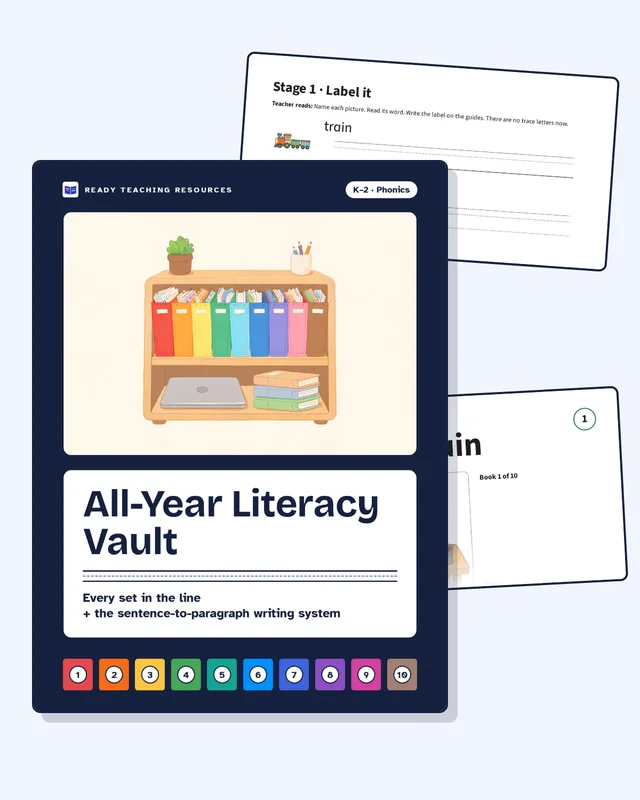
The All-Year K-2 Literacy Vault is one set you can put on the checklist: decodable books, fluency passages, worksheets, lesson decks, assessments, a class tracker, and a writing system, organized by unit, for kindergarten, 1st grade, and 2nd grade. It is an instant download after checkout, one ZIP with a Start Here guide and one ZIP per unit. School-year units released later are delivered as part of this purchase, after the first download.
What should a K-2 phonics curriculum include?
A scope from simple spellings to longer ones, a daily routine that models and blends the current pattern, text the child can decode, and time for vocabulary and read-alouds. Phonics alone is not the whole curriculum.
Is a science of reading curriculum the same as a phonics program?
No. Phonics is one piece. A curriculum that matches the research also teaches word reading in text, fluency on readable pages, vocabulary, and comprehension. A phonics packet with no sequence and no books fails the checklist.
Sources
- Timothy Shanahan: What is the science of reading?
- Lexia Learning: A Full Breakdown of the Science of Reading Components
- Institute of Education Sciences: Foundational Skills to Support Reading for Understanding in Kindergarten Through 3rd Grade
- Hill for Literacy: The Science of Reading Professional Learning Series
-
All-Year Literacy Vault
Every set in the line, plus the sentence-to-paragraph writing system